
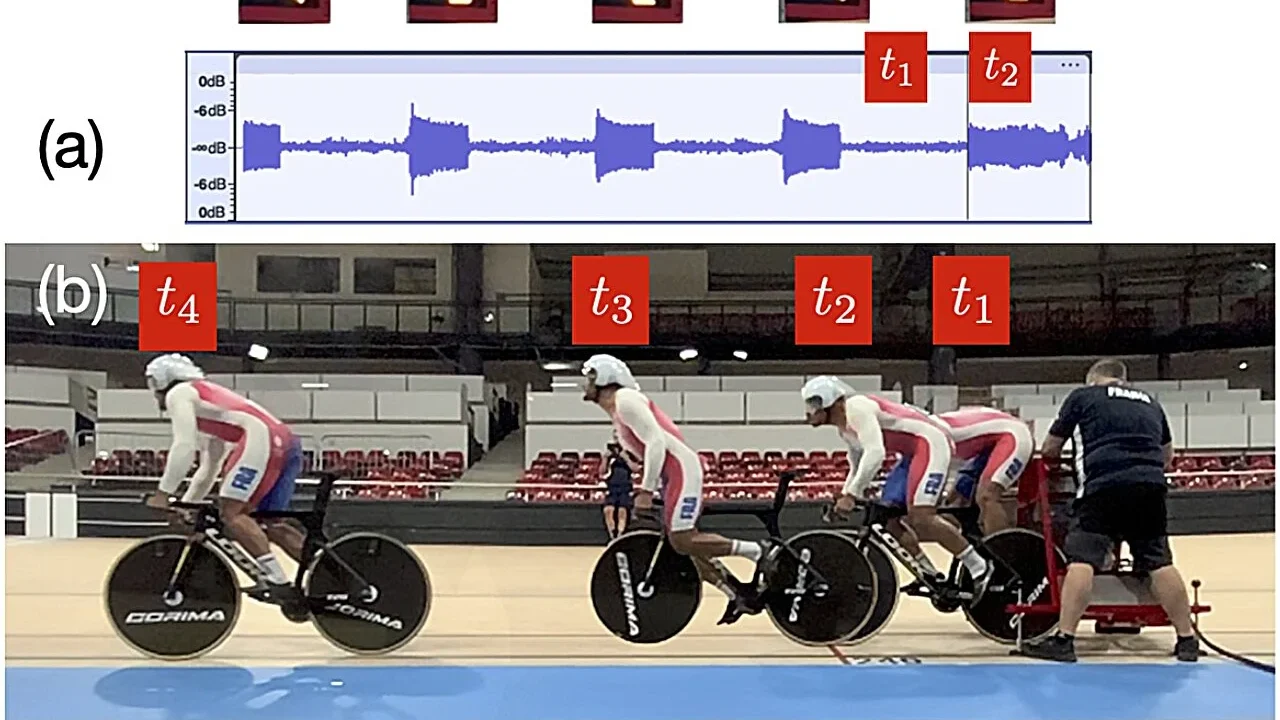
A new study published in Royal Society Open Science presents a physics model that explains the longstanding “standing-start paradox” in track cycling, where some riders appear to have a nonzero forward velocity at the official start signal despite starting from rest. Conducted by researchers studying elite French cyclists, the work clarifies how finely-timed, whole-body movements generate an initial push without breaking race rules or physical laws.
What Happened
The research team analyzed high-speed video footage of three elite French track cyclists performing standing starts, a format in which racers are initially held stationary by a rear-wheel gate before the start signal. By tracking the cyclists’ bike movement and reconstructing each rider’s center of mass (CoM), they measured pedal torque and gate braking force. These data were integrated into a physics-based model predicting the dynamics of the rider-bicycle system during the transition from gate hold to pedal-driven acceleration.
Results showed that a rapid backward-then-forward shift of the rider’s body mass in the moments just before and during gate release transfers momentum to the bicycle. This body-driven impulse creates a brief forward velocity lasting around 0.2 seconds, even though the rider technically starts from rest. One cyclist in the study, with a 6-centimeter offset—the small initial distance between the front wheel and the start line—achieved a starting speed of approximately 0.4 meters per second and a peak CoM velocity of 2.0 meters per second.
Key Facts
- The standing-start paradox describes the phenomenon where cyclists seemingly have forward speed at the start despite being held stationary.
- The offset distance between the front wheel and start line varies with bicycle frame size, influencing initial motion.
- A backward-then-forward body movement creates a transient inertial force that propels the bike forward before pedaling dominates acceleration.
- In the experiment, one cyclist’s starting speed was 0.4 m/s, with a peak center of mass velocity of 2.0 m/s occurring within the first 0.2 seconds.
- The model indicates a theoretical maximum starting velocity around 1.3 m/s, contingent on precise timing and physical parameters such as crank torque, rider mass, and gear ratio.
What This Means
This study provides a detailed mechanical explanation for an observed anomaly in track cycling starts, showing that riders do not violate rules by jumping the start but instead exploit biomechanical timing to optimize acceleration. For coaches and athletes, the findings emphasize the importance of millisecond-level coordination and targeted neuromuscular training to enhance early-phase speed. The offset created by bike geometry also plays a subtle role, suggesting equipment choices could influence starting tactics though with limited effect at the earliest phase. Practically, this insight could guide refined training methods and video-feedback techniques aimed at synchronizing the rider’s body movement with gate release for more effective starts.
Moreover, this work cautions that achieving such a rapid and precise motion sequence is challenging, requiring split-second control. Its confirmation through real rider data and predictive modeling bridges a gap between theory and athletic performance, potentially setting the stage for further biomechanical optimizations in competitive track cycling.
Background
Previous analyses of track cycling starts typically treated the initial velocity as a known condition rather than explaining the transition from rest to motion in milliseconds. The offset zone—determined by bike frame size and geometry—offers space for subtle pre-start movements that can be exploited to generate momentum without crossing the starting line early. This study extends the understanding of this brief, explosive transitional regime, highlighting inertial forces generated by rider movement that had not been fully captured before.
What Comes Next
The authors propose expanding the model to larger samples of riders across different events and gate designs to test the general applicability of their findings. Future research may incorporate the model into full sprint performance simulations and explore training regimes targeting the neuromuscular control underpinning this impulsive phase. Additionally, further validation could refine how equipment parameters like gear ratio and frame size influence starting acceleration potential.
Sources
This article is based on reporting and publicly available information from the following source:
Read more Science Discoveries stories on Goka World News.