
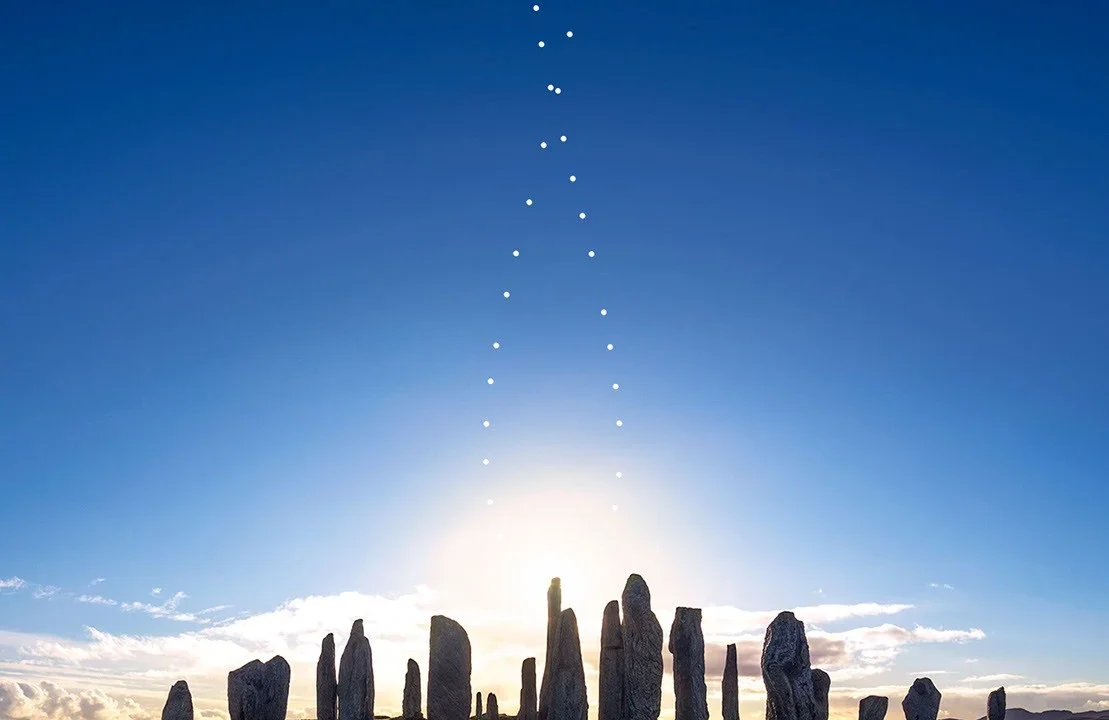
The NASA Astronomy Picture of the Day (APOD) for September 20, 2026, features a striking analemma—an image tracing the Sun’s position in the sky at the same time daily throughout the year—photographed over the ancient Callanish Stones in Scotland. This composite captures the characteristic figure-8 pattern caused by Earth’s axial tilt and elliptical orbit.
What Happened
Photographs taken near noon every few days over the course of a year near the village of Callanish in the Outer Hebrides, Scotland, were combined to construct the analemma. The resulting image shows the Sun’s changing position correlating with seasonal and orbital dynamics, notably including the Sun’s location near the December solstice at the analemma’s lower loop.
Key Facts
The location of the images is the site of the Callanish Stones, a Bronze Age stone circle erected around 2700 BC. The stones stand prominently in the foreground of the analemma image. The figure-8 shape arises from two main factors: the tilt of Earth’s axis relative to its orbital plane and the elliptical shape of Earth’s orbit around the Sun. The analemma’s top and bottom loops correspond to solar solstices, with equinoxes marking the middle points on the curve. This particular image was captured near the December solstice, placing the Sun near the analemma’s bottom loop.
What This Means
This visual demonstration of Earth’s solar motion offers a tangible representation of fundamental celestial mechanics impacting daily life on Earth—such as seasonal changes and the varying length of days. The presence of the ancient Callanish Stones in the foreground also invites reflection on humanity’s long-standing relationship with the sky, even if the stones’ astronomical purpose remains uncertain. For observers today, the analemma provides a direct way to understand why solar time and clock time differ and highlights the precision with which ancient cultures may have observed the Sun’s path.
By capturing the analemma over such a historically significant site, the image bridges millions of years of human curiosity and scientific observation. It encourages contemporary viewers to appreciate Earth’s complexity and the natural rhythms governing the planet’s climate and light cycles, which continue to shape ecosystems and human activity worldwide.
Background
The Callanish Stones are a prehistoric megalithic arrangement dating to around 2700 BC, constructed during the Bronze Age. While their purpose is not definitively known, many stone circles worldwide have been hypothesized to align with solar, lunar, or stellar events, making them subjects of ongoing archaeological and astronomical study. An analemma, by comparison, is a well-understood astronomical concept illustrating Earth’s tilt of approximately 23.5 degrees and elliptical orbital path. The interaction of these factors results in the Sun’s apparent yearly oscillation in time and position.
What Comes Next
The APOD notes that the upcoming equinox, occurring two days after this image was released, marks a moment when daylight and night are approximately equal worldwide. This seasonal milestone is celebrated across many cultures and offers an opportunity for further observations of solar positions relative to fixed landmarks, continuing traditions and scientific inquiry into Earth’s celestial cycles.
Sources
This article is based on reporting and publicly available information from the following sources:
Read more Science Discoveries stories on Goka World News.