
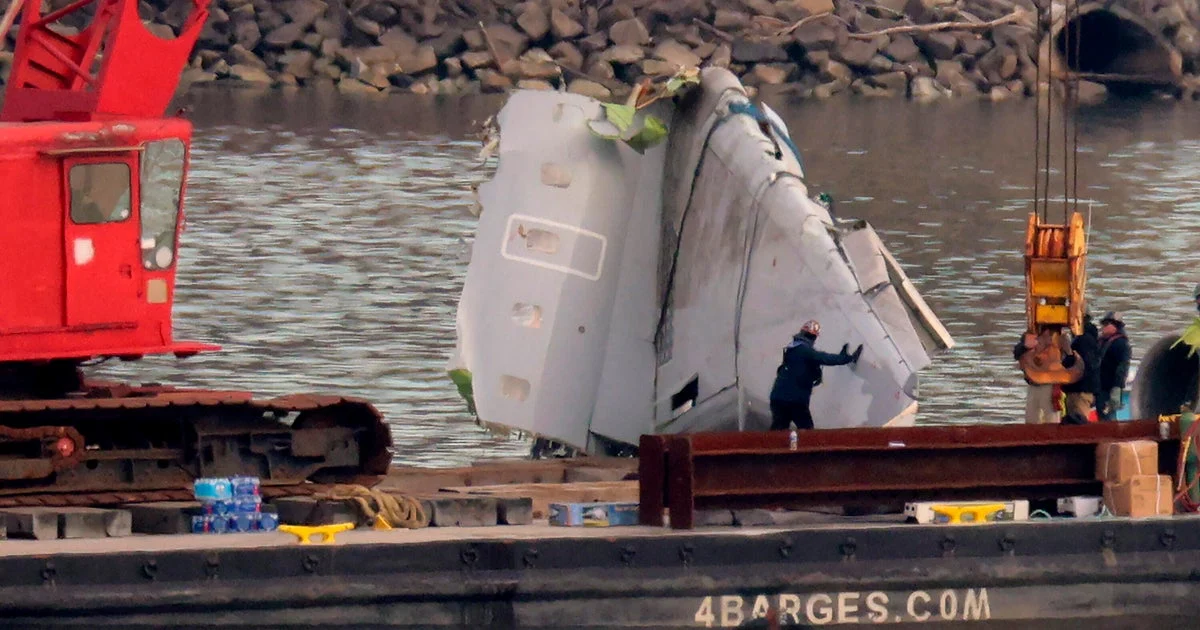
The House of Representatives passed the ALERT Act on April 14, 2026, to improve aviation safety by mandating that all aircraft flying near busy airports be equipped with advanced collision-avoidance technology. The legislation comes after a January 2025 midair collision near Ronald Reagan Washington National Airport between an American Airlines passenger jet and a military Black Hawk helicopter, which resulted in 67 fatalities.
The bill passed overwhelmingly by a 396-10 vote and specifically requires aircraft, including military planes, to install systems that can receive data about the locations of nearby aircraft. Although most planes already use technology called ADS-B Out to broadcast their position, many lack ADS-B In, which enables receiving detailed location information to prevent collisions.
Investigations by the National Transportation Safety Board (NTSB) and statements from victims’ families indicate the accident could have been avoided if the American Airlines flight had been equipped with ADS-B In. The ALERT Act sets a deadline of 2031 for military aircraft to adopt collision-prevention technology, except for fighters, bombers, drones, and other special mission aircraft.
The bill also incorporates measures to improve helicopter route safety and air traffic control training, addressing probable causes identified by the NTSB. House Republicans expedited the bill’s passage, overcoming prior setbacks experienced by a related Senate bill known as the ROTOR Act.
The ROTOR Act had passed the Senate unanimously but failed in a subsequent vote following a reversal of support from the Pentagon, which cited concerns over budget impacts and operational security for national defense.
Despite the House’s amendments aimed at addressing 50 NTSB safety recommendations, some critics, including victims’ families and Senate Transportation Committee leaders, argue the ALERT Act does not go far enough. Families warn that the collision-prevention technologies mandated by the bill are not yet market-ready and may face extensive delays in adoption.
Senator Ted Cruz, a Republican and co-chair of the Senate Transportation Committee, has called for further improvements, describing the ALERT Act as insufficient in closing safety loopholes and urging Congress to consider revising the legislation for greater effectiveness.
Why it matters
The ALERT Act represents a significant legislative response to a tragic aviation accident that exposed gaps in air traffic safety protocols near congested airports. Its passage marks progress toward mandatory collision-avoidance technology on both civilian and military aircraft, potentially reducing the risk of future midair collisions. However, ongoing concerns about technology readiness and exemptions for certain military aircraft highlight challenges ahead for full implementation and effective enforcement.
Background
The fatal midair collision in January 2025 involved an American Airlines jet and an Army Black Hawk helicopter, killing all 67 people aboard both aircraft. The NTSB investigation attributed the accident partly to insufficient separation between helicopter routes and inadequate detection technology on the passenger jet. The tragedy prompted calls for improved aviation safety regulations, particularly the adoption of ADS-B In technology to enhance pilots’ situational awareness in crowded airspace.
Previous attempts to legislate these safety improvements stalled due to defense concerns and legislative disagreements, but the ALERT Act’s passage in the House signals renewed momentum to address these critical safety issues.
Read more Politics stories on Goka World News.