
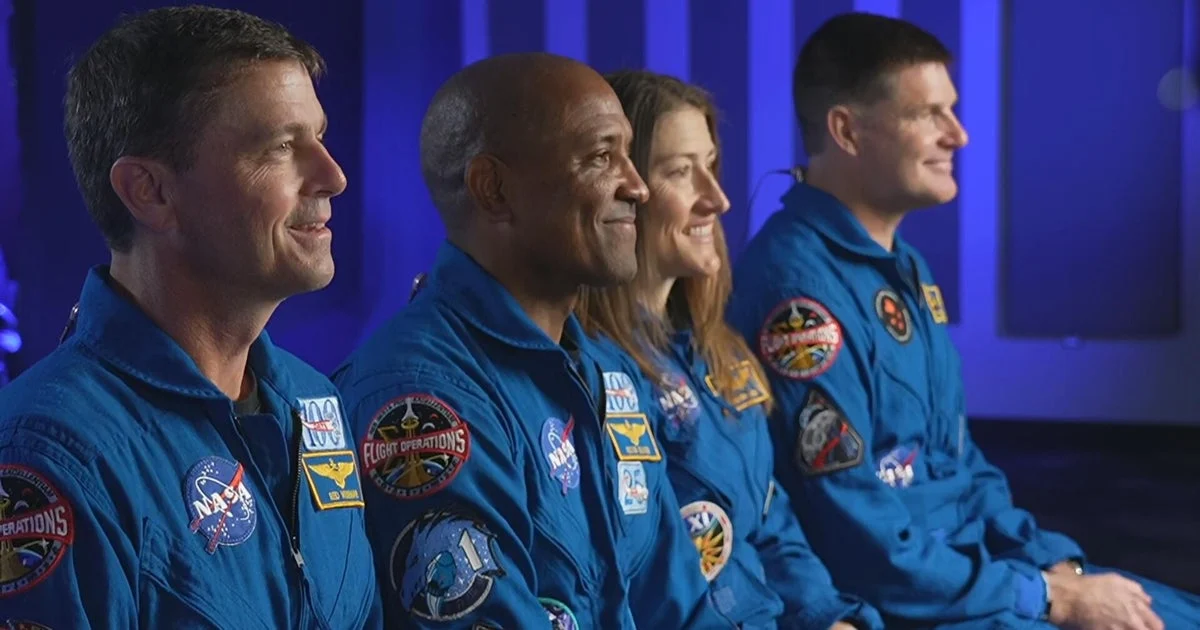
The Artemis II crew, comprising commander Reid Wiseman, pilot Victor Glover, and mission specialists Christina Koch and Jeremy Hansen, safely returned to Earth after completing NASA’s first crewed mission around the moon. Splashing down off the coast of San Diego, the astronauts shared vivid reflections on their experience and what the mission means for future space exploration.
During their lunar orbit, the crew encountered remarkable sights unique to space travel. Glover highlighted the moon’s terminator—the dividing line between night and day—as his favorite feature, noting how it dramatically revealed the lunar surface’s topography. Koch described observing the sharp outline of the moon’s mountainous horizon against the black sky, made possible by the lack of atmosphere. Hansen pointed out a distinctive “handprint” pattern visible on the moon’s far side, an observation he and Wiseman found notable. Wiseman himself recalled witnessing a solar eclipse from space, describing the moon as “a dark matte black sphere” silhouetted against the sun.
Since returning, the astronauts have been focused on post-mission medical assessments, scientific analyses, and physical reconditioning to readjust to Earth’s gravity. Glover emphasized their appreciation for everyday comforts such as gravity, showers, and spending time with family. Koch expressed a transformed perspective on Earth, describing how ordinary views, like looking at the blue sky, now prompt thoughts of Earth’s smallness within the vast universe.
Why it matters
The Artemis II mission marks a significant milestone in NASA’s broader Artemis program, which aims to establish sustainable human presence on the moon and eventually support human exploration of Mars. This mission demonstrated critical capabilities in crewed lunar operations after a decades-long hiatus. For the global community, Artemis II has inspired renewed optimism in international collaboration and human ingenuity.
Wiseman remarked on the mission’s symbolic impact, noting how humanity came together worldwide to celebrate this achievement without any solicitation. Hansen raised the mission’s role in countering societal feelings of powerlessness by showcasing collective human effort and the drive to improve the world. Koch urged remembrance of the trust and hope placed in such missions, viewing them as reflections of humanity’s capacity for great accomplishments.
Background
The Artemis II mission, launched in April 2026, was NASA’s first crewed flight around the moon since the Apollo era. It involved sending four astronauts aboard the Orion spacecraft, which orbited the moon multiple times before returning to Earth. This mission tested spacecraft systems crucial for longer lunar stays planned in upcoming Artemis missions, including Artemis III, which aims to land astronauts on the lunar surface.
Articulating their mission as a “relay race” rather than a sprint, the crew anticipates passing the legacy forward to the next generation of explorers preparing for deeper space exploration.
Read more Space & NASA stories on Goka World News.