
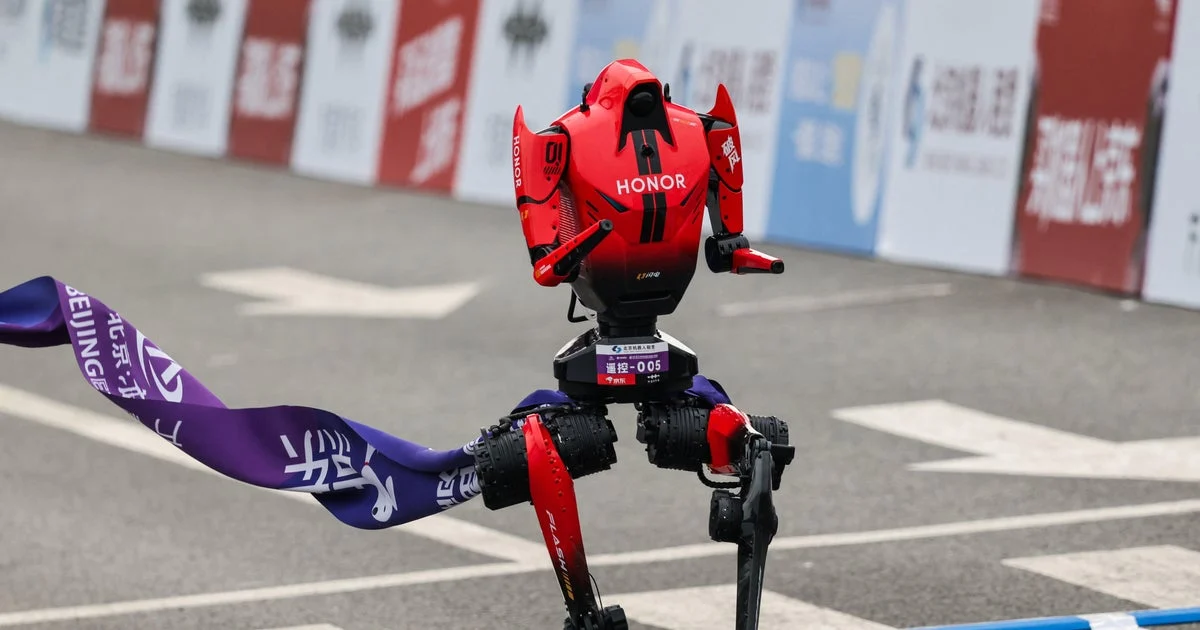
A humanoid robot named Lightning set a new record by completing a half-marathon in just over 50 minutes at the Beijing E-Town Robot Half Marathon on April 19, 2026. Developed by the Chinese smartphone manufacturer Honor, Lightning’s time surpassed the human half-marathon world record of over 57 minutes.
The event featured dozens of robots racing over the 13-mile (21-kilometer) course on a parallel track alongside human runners, ensuring no collisions occurred. The robots were tested on various capabilities including balance, endurance, and navigation. Some competed autonomously, while others were remotely controlled.
The race demonstrated significant technological progress from the previous year when many robots struggled to finish. Despite some mishaps—such as robots stumbling, veering off course, or suffering mechanical failures—the overall performance showed marked improvement. One robot even had to be carried away on a stretcher after breaking down post-finish line.
Du Xiaodi, a development engineer with Honor, indicated the potential for this technology to influence other industries, drawing parallels to how automotive technology advanced through competitive events. “Looking ahead, some of these technologies might be transferred to other areas,” Du said.
Organizers emphasized that the marathon’s goal was not only about speed but also advancing robotics beyond laboratory settings. They highlighted applications for this technology in manufacturing, logistics, and emergency response scenarios.
Public reaction to Lightning’s achievement was largely positive. Spectators expressed surprise and enthusiasm about robots surpassing human endurance and speed. “Their performance is quite impressive,” said one attendee, noting the robots’ stability and pace.
Why it matters
This milestone reflects rapid advancements in robotics, signaling potential transformative impacts on various industries such as logistics, manufacturing, and emergency services. Demonstrating the robots’ ability to perform under real-world conditions marks a critical step toward integrating humanoid robots into practical applications beyond entertainment and research.
Background
The Beijing E-Town Robot Half Marathon provides a controlled but realistic setting for testing robotic endurance and agility. Since its inception, the race has served as a benchmark for assessing performance improvements in humanoid robots. Chinese companies, including Honor, are at the forefront of robotics development, focusing on both civilian and military applications.
Read more Science & Technology stories on Goka World News.