
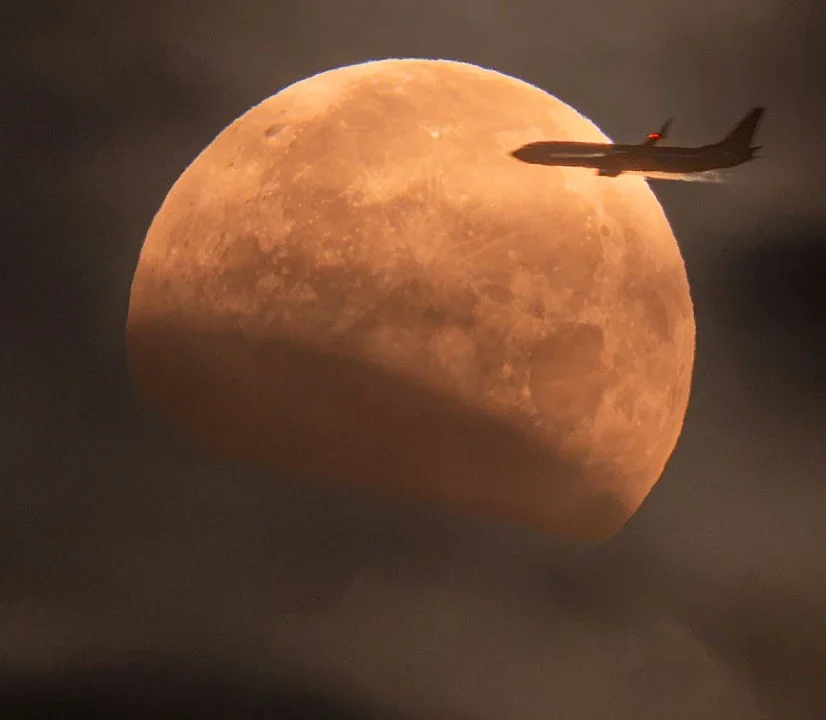
The lunar eclipse occurring on September 1, 2026, presented a striking celestial spectacle visible across the half of Earth facing the Moon. One notable image from Portugal captures this event with an airplane in the foreground, illustrating both the eclipse’s accessibility and the ease of viewing it without specialized equipment.
What Happened
The lunar eclipse in question unfolded on September 1, 2026, as the Earth’s shadow passed over the Moon, causing a darkening and reddening visible to observers on roughly half the planet’s surface. Notably, lunar eclipses do not require special protective gear since the Moon is dimmer during the eclipse rather than brighter, unlike solar eclipses. This particular event was photographed from Portugal, where the image features an airplane taking off. Observers seated on the left side of the airplane might have initially seen an obstructed view, but thanks to the typical several-hour duration of lunar eclipses, crossing the aisle soon allowed clear observation of the phenomenon.
Key Facts
- The lunar eclipse was visible from approximately 50% of Earth’s surface illuminated by the Moon at that time.
- The event captured by photographer Paulo Ferreira took place over Portugal last week before the publication date.
- Lunar eclipses typically last for several hours, providing ample viewing time.
- Unlike solar eclipses, lunar eclipses require no eye protection for safe observation.
- This image was featured as the Astronomy Picture of the Day (APOD) by NASA, with contributions from the NASA Goddard Space Flight Center and Michigan Technological University.
What This Means
Lunar eclipses remain among the most accessible and awe-inspiring astronomical events for the general public, requiring no special equipment or geographical exclusivity beyond facing the Moon’s side of Earth. Their prolonged visibility offers ample opportunity for casual skywatchers, photographers, and educators worldwide to engage with and promote astronomical understanding. The featured image emphasizes this point by combining everyday human activity—air travel—with a major cosmic event, highlighting the interplay between human life and celestial mechanics.
Such events foster public interest in astronomy and encourage the habit of observing the night sky regularly. Unlike fleeting solar eclipses that demand specific locations and safety precautions, lunar eclipses democratize celestial viewing, making them a valuable tool for science outreach and engagement. The photo from Portugal exemplifies how ordinary environments and moments can intersect with extraordinary universal phenomena, bringing the cosmos closer to daily experience.
Background
Lunar eclipses occur when the Earth passes directly between the Sun and the Moon, casting a shadow on the Moon’s surface. These eclipses can be total, partial, or penumbral, depending on how fully the Earth’s shadow covers the Moon. Historically, lunar eclipses have been observed and documented for millennia, serving as important tools for studying celestial mechanics and the Earth-Moon-Sun system. NASA’s Astronomy Picture of the Day regularly highlights such events to showcase their beauty and scientific significance.
What Comes Next
Following this event, lunar eclipses will continue to occur as part of predictable celestial cycles. The gradual movement of the Earth and Moon ensures that opportunities for observation persist, providing educators and enthusiasts regular occasions to observe and photograph these phenomena. Upcoming lunar eclipses are historically tracked and announced by astronomy organizations worldwide, continuing to enrich the public’s engagement with space science.
Sources
This article is based on reporting and publicly available information from the following sources:
Read more Science & Technology stories on Goka World News.