
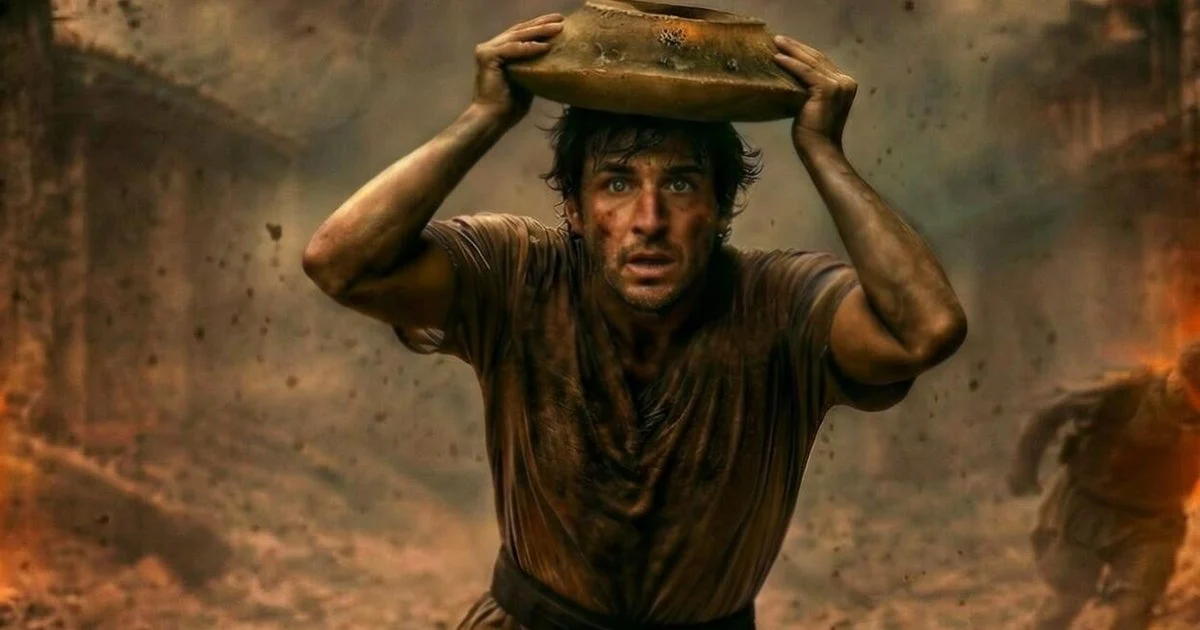
Archaeologists at Pompeii have used artificial intelligence (AI) for the first time to digitally reconstruct the face of a victim who was attempting to flee the catastrophic eruption of Mount Vesuvius in AD 79. The victim, an older man, was among two individuals discovered outside the city walls near Porta Stabia, indicating they were trying to escape toward the coast.
The reconstruction project was led by the Pompeii Archaeological Park in collaboration with the University of Padua and is based on detailed archaeological survey data from excavations near the Porta Stabia necropolis. The digital portrait was created by applying AI and photo-editing techniques to skeletal and archaeological information, generating a realistic image of the man’s appearance.
The victim was found clutching a terracotta mortar, believed to be an improvised shield against the lapilli—small volcanic stones—that rained down during the eruption. He also carried personal items including an oil lamp, a small iron ring, and 10 bronze coins. These artifacts provide valuable context about daily life in Pompeii and the victim’s final moments.
Why it matters
The use of AI to reconstruct faces from skeletal remains represents an innovative approach in archaeology, enhancing our understanding of historical events and humanizing the people affected. Pompeii, a UNESCO World Heritage site, offers an extraordinary glimpse into Roman life preserved by volcanic ash, and AI helps bring this ancient world to life in new ways.
Gabriel Zuchtriegel, director of the Pompeii Archaeological Park, emphasized AI’s potential to manage vast archaeological data and renew classical studies by making discoveries more accessible and engaging. Italian Culture Minister Alessandro Giuli highlighted that such methodologies can provide fresh historical perspectives while maintaining scientific rigor.
Background
Pompeii was buried under ash and pumice when Mount Vesuvius erupted nearly two millennia ago, preserving buildings, artifacts, and even the remains of its inhabitants. Many victims were found near city gates and outside its walls, underscoring the peril faced by those attempting to escape. Recent discoveries in Pompeii include a 2,000-year-old love note and a gladiator fight scene mural, showcasing ongoing archaeological breakthroughs at the site.
This latest reconstruction adds a human face to the tragedy and demonstrates how AI technology can deepen both scholarly research and public engagement with history.
Read more Science Discoveries stories on Goka World News.
Sources
This article is based on reporting and publicly available information from the following source: