
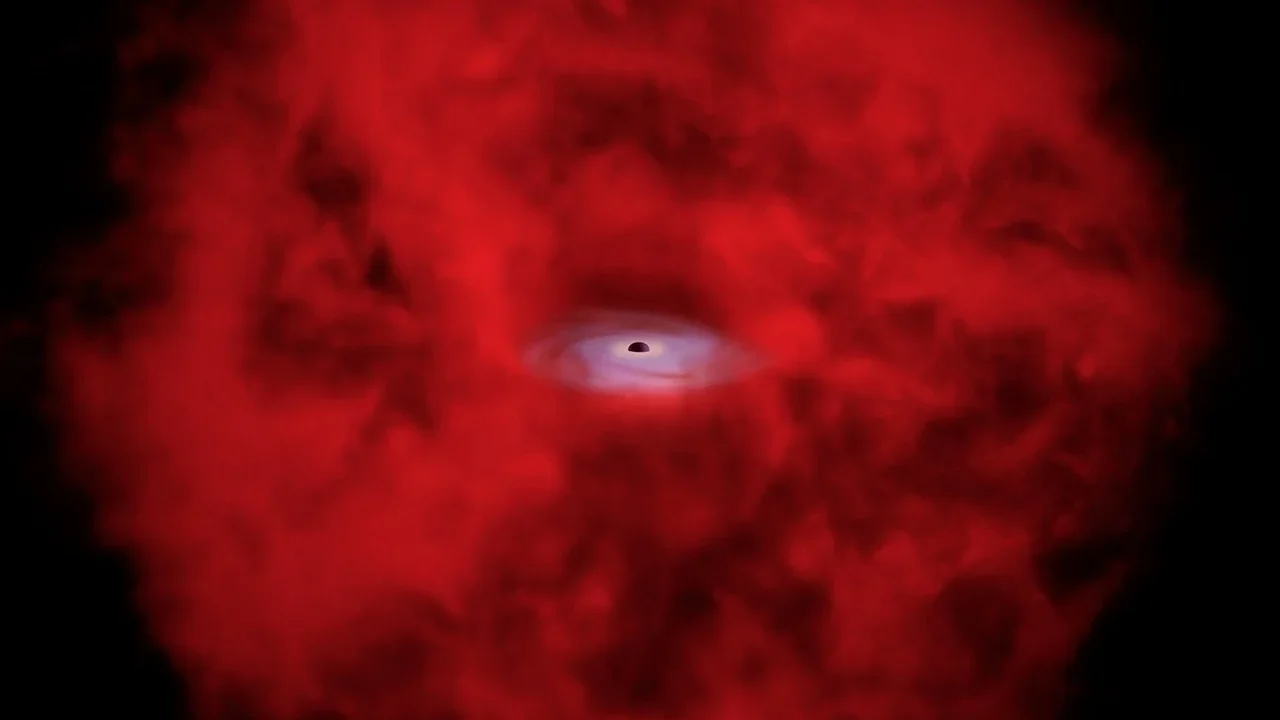
A recently identified X-ray source by NASA’s Chandra X-ray Observatory may provide crucial insight into the nature of “little red dots” (LRDs), a mysterious class of distant celestial objects discovered by the James Webb Space Telescope (JWST). The object, designated 3DHST-AEGIS-12014 and located about 11.8 billion light-years from Earth, displays properties that could link LRDs to growing supermassive black holes in the early universe.
LRDs are small, red-colored objects observed at extreme distances—approximately 12 billion light-years away or more—and are thought to represent supermassive black holes enveloped in dense gas clouds. This dense gas obscures many typical signs, particularly ultraviolet and X-ray emissions, which astronomers rely on to identify such black holes. Due to their unique features, LRDs have been described as “black hole stars,” suggesting they differ from more visible growing supermassive black holes that emit bright X-rays and ultraviolet light.
The newly discovered X-ray dot shares many characteristics with LRDs but notably emits X-rays, a feature largely absent in previously studied LRDs. This distinction makes it a potential transitional object bridging the “black hole star” scenario and the typical active supermassive black holes. According to Raphael Hviding, lead author from the Max Planck Institute for Astronomy, this object could be “what lets us connect all of the dots” regarding these enigmatic sources.
Transition Phase Indicator
The researchers propose that this X-ray source represents a phase where the black hole star is beginning to clear its surrounding dense gas. As pockets form in the gas clouds, X-rays emitted by material accreting onto the black hole start to escape, becoming detectable by Chandra. Over time, as the black hole consumes its gaseous environment, the surrounding obscuring material dissipates, ultimately revealing a typical growing supermassive black hole.
Supporting this interpretation, Chandra observations show possible fluctuations in the X-ray brightness of the object, consistent with variations in gas density as the clouds orbit the black hole. Hanpu Liu of Princeton University said if confirmed, this would represent the first direct look into the heart of an LRD during its transitional phase and provide strong evidence linking LRDs to supermassive black hole growth.
Alternative Explanations and Future Studies
A competing hypothesis suggests that the X-ray-emitting object might be a common growing supermassive black hole hidden behind an unusual type of dust unknown to astronomers, rather than an LRD transition phase. To resolve this, further observations are planned to clarify the nature of the X-ray dot.
This discovery was made possible by combining deep legacy X-ray data from Chandra with new infrared observations from JWST. Andy Goulding of Princeton noted that the X-ray source had existed unnoticed in Chandra’s data for over a decade before Webb data enabled its identification, highlighting the effective collaboration between these observatories.
Background
The discovery of LRDs shortly after JWST began science operations opened new questions about supermassive black hole formation in the early universe. Traditional signatures of rapidly growing black holes are often masked in these objects, complicating their study. The joint analysis of data from NASA’s Chandra X-ray Observatory and JWST represents a significant step toward understanding these elusive sources.
NASA’s Marshall Space Flight Center manages the Chandra program, with science operations conducted by the Smithsonian Astrophysical Observatory’s Chandra X-ray Center in Cambridge, Massachusetts.
Read more Space & NASA stories on Goka World News.
Sources
This article is based on reporting and publicly available information from the following source: