
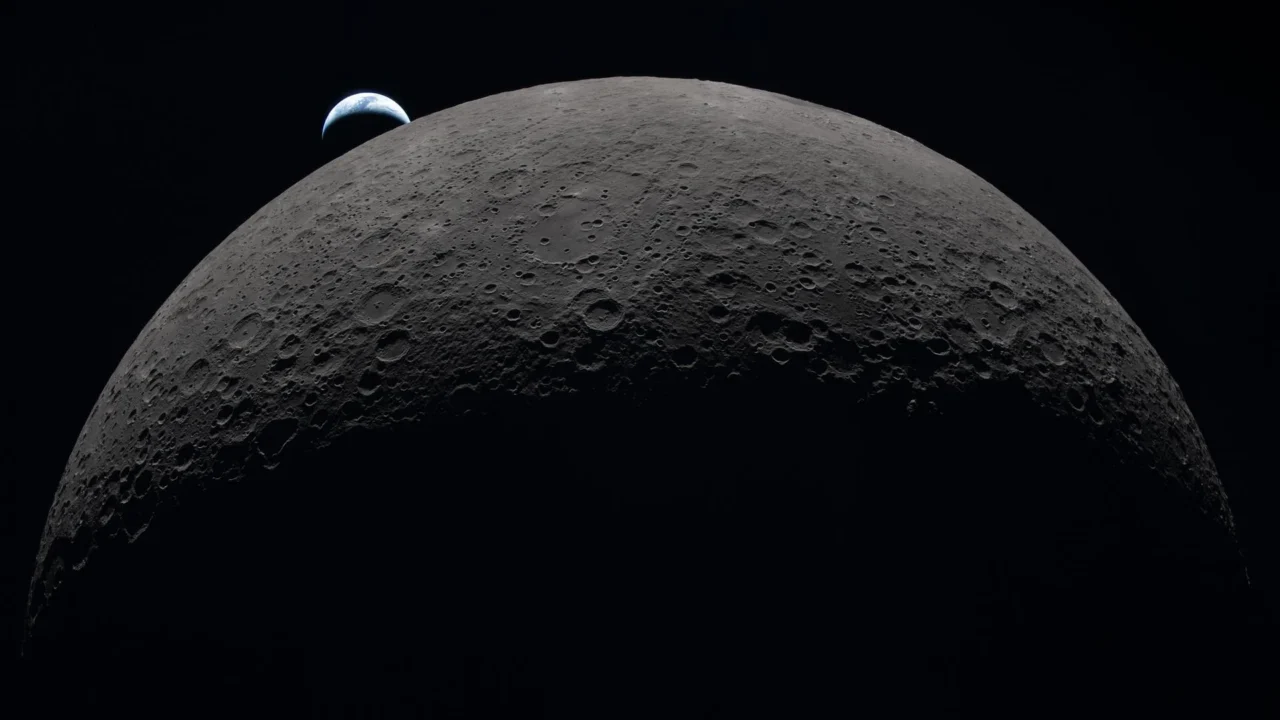
NASA has awarded a $6.9 million contract to Interlune, a Seattle-based company, to develop and validate technologies for extracting resources from lunar soil, enhancing the sustainability of future Moon missions. This effort focuses on in-situ resource utilization (ISRU), which allows astronauts to use materials found on the Moon, such as hydrogen and helium-3, instead of relying entirely on supplies from Earth.
The contract, funded through NASA’s Small Business Innovation Research (SBIR) Phase III program, highlights the agency’s commitment to transitioning innovative technologies into practical applications supporting long-duration exploration. Interlune will design, build, and test engineering units and flight hardware capable of collecting lunar regolith samples, sorting particles by size, extracting volatile gases implanted by the solar wind, and measuring these gases’ concentrations.
A key component of this technology is a mass spectrometer inspired by NASA’s Mass Spectrometer Observing Lunar Operations (MSOLO), originally developed at Kennedy Space Center. MSOLO is a compact, rugged instrument designed to analyze the gases and chemical makeup of lunar landing sites. NASA’s Game Changing Development Program successfully demonstrated MSOLO hardware’s operation in lunar conditions during the 2025 Intuitive Machines 2 mission to the Moon’s South Pole.
Michael Johansen, Deputy Program Manager for NASA’s Game Changing Development Program, emphasized the significance of evolving MSOLO into a flight-ready instrument and its adoption by industry as a milestone for commercial lunar resource prospecting.
The MSOLO-based instrument incorporates a hybrid computer for onboard data processing and a calibration gas system to self-verify measurement accuracy directly on the lunar surface. Its software is adaptable and has already interfaced with multiple Commercial Lunar Payload Services (CLPS) lander designs, increasing its suitability for a variety of commercial and NASA missions.
Why it matters
Developing reliable ISRU technologies can reduce the cost and complexity of deep space exploration by enabling astronauts to harvest water, gases, and minerals locally rather than transporting all supplies from Earth. This capability is crucial for sustaining longer missions on the Moon and potentially Mars, supporting propulsion, energy, and life support systems. By fostering commercial partnerships through programs like SBIR, NASA accelerates the maturation of transformative technologies essential for future space exploration.
Background
NASA’s SBIR and Small Business Technology Transfer (STTR) programs fund small businesses to develop technologies aligned with agency goals. The Phase III award given to Interlune is designed to move successful prototypes and concepts toward deployment on missions. The MSOLO instrument, developed under the Game Changing Development Program, represents a proven technology platform making the leap from government-led demonstration to commercial utilization. This transition exemplifies NASA’s strategy to leverage private sector innovation for sustainable lunar exploration initiatives under the Artemis program and beyond.
Sources
This article is based on reporting and publicly available information from the following source:
Read more Space & NASA stories on Goka World News.