
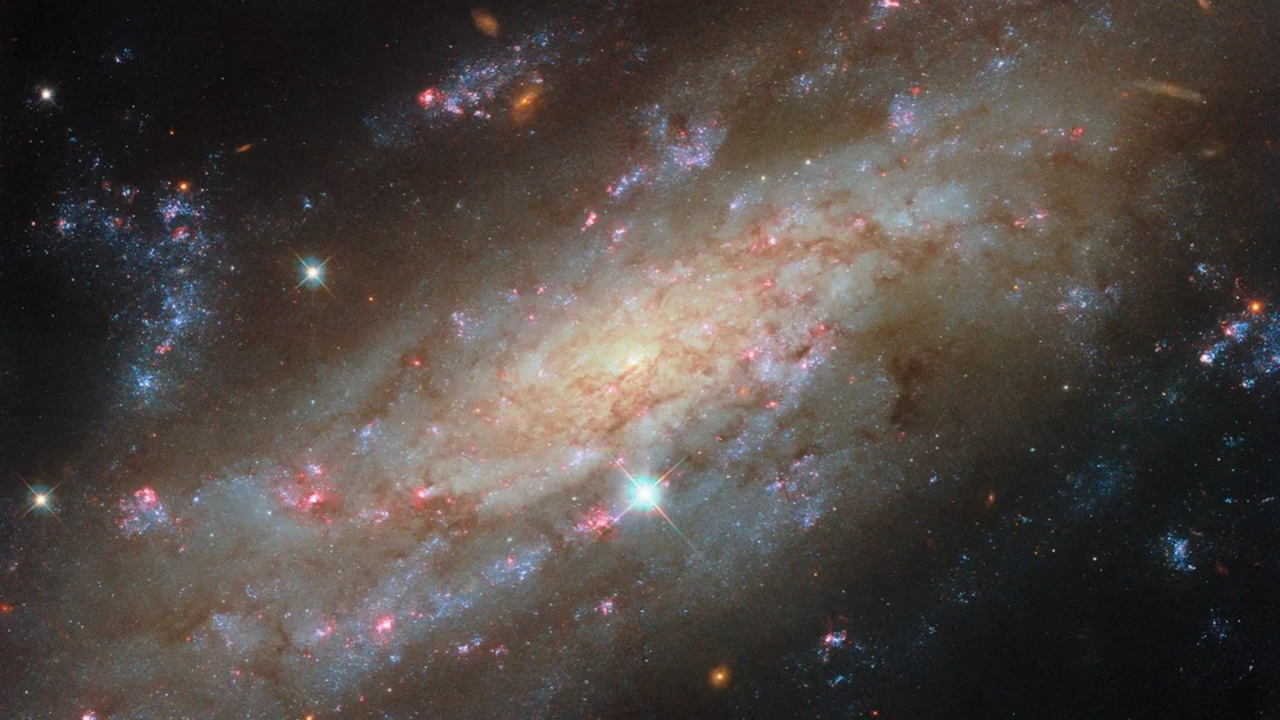
NASA’s Hubble Space Telescope has captured a detailed image of the spiral galaxy NGC 3137, located about 53 million light-years away in the constellation Antlia. This nearby galaxy is part of a small group that provides astronomers a valuable opportunity to study stellar processes and galactic dynamics in a system comparable to our own Milky Way’s group of galaxies.
Characteristics of NGC 3137 and Its Group
NGC 3137 is notable for its glittering clusters of stars and its classification as a spiral galaxy. It travels through space accompanied by other galaxies in the NGC 3175 group, which astronomers consider similar to the Local Group—the galaxy cluster that includes the Milky Way. Both groups consist of two large spiral galaxies plus numerous smaller dwarf galaxies. The NGC 3175 group’s largest members are NGC 3137 and NGC 3175, while in the Local Group, the Milky Way and Andromeda dominate.
While the Local Group’s dwarf galaxies have been well cataloged, the exact number of dwarf galaxy companions in the NGC 3175 group remains uncertain. Researchers have identified over 500 dwarf galaxy candidates associated with this group, suggesting a rich environment for further study.
Implications for Galactic Research
Because of its proximity and structural similarities to the Local Group, the NGC 3175 group offers astronomers a laboratory to investigate the lifecycle of stars, including their birth and death cycles, as well as the gravitational interactions between galaxies. Observations like those from Hubble can enhance understanding of how galaxies evolve and how their satellite systems influence their development.
NGC 3137 and its group thus provide an important point of comparison for studying the Milky Way’s cosmic neighborhood and broader galactic phenomena.
Background
The Local Group is the galaxy assembly that contains the Milky Way and over 50 known galaxies, including the Andromeda Galaxy and many dwarf galaxies. Similar nearby groups, such as the NGC 3175 group, are studied to compare evolutionary patterns and galactic structures. NASA’s Hubble Space Telescope, in operation since 1990, has played a crucial role in imaging and analyzing these distant systems with high resolution.
Sources
This article is based on reporting and publicly available information from the following source:
Read more Space & NASA stories on Goka World News.