
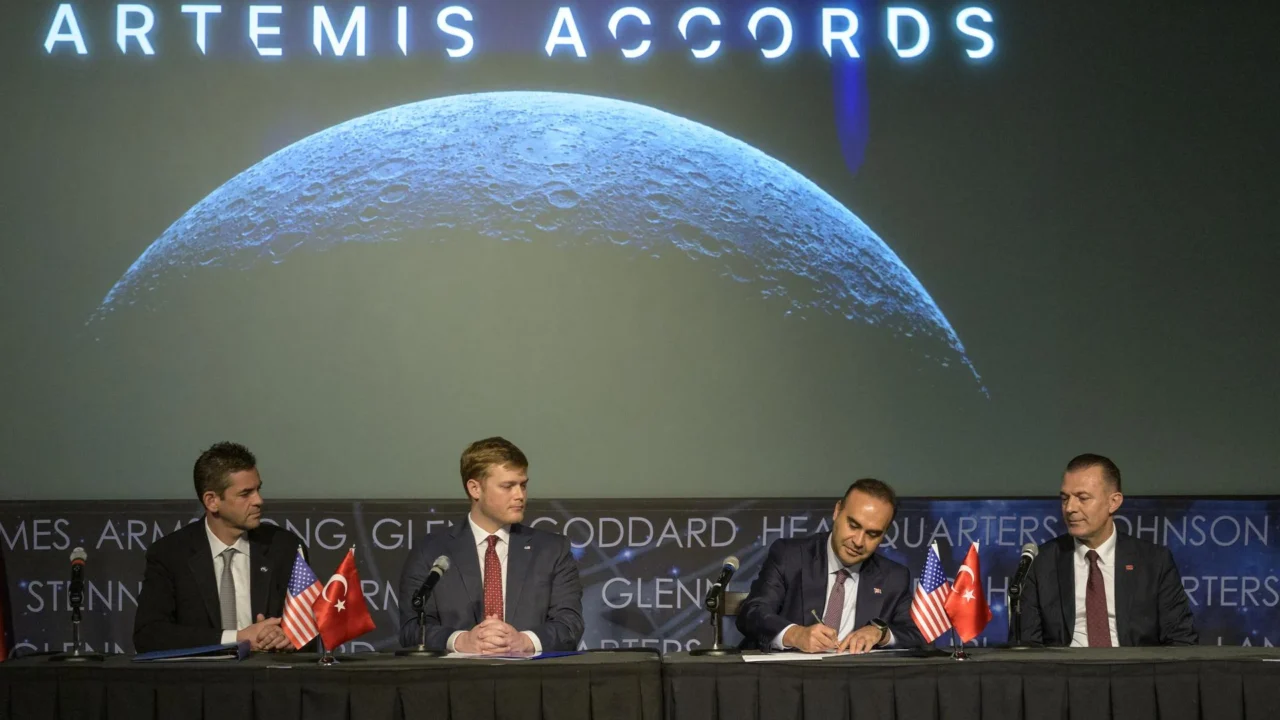
The Republic of Türkiye has become the 71st nation to join NASA’s Artemis Accords, formalizing its commitment to peaceful, transparent space exploration focused on the Moon and beyond. The signing ceremony took place at NASA Headquarters in Washington, D.C., underscoring Türkiye’s growing role in the international space community and its participation in upcoming Artemis missions.
What Happened
On Monday, Turkish Minister of Industry and Technology Mehmet Fatih Kacır signed the Artemis Accords at a ceremony hosted by NASA Administrator Jared Isaacman. The event also included the presence of Yusuf Kıraç, President of the Turkish Space Agency, and U.S. Deputy Assistant Secretary of State for Space and Environment Connor Tomlinson. This agreement situates Türkiye among more than 70 nations committed to cooperative principles guiding lunar exploration.
The Artemis Accords, first established in 2020 by NASA and the U.S. State Department alongside seven founding nations, serve as a framework to ensure all parties explore space activities peacefully and transparently. They promote safety coordination, scientific data sharing, aid for others in need, and preservation of historic space sites.
Key Facts
Türkiye’s formal accession to the Artemis Accords aligns with recent notable milestones in its space program. In 2024, Turkish astronaut Alper Gezervaci participated in Axiom Mission 3 to the International Space Station (ISS), carrying out scientific research alongside NASA crew members. Later that year, a second astronaut, Tuva Atasever, flew on Virgin Galactic’s suborbital flight Virgin Galactic 07, performing experiments and physiology studies.
Furthermore, Türkiye is preparing to launch its first lunar satellite mission, AYAP-1, which will establish its presence in lunar orbit. Later in 2024, Türkiye will host the International Astronautical Congress in Antalya, where numerous Artemis Accords signatories are expected to gather for discussions on future collaborative space efforts.
What This Means
Türkiye’s inclusion in the Artemis Accords signifies a major expansion of the international coalition working with NASA to return humans to the Moon and establish a sustainable lunar presence. For Türkiye, this represents increased opportunity to contribute hardware, scientific instruments, and technology demonstrations to Artemis missions, advancing its space capabilities on a global stage.
For the broader space community and the general public, this step enhances global cooperation essential for safe and orderly exploration of the Moon and Mars. As NASA leads plans to build a Moon Base for longer-term human presence, partnerships with nations like Türkiye create avenues for sharing costs, knowledge, and innovation while ensuring peaceful conduct in the increasingly crowded lunar environment.
In practical terms, these multilateral accords foster transparency in space activities, reducing risks of conflict and duplication of efforts. They open doors for emerging space nations to engage in deep-space exploration, potentially accelerating scientific discovery and commercial opportunities. Türkiye’s active spaceflight program and upcoming lunar mission reveal the country’s strategic commitment not just to participate but to help shape humanity’s next chapter beyond Earth.
Background
The Artemis Accords are NASA’s response to the growing interest from countries and private companies in lunar exploration and exploitation. By grounding operations in defined principles such as peaceful use, scientific data sharing, and artifact preservation, they aim to create safe, sustainable frameworks for lunar and planetary missions. This approach supports NASA’s broader Artemis program goal to establish humanity’s first enduring presence on another world, ultimately serving as a stepping stone for Mars exploration.
What Comes Next
With Türkiye now a formal partner, NASA invites the Turkish space community to contribute to future Artemis mission payloads and technology demonstrations. The forthcoming International Astronautical Congress in Antalya will be a key venue for signatories to coordinate joint projects and discuss the evolving legal and operational landscape of lunar activities.
Sources
This article is based on reporting and publicly available information from the following sources:
Read more Space & NASA stories on Goka World News.