
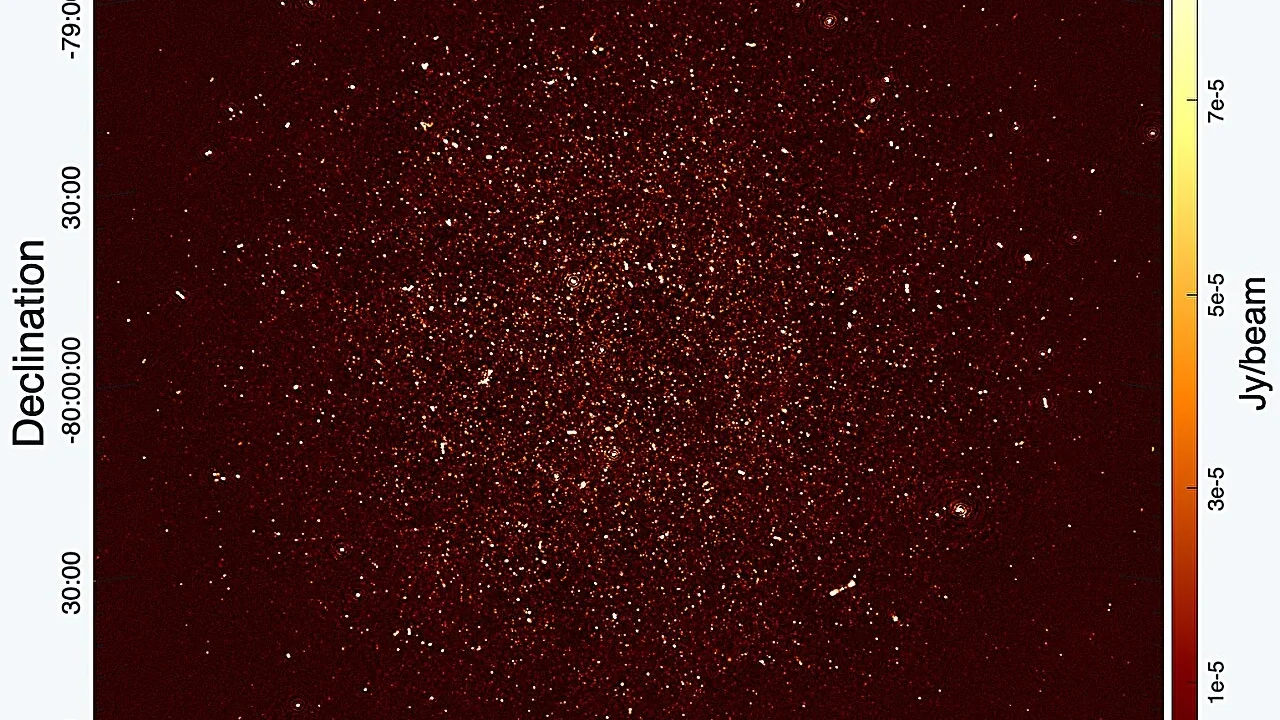
Astronomers from the University of Manchester and the University of the Western Cape have directly detected an extremely faint radio signal emitted by neutral hydrogen gas located billions of light-years from Earth. This achievement, made possible with South Africa’s MeerKAT radio telescope, provides a new avenue for mapping the large-scale structure of the universe by leveraging hydrogen intensity mapping techniques.
What Happened
The international research team analyzed approximately 96 hours of radio observations from MeerKAT, targeting emissions from neutral hydrogen that originated roughly four to five billion years ago. Unlike traditional methods requiring the combination of radio data with optical galaxy surveys, their study — published in The Astrophysical Journal Letters — succeeded in detecting the hydrogen intensity mapping signal using radio data alone.
The detected emissions correspond to the 21-centimeter radio line naturally emitted by neutral hydrogen atoms. As the universe expands, this signal shifts to longer wavelengths, allowing astronomers to trace hydrogen distribution across different cosmic epochs. The researchers focused on two periods in cosmic history, mapping hydrogen gas over scales spanning millions of light-years, distances comparable to that between the Milky Way and the nearby Andromeda galaxy.
Key Facts
Hydrogen intensity mapping measures the aggregate radio signal from many unresolved galaxies instead of individually detecting galaxies, enabling efficient studies of vast cosmic volumes. The signal measured by MeerKAT is extremely faint and easily contaminated by foreground emissions, human-made radio interference, and instrumental noise.
The data analyzed were obtained in 2018, soon after MeerKAT began scientific operations, showcasing the telescope’s high sensitivity even during its early phase. The findings are detailed in the paper titled “A Direct Detection of Neutral Hydrogen Intensity Mapping on Mpc Scales at z ≈ 0.32 and z ≈ 0.44” by Sourabh Paul and colleagues, with DOI: 10.3847/2041-8213/ae808f.
What This Means
This direct detection marks a significant step forward in practical cosmological applications of hydrogen intensity mapping, a method poised to complement or even surpass traditional optical galaxy surveys. By capturing the combined hydrogen signal from expansive cosmic regions, astronomers can more efficiently construct three-dimensional maps of the universe’s underlying matter distribution and its evolution over billions of years.
Because hydrogen is a fundamental component in galaxy formation and evolution, this technique opens new opportunities to investigate how galaxies develop and how dark matter shapes the cosmic web. MeerKAT’s success also validates the potential of future large-scale projects, particularly the Square Kilometer Array Observatory (SKAO), which will rely heavily on hydrogen intensity mapping to probe the cosmos.
For scientists and observational cosmologists, these advancements mean more precise data to refine models of the universe’s structure, while for the broader scientific community, it signals an improvement in how we visualize the large-scale distribution of matter without requiring prohibitively detailed galaxy cataloging.
Background
Neutral hydrogen emits a characteristic 21-centimeter wavelength radio signal, a spectral line long used in radio astronomy to study the interstellar medium. However, detecting this signal at cosmological distances has been challenging due to its faintness and interference from other sources. Previous studies often depended on cross-correlating radio measurements with optical galaxy surveys to confirm detections. The MeerKAT results demonstrate direct detection feasibility without such corroboration.
What Comes Next
The research team plans to extend observations across larger sky areas and increase integration times to enhance the sensitivity and resolution of future hydrogen maps. Such efforts are expected to provide deeper insight into the universe’s evolution, galaxy formation processes, and the influence of dark matter over cosmic time, particularly as SKAO enters full operation in the coming years.
Sources
This article is based on reporting and publicly available information from the following sources:
Read more Space & NASA stories on Goka World News.