
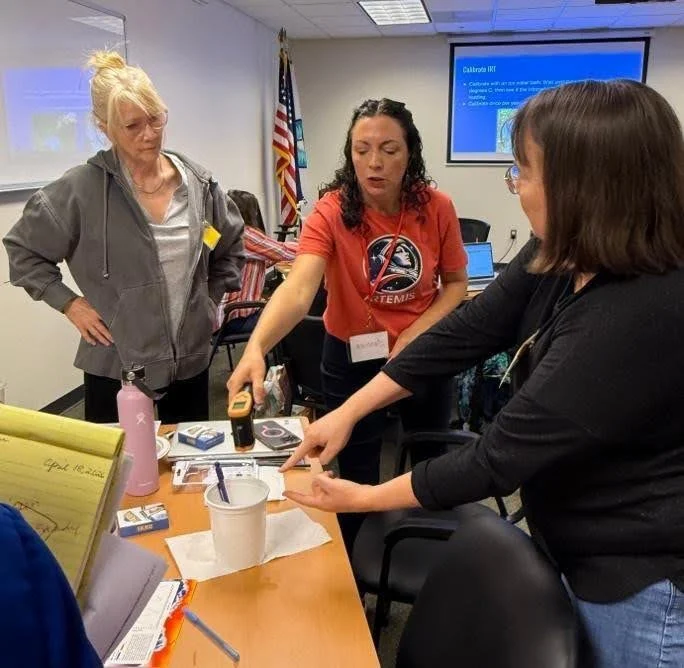
Thirty-eight science educators from seven school districts in Virginia’s Tidewater region took part in a collaborative project between NASA eClips and the GLOBE (Global Learning and Observation to Benefit the Environment) Program to strengthen STEM education and build a regional STEM ecosystem.
The program, part of NASA’s Science Activation initiative, integrates NASA’s authentic science resources with citizen science participation to enhance classroom learning. Educators engaged in a three-hour professional development session held on March 7 and April 18, 2026, at the National Institute of Aerospace in Hampton, Virginia.
Hands-On Environmental Investigations
During the sessions, participants explored the impact of land cover on surface temperature, cloud influence on the atmosphere, and the role of soil in environmental systems. Activities were based on NASA eClips educational resources and GLOBE Program protocols aligned with Virginia’s Science Standards of Learning, focusing on weather, climate, land cover, and Earth’s energy budget.
Educators gained practical experience using scientific instruments such as infrared thermometers and multi-day minimum/maximum thermometers to collect environmental data accurately. They also studied phenomena like the urban heat island effect and performed interactive demonstrations, including a cloud opacity test and a cloud dance activity.
Participants practiced submitting observations using the GLOBE Observer app, reinforcing how citizen science tools can connect classroom lessons to real-world science.
Building a Sustainable STEM Ecosystem
This initiative builds on two years of collaboration involving NASA eClips Educators from the National Institute of Aerospace’s Center for Integrative STEM Education (NIA-CISE), GLOBE scientists from the NASA Langley Research Center, regional school divisions, and community partners including the Elizabeth River Project.
Funding from the Coastal Virginia STEM Hub, supported by the Virginia General Assembly, enabled educator stipends and the acquisition of equipment such as weather instrument shelters and soil kits. Career and Technical Education students from Hampton City Schools and Norfolk Public Schools constructed these instrument shelters following GLOBE standards, linking technical education with environmental science efforts.
As districts and community organizations incorporate NASA eClips and GLOBE resources into curricula and outreach, they provide learners with authentic, data-driven science opportunities that extend learning beyond classrooms into the community.
Why it matters
This partnership exemplifies effective collaboration among federal agencies, educational institutions, and community groups to deepen STEM engagement at the regional level. By aligning hands-on scientific investigations with state standards and leveraging citizen science platforms, the program prepares educators to deliver relevant and experiential science education, supporting broader STEM workforce development goals.
Sources
This article is based on reporting and publicly available information from the following source:
Read more Space & NASA stories on Goka World News.