
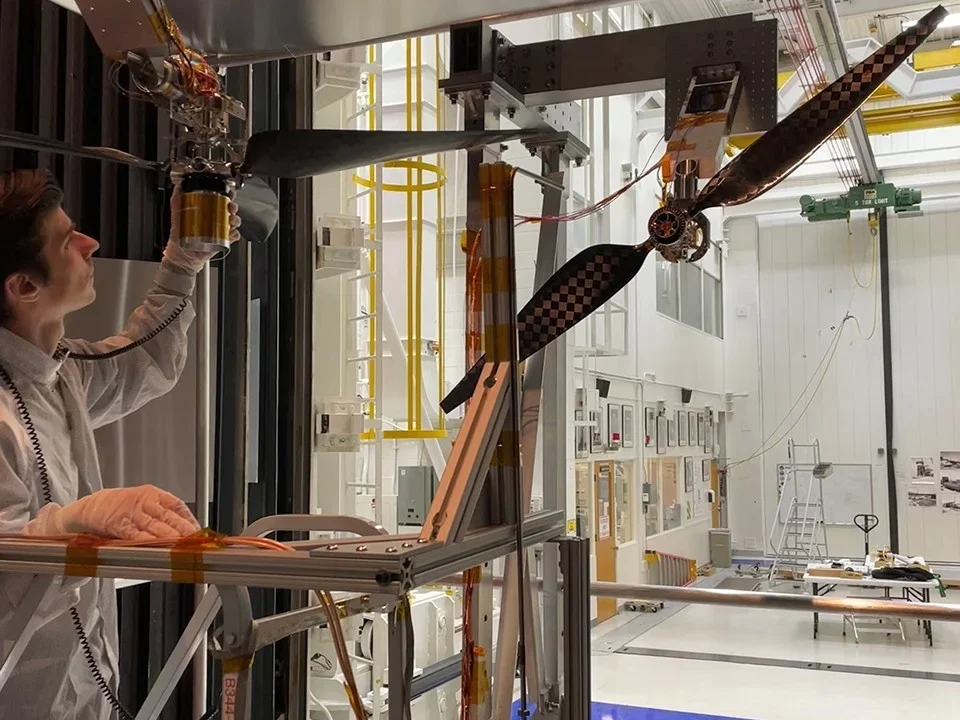
NASA engineers have successfully tested next-generation rotor blades designed for Mars helicopters that may exceed the speed of sound, according to data from trials at the agency’s Jet Propulsion Laboratory (JPL) in Southern California. The tests took place in November 2025 inside JPL’s 25-Foot Space Simulator, where the rotor blades were evaluated under conditions simulating supersonic speeds.
The experimental rotor system consists of a three-bladed configuration mounted horizontally. During testing, a two-bladed rotor set vertically generated a “headwind” effect, allowing the tips of the three-bladed rotor to surpass Mach 1, the speed of sound. Engineers monitored the structural integrity of the rotor blades throughout these high-speed conditions, and the blades remained intact without breaking apart.
These test results indicate that future Mars helicopters could operate with enhanced aerodynamic performance, providing greater flight capability in the thin Martian atmosphere. The Mars Exploration Program funded the test campaign, seeking to expand the operational envelope of aerial vehicles on the Red Planet.
JPL, managed by the California Institute of Technology in Pasadena, oversees NASA’s Mars Exploration Program on behalf of the agency’s Science Mission Directorate in Washington. This advancement in rotor technology builds on NASA’s ongoing efforts to explore Mars with robotic aircraft, following the success of previous Mars helicopter missions.
Sources
This article is based on reporting and publicly available information from the following source:
Read more Space & NASA stories on Goka World News.