
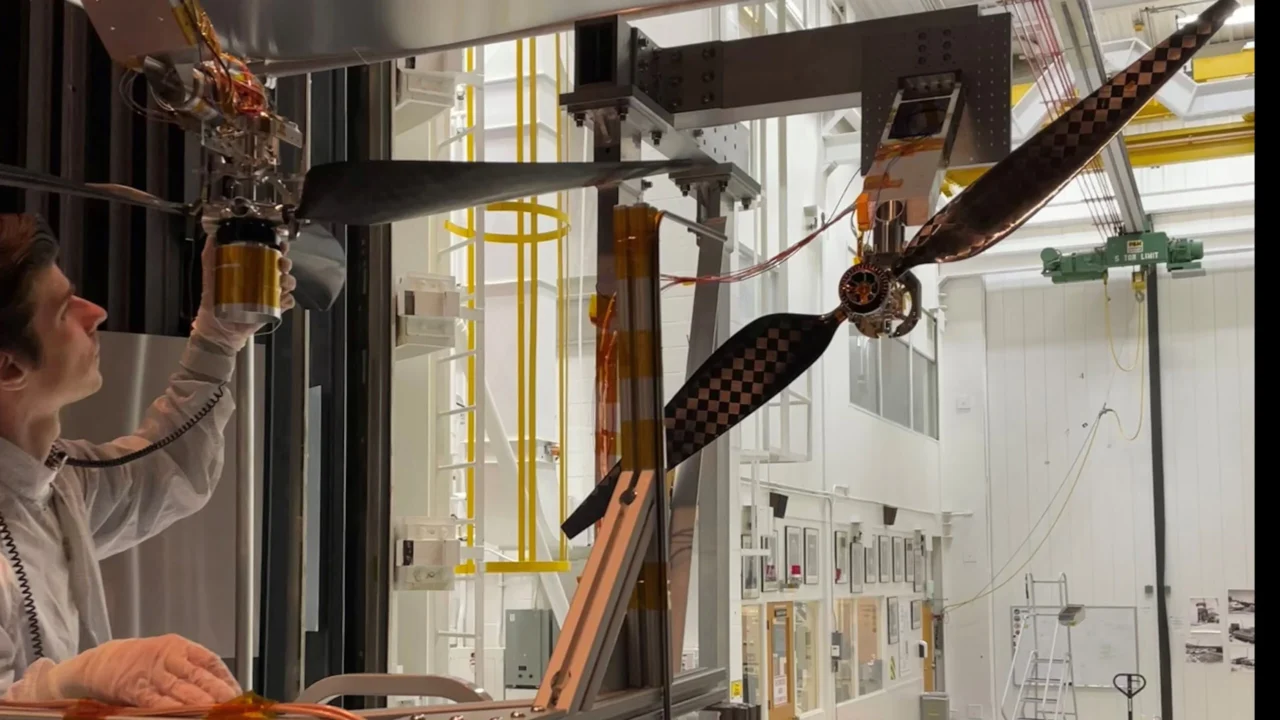
NASA has successfully tested rotor blades for its next-generation Mars helicopters at speeds surpassing Mach 1, offering promise for aircraft capable of carrying heavier payloads on the Red Planet. The tests were conducted at NASA’s Jet Propulsion Laboratory (JPL) in Southern California under conditions simulating the thin Martian atmosphere.
Breaking the sound barrier in Martian conditions
The rotor blades—developed by AeroVironment in California—were spun inside JPL’s 25-Foot Space Simulator, where air was replaced with carbon dioxide to mimic Mars’ atmosphere. The team increased rotor speeds to Mach 1.08 at the blade tips, surpassing the speed of sound on Mars, which is about 540 mph (869 kph). This milestone represents a 30% boost in potential lift compared to previous designs, critical for supporting heavier scientific instruments, advanced sensors, and larger batteries for extended flights.
Ingenuity, NASA’s first Mars helicopter, restricted its rotor tip speeds to Mach 0.7 during its 72 flights to avoid unpredictable effects near the sound barrier. Ingenuity carried no science instruments, serving primarily as a technology demonstration. In contrast, these new rotors are being designed to deliver greater performance and payload capacity.
Testing approach and significance
The JPL team conducted 137 test runs, gradually increasing rotor speeds and introducing headwinds to push the blades under supersonic aerodynamic conditions. Test engineers reinforced the chamber with sheet metal to contain any debris in case of blade failure. They tested both a three-bladed rotor and a slightly longer two-bladed design for NASA’s planned SkyFall mission, which aims to deliver three next-generation helicopters to Mars by December 2028.
Shannah Withrow-Maser, an aerodynamicist at NASA’s Ames Research Center, called the tests a “major step” toward confirming the feasibility of flight in Mars’ demanding environment. The data gathered will help optimize rotorcraft designs capable of functioning effectively despite the planet’s thin atmosphere and gravity challenges.
Why it matters
Flying on Mars is exceptionally challenging due to its atmosphere, which is only 1% the density of Earth’s, making lift generation difficult. Pushing rotor tips beyond Mach 1 is a necessary advancement to increase thrust and enable carrying useful payloads for scientific exploration. This progress supports NASA’s broader goals of aerial reconnaissance and data collection for robotic and future human missions on Mars.
Background
Ingenuity’s historic powered flight on April 19, 2021, marked the first controlled flight on another planet but was limited to technology demonstration without science instruments. The upcoming SkyFall mission and other concepts aim to build on this pioneering work by deploying helicopters equipped to conduct detailed scientific investigations and expand reach across Mars’ varied terrain.
JPL, managed by Caltech, oversees NASA’s Mars Exploration Program, advancing robotic exploration through innovative technologies like helicopter rotorcraft.
Sources
This article is based on reporting and publicly available information from the following source:
Read more Space & NASA stories on Goka World News.