
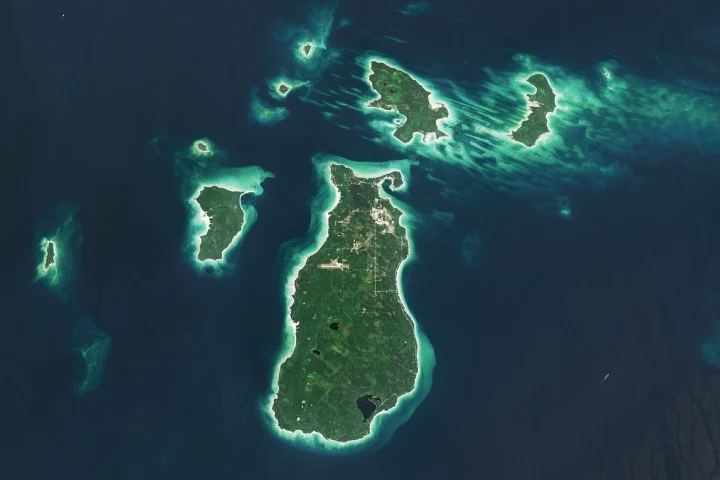
Beaver Island, located in northern Lake Michigan, is the largest island in the lake, measuring approximately 13 miles (21 kilometers) long and 6 miles (10 kilometers) wide. It is the only inhabited island in the Beaver Archipelago, with around 600 residents, many of whom are descendants of Irish immigrants from County Donegal who settled there in the mid-1800s.
The island’s landscape was shaped thousands of years ago by retreating ice sheets that carved ridges and valleys beneath Lake Michigan. Erosion-resistant rock formations formed the Beaver Archipelago, a series of islands featuring upland forests, dunes, wetlands, and marshes. These diverse ecosystems provide critical habitats for rare plant species like Pitcher’s thistle and Lake Huron tansy, as well as important spawning grounds for freshwater fish, including perch and smallmouth bass.
During the late 19th century, Beaver Island became notable for its thriving fishing and farming industries. By the 1880s, it was the largest supplier of freshwater fish in the United States, though overfishing eventually diminished its productivity. The island also supported ship navigation with two lighthouses: the Beaver Head Lighthouse, operational from 1852 to 1962 on the southern end, and the still-active Beaver Island Harbor Light on the northern side, first lit in 1870.
Today, visitors can reach Beaver Island by boat or plane to engage in recreational activities such as biking, fishing, and kayaking. In 2024, the island gained recognition for its minimal light pollution, leading to the designation of the Beaver Island State Wildlife Research Area International Dark Sky Sanctuary. This status attracts sky watchers interested in observing phenomena like the aurora borealis.
Neighboring islands in the archipelago remain largely uninhabited and ecologically undisturbed. For example, High Island boasts perched sand dunes rising nearly 200 feet above the lake, while Hog Island contains patches of old-growth northern hardwood forest. The surrounding shallow waters feature sandy beaches and deeper zones reaching depths of about 330 feet (100 meters).
Why it matters
Beaver Island and its surrounding archipelago are important for conservation due to their unique geological formation and rare ecological habitats. The recent dark sky sanctuary designation highlights growing efforts to preserve natural environments and provide opportunities for science and recreation. Understanding the island’s history of settlement and resource use also informs broader Great Lakes cultural and environmental narratives.
Background
The Great Lakes region, including Lake Michigan, was extensively shaped by glacial retreat around 10,000 years ago. These geological processes formed ridges and valleys that underpin the current lake floor and islands. The Beaver Archipelago’s formation reflects this glacial history, with resistant rock outcrops emerging as islands. Historically, the Great Lakes served as vital routes for commerce and fishing, making islands like Beaver Island significant both economically and culturally.
Sources
This article is based on reporting and publicly available information from the following source:
Read more Climate & Environment stories on Goka World News.