
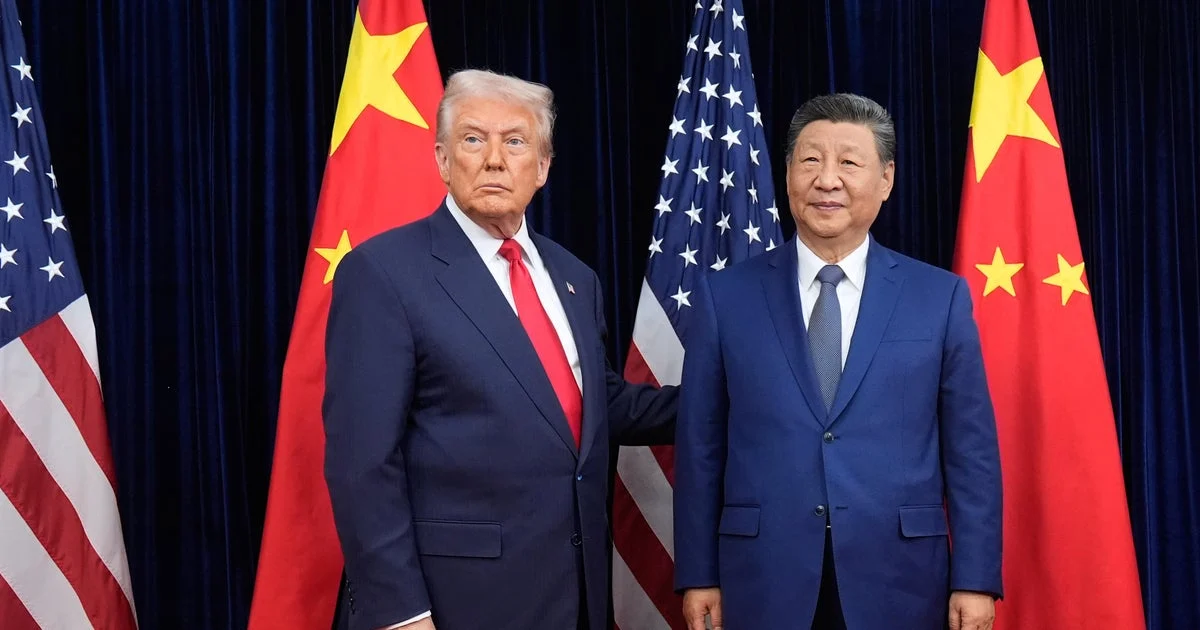
President Donald Trump traveled to Beijing on Tuesday for a highly anticipated summit with Chinese President Xi Jinping, resuming a meeting postponed earlier due to the conflict in Iran. The two leaders are set to discuss heightened trade tensions, energy, Taiwan, and the broader geopolitical impact of the Iran war.
The White House confirmed Trump’s arrival in Beijing on Wednesday morning Eastern Daylight Time, with the time difference placing Beijing 12 hours ahead of Washington. Trade issues, though somewhat eased after the 2025 trade war and a temporary tariff truce, remain central to the talks.
The situation in Iran and its effect on global supply chains, particularly through the Persian Gulf and the Strait of Hormuz, is expected to weigh heavily on discussions. China depends on oil transported through this route for about 60% of its total supply. Despite U.S. sanctions on Iran that recently targeted Chinese firms, Beijing has indicated it will protect these businesses. Trump has acknowledged that while Beijing has been “very nice” regarding Iran, it could do more to aid U.S. interests in stabilizing the region.
Taiwan is anticipated to be a key subject as well, with Trump noting that Xi will likely raise the issue more extensively than he will. Beijing aims to assert full control over Taiwan, viewing it as a domestic matter, while the U.S. has historically supported Taiwan’s democratically autonomous status. President Trump expressed openness to discussing U.S. arms sales to Taiwan during the summit but indicated that China would prefer to see them discontinued.
Foreign policy experts emphasize the summit’s importance as a platform to stabilize U.S.-China relations amid ongoing strategic competition. Zongyuan Zoe Liu of the Council on Foreign Relations described the meeting itself as a significant outcome, aiming to avoid military escalation while managing rivalry. Similarly, Henrietta Levin of the Center for Strategic and International Studies noted that China’s confidence has grown amid the Iran war, as U.S. military focus shifts away from Asia.
The delegation accompanying President Trump includes notable figures such as Tesla CEO Elon Musk, Nvidia CEO Jensen Huang, filmmaker Brett Ratner, and Fox News host Sean Hannity. Other high-profile invitees reportedly included Tim Cook of Apple, Larry Fink of BlackRock, and David Solomon of Goldman Sachs, though their presence on the trip was not confirmed.
Why it matters
This summit takes place amid fraught global conditions involving trade tensions, military conflicts, and strategic competition in Asia. Stabilizing U.S.-China relations is critical to preventing unintended escalation, maintaining global supply chains, and addressing security issues surrounding Taiwan and Iran. The outcome may influence future diplomatic, economic, and security policies between the two powers.
Background
Trade disputes between the U.S. and China have fluctuated since the 2025 trade war, with tariffs imposing significant economic costs on both nations. A one-year agreement currently suspends many tariffs through late 2026. The Taiwan Strait remains a flashpoint, with China asserting sovereignty claims and the U.S. maintaining strategic support. The recent Iran conflict has further complicated global energy markets and U.S.-China dynamics, as China remains a principal buyer of Iranian oil despite U.S. sanctions.
President Trump and Xi last met in person in October 2025 at the Asia-Pacific Economic Cooperation summit in South Korea, where Taiwan was not a raised topic. The upcoming talks are expected to provide a more comprehensive platform to address these intertwined challenges.
Sources
This article is based on reporting and publicly available information from the following source:
Read more Politics stories on Goka World News.