
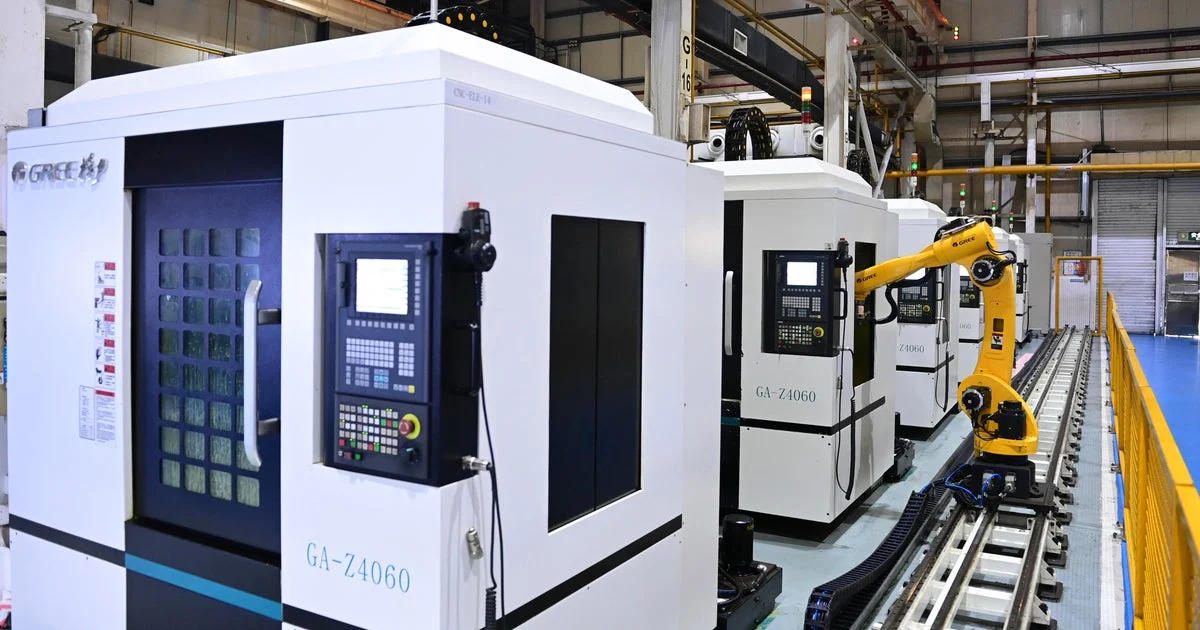
As President Donald Trump arrives in China for high-level talks with Xi Jinping, one key area of focus is securing Chinese investment to modernize American factories. However, a visit to a cutting-edge “dark factory” in Zhuhai, southern China, reveals the significant technological gap in manufacturing automation between the two countries.
The Zhuhai facility, operated by Gree Electric Appliances — China’s largest air conditioner manufacturer — exemplifies next-generation industrial production. Hundreds of robotic arms assemble thousands of components every 10 seconds without human presence on the assembly lines, functioning continuously 24/7 under artificial intelligence (AI) control.
Chen Huadong, Gree’s general manager, described the factory as a model for the future of manufacturing: “This is how future intelligent factories will look like, with AI-supported robots everywhere, working in real time.” The factory’s nerve center features large displays tracking real-time production metrics, global sales, and delivery schedules.
More than 60% of Gree’s output is exported internationally, including substantial shipments to North America. The company has actively promoted its brand in the U.S., even advertising in New York’s Times Square.
China currently accounts for approximately 30% of global manufacturing output, with projections indicating this could approach 50% within the next four years. Chen emphasized that China’s manufacturing advantage extends beyond products to include advanced factory infrastructure: “Gree is not only capable of manufacturing high-quality air conditioners, but also high-quality factories.”
Typically, a factory of this scale would employ roughly 10,000 workers. However, this dark factory operates with just 1,000 staff—one-third of whom are engineers responsible for maintaining and managing the AI systems. Chen observed that physical labor in manufacturing is declining, while demand for skilled workers to oversee automated equipment is growing.
“Artificial intelligence has transformed the way businesses operate,” Chen said. He predicts that factories worldwide will increasingly adopt automation, creating more roles in engineering and technical fields to design, install, and support robotic production lines. “Our workers are transitioning and upgrading in this direction,” he added.
Why it matters
China’s advancement in automated manufacturing presents a challenge for U.S. industrial competitiveness as it pursues investment to revitalize its production sector. The gap between high-tech Chinese factories and traditional U.S. facilities raises questions about workforce development, capital investment, and technology adoption. Securing partnerships to bring AI-driven manufacturing advancements back to the U.S. could be essential for maintaining manufacturing jobs and global market share.
Background
The concept of “dark factories”—facilities that operate fully automated with minimal human intervention—has gained traction in China amid efforts to boost productivity and reduce labor costs. These factories leverage AI and robotics to run nonstop, increasing efficiency but requiring a workforce that is more technically skilled. The growing divide in manufacturing technology reflects broader economic and geopolitical shifts between the U.S. and China, particularly as trade tensions and supply chain considerations influence industrial policy.
Sources
This article is based on reporting and publicly available information from the following source:
Read more Politics stories on Goka World News.