
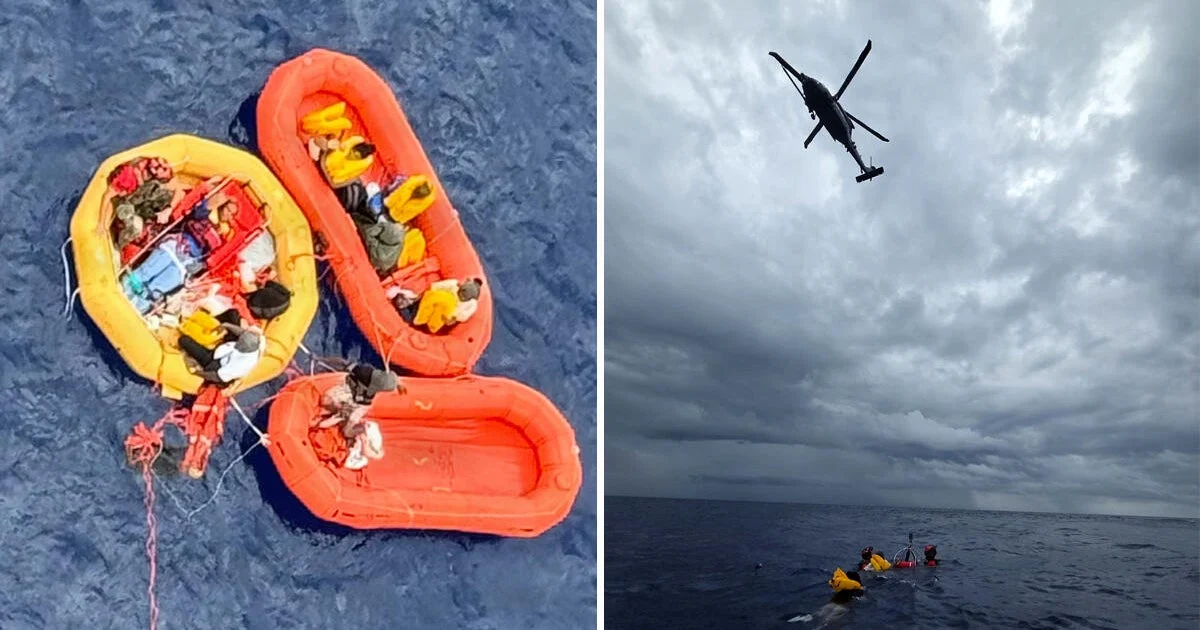
Eleven adults survived a plane crash about 80 miles off the coast of Melbourne, Florida, after spending approximately five hours stranded on a life raft, the U.S. military said. The rescue operation was launched Tuesday following a signal from the plane’s emergency locator transmitter (ELT), which alerted the U.S. Coast Guard to the distress situation.
The twin-engine turboprop aircraft, carrying all Bahamian passengers, had departed from Marsh Harbor, Bahamas, en route to Freeport before experiencing engine failure and crashing into the Atlantic Ocean. Bahamian authorities will investigate the incident’s cause.
Rescue Operation Details
A 920th Rescue Wing HH-60W Jolly Green II helicopter crew, already conducting a training mission nearby, was swiftly redirected to assist after the ELT alert was received around 11 a.m. Additional support came from a Coast Guard C-27 Spartan aircrew and an HC-130J Combat King II from Patrick Space Force Base.
The survivors, found floating on a life raft, were described as physically, mentally, and emotionally distressed but free of major injuries. Military officials characterized their survival as “miraculous,” noting that avoiding dehydration and managing possible crash injuries were critical challenges during the hours adrift. Captain Rory Whipple commented that the survivors had no communication and were unaware that rescuers were nearby until the helicopter appeared overhead.
Timing and Conditions of the Rescue
Officials emphasized the urgency of the rescue, which took place just before a thunderstorm approached the area. Upon locating the survivors, rescuers saw that they had used a rain tarp to protect themselves from exposure. The helicopter recovered all 11 passengers with only minutes of fuel remaining and transported them to Melbourne Orlando International Airport, where they were reported in stable condition.
Major Elizabeth Piowaty, aircraft commander on the HC-130J, highlighted the rarity of surviving an ocean ditching. She noted the pilot’s careful balancing of speed and safety during the crash landing to maximize chances of survival.
Why it matters
This rescue underscores the critical role of emergency locator transmitters and rapid military response in saving lives during aviation emergencies over water, especially given the challenging conditions survivors face and the narrow window for successful rescue before weather developments.
Background
The U.S. 920th Rescue Wing and Coast Guard frequently conduct training and real-world search and rescue operations over the Atlantic. Their coordination and quick response are vital in incidents involving aircraft distress signals far from shore, where survivors face significant risks from exposure, dehydration, and injuries.
Sources
This article is based on reporting and publicly available information from the following source:
Read more US News stories on Goka World News.