
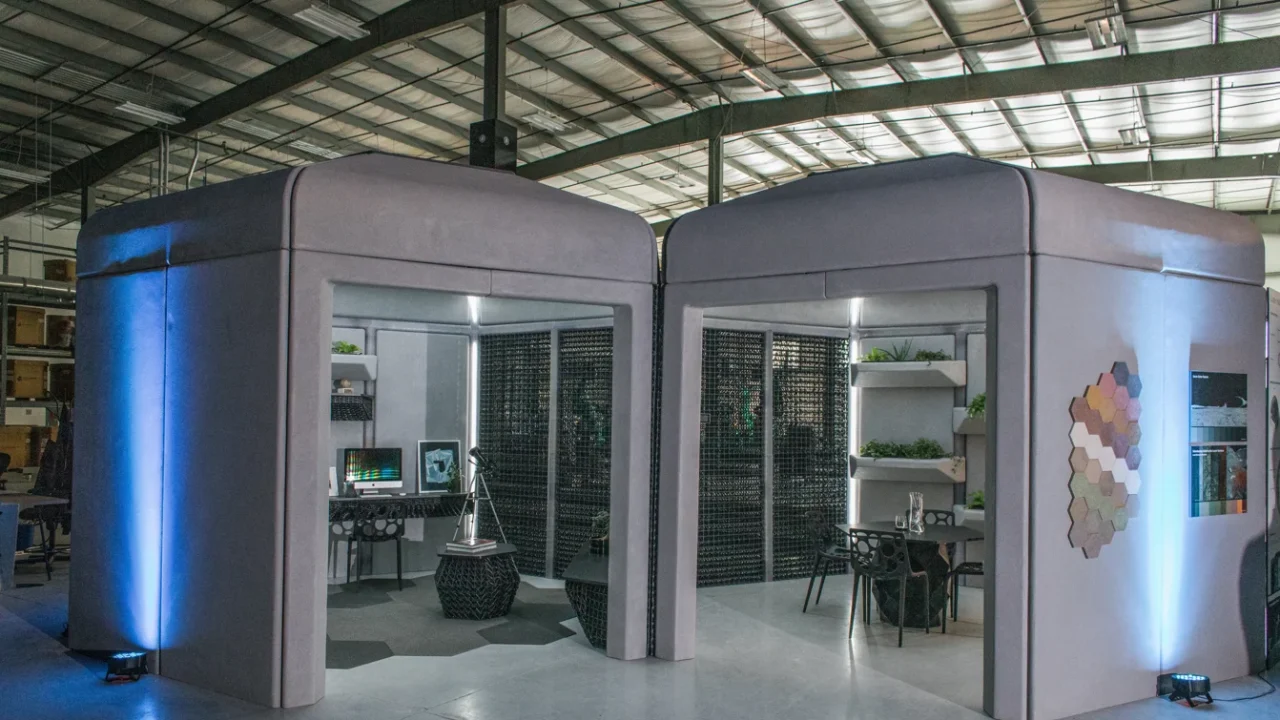
Branch Technology Inc., a Chattanooga, Tennessee-based company, has adapted a 3D printing process developed with NASA support to improve construction on Earth by producing lightweight, modular building elements. This innovative method, known as Freeform 3D Printing, creates lattice structures that are both material-efficient and adaptable for various architectural uses.
The technology emerged from NASA’s 3D-Printed Habitat Challenge, a competition aimed at designing habitats suitable for deep space exploration. Branch Technology won Phase II of the challenge in 2017 and collaborated further with NASA through a cooperative agreement to refine its fabrication process. According to David Goodloe, leader of Branch Technology’s Advanced Concepts team, the process reduces material use by printing lattice structures rather than solid forms, which enhances the strength-to-weight ratio while enabling complex shapes.
Tracie Prater, a technical manager at NASA’s Marshall Spaceflight Center who worked as a subject matter expert on the Habitat Challenge, explained that the cooperative agreement focused on how the company’s on-demand printing techniques could be applied to interior components of pressurized habitats. This involved developing novel designs for interior systems and furnishings, advancing the versatility of 3D printing beyond structural shells.
Branch Technology’s innovation extends to its extrusion nozzles, which can produce both intricate lattice patterns and conventional solid layers within the same panel. This dual-mode printing allows for practical assembly features, such as solid substrates where fasteners can be securely attached. The materials used were shaped by requirements from the Habitat Challenge, prioritizing the use of mission-relevant substances like basalt fiber-reinforced plastics inspired by Martian soil composition and potential recycling of mission materials.
Leveraging this space-driven materials research, Branch developed optimized “inks” for terrestrial construction that maintain the strength and efficiency benefits of their space-grade counterparts. This approach exemplifies NASA’s Technology Transfer program, which aims to apply space-developed technologies to improve everyday life on Earth.
Why it matters
The transition of space-grade 3D printing technology to terrestrial construction addresses challenges of material usage, structural efficiency, and architectural flexibility. By promoting lightweight and modular building components, the technology supports sustainable and innovative construction techniques that could influence future building standards.
Background
The 3D-Printed Habitat Challenge was created by NASA to foster the development of construction techniques needed for extraterrestrial habitats on the Moon or Mars. The competition prizes encouraged teams to innovate with materials and manufacturing processes capable of handling the extreme environments of deep space while conserving mission resources.
Over five decades, NASA’s Technology Transfer program has facilitated the adaptation of space technologies for commercial use on Earth, documented in the agency’s Spinoff publication. This program highlights how space exploration continues to drive advancements in materials science, manufacturing, and design that benefit various industries.
Sources
This article is based on reporting and publicly available information from the following source:
Read more Space & NASA stories on Goka World News.