
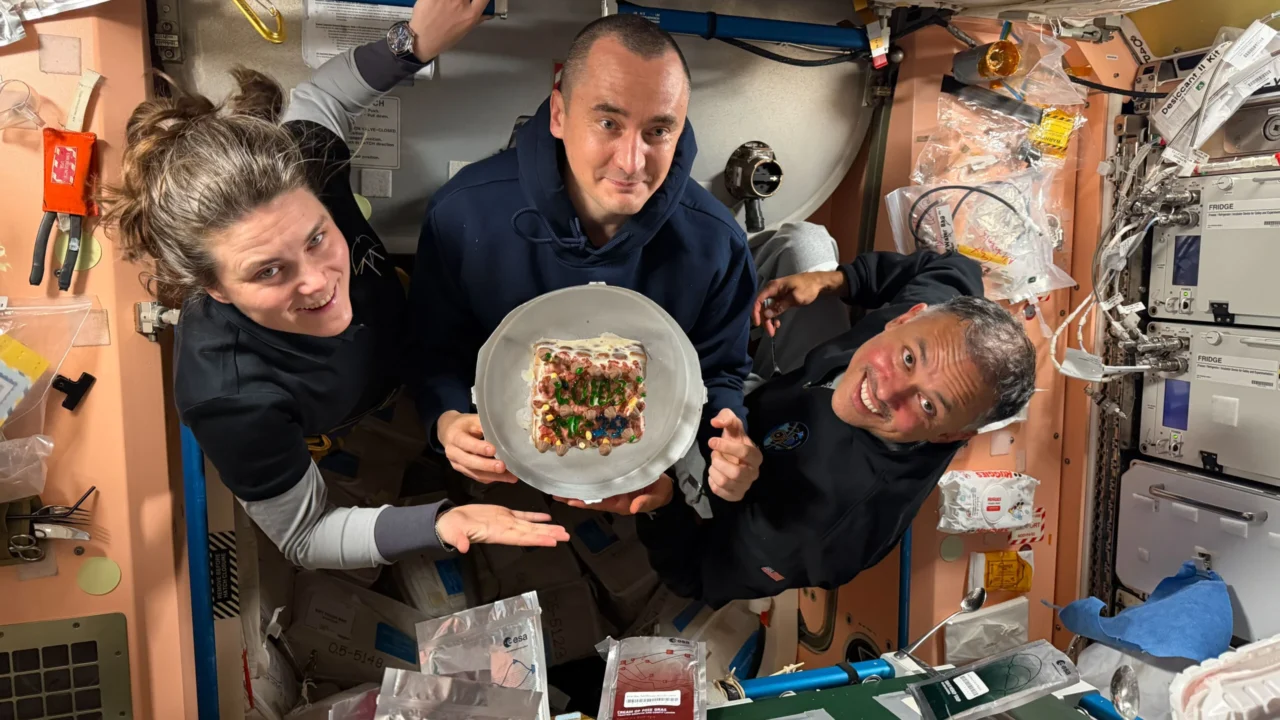
Anna Kikina and Pyotr Dubrov of Roscosmos, along with NASA astronaut Anil Menon, arrived at the International Space Station (ISS) on July 14, 2026, marking the beginning of their planned eight-and-a-half-month mission in space. This crew of Expedition 74 flight engineers launched earlier that day from the Baikonur Cosmodrome in Kazakhstan, joining ongoing research and station operations.
What Happened
On July 14, 2026, the spacecraft carrying Expedition 74 flight engineers Kikina, Dubrov, and Menon lifted off from the Baikonur Cosmodrome. After hours of travel, they successfully docked with the ISS, joining the orbiting laboratory currently circling Earth. By July 18, they were captured in a photo celebrating their arrival while holding a cake, emblematic of their camaraderie and the milestone achieved. The crew has entered the early phase of their mission, focusing both on acclimating to life in microgravity and applying their expertise to conduct ongoing scientific research aboard the station.
Key Facts
The three crew members—two representing Roscosmos and one from NASA—are scheduled to remain aboard the ISS for approximately eight and a half months. Their launch from Baikonur, the historic spaceport in Kazakhstan, occurred on July 14. The mission is part of Expedition 74, the current expedition numbering at the ISS. During their initial weeks, the astronauts balance familiarization with the station’s systems and environment alongside the commencement of complex experiments designed to advance space science and technology.
What This Means
The arrival of this new crew continues the seamless international collaboration that defines the ISS program, ensuring constant human presence in low Earth orbit and ongoing scientific output. Long-duration missions like this one are critical for understanding human adaptation to space—a key factor in planning future deep-space exploration missions to the Moon, Mars, and beyond. The combination of skills brought by Russian and American crew members underscores the cooperative nature of the station, providing diverse expertise crucial for a broad range of experiments in microgravity.
For the general public, these missions sustain the flow of new scientific knowledge, which can translate into advancements in medicine, materials science, and environmental monitoring on Earth. The ISS also functions as a proving ground for technologies that could eventually support commercial spaceflight and permanent human habitats in orbit.
Background
The International Space Station has hosted continuous human presence in orbit since the year 2000, serving as a multinational research laboratory. Previous expeditions have paved the way for sustained international cooperation and scientific discovery in space. The 74th expedition continues this legacy, operating under a partnership among NASA, Roscosmos, ESA, JAXA, and CSA.
What Comes Next
Having settled in, the Expedition 74 crew will intensify their scientific work while maintaining the station’s operation. The team is expected to conduct a variety of experiments across disciplines like biology, physics, and Earth science throughout their stay. Updates on their activities and new research findings will be shared via the International Space Station blog and other official NASA communications as their mission progresses.
Sources
This article is based on reporting and publicly available information from the following sources:
Read more Space & NASA stories on Goka World News.