
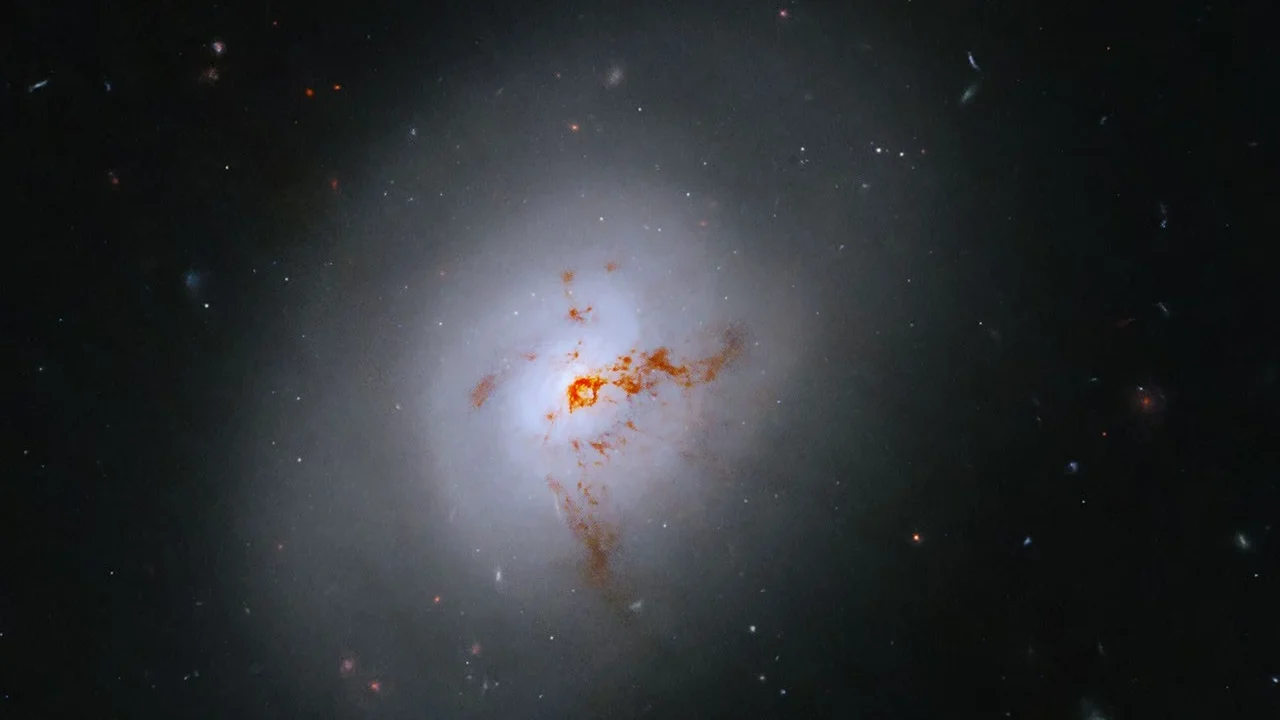
NASA’s Hubble Space Telescope has observed NGC 1266, a lenticular galaxy located about 100 million light-years away in the constellation Eridanus, revealing its transitional state from a star-forming galaxy to a quieter elliptical galaxy. This rare galaxy exhibits characteristics of a post-starburst phase, featuring a bright core and a hint of spiral structure but lacking the prominent spiral arms typical of star-forming galaxies.
Galaxy Structure and Classification
NGC 1266 is classified as a lenticular galaxy, which is considered an evolutionary bridge between spiral and elliptical galaxies. Lenticular galaxies have a flattened disk and a bright central bulge like spirals, yet they lack spiral arms and exhibit little to no ongoing star formation, characteristics shared with elliptical galaxies. The galaxy’s face is partially obscured by reddish-brown dust clumps and filaments, while distant galaxies visible in the background shine through its diffuse outer regions.
Post-Starburst Activity and Black Hole Influence
Post-starburst galaxies like NGC 1266 are known for having young stars but very limited current star formation, comprising roughly one percent of the local galaxy population. Astronomers believe that about 500 million years ago, NGC 1266 underwent a minor merger with another galaxy. This event triggered a surge in star formation and increased the mass of its central bulge, while also funneling gas into its supermassive black hole.
The influx of gas intensified the activity of the black hole, creating what is known as an active galactic nucleus (AGN). This increased activity likely produced powerful jets and winds along the black hole’s rotation axis, which over time expelled or stripped away the galaxy’s star-forming gas. The turbulence generated by these processes has further suppressed new star formation by disturbing the gas and dust needed to form stars.
Observational Evidence from Hubble
Hubble and other observatories have detected strong outflows of gas being ejected from NGC 1266, along with evidence of shockwaves and highly disturbed interstellar material. Researchers note that almost all remaining star formation is confined to the galaxy’s core, with little to none occurring outside that region. This supports the idea that the active black hole is the primary mechanism suppressing star birth by disrupting or removing the gas needed for star formation.
Why it matters
Studying galaxies like NGC 1266 offers astronomers valuable insights into how supermassive black holes influence their host galaxies and regulate star formation. Understanding the processes that shut down star formation illuminates key stages in galaxy evolution, revealing how galaxies transition from active star-forming systems to more quiescent states.
Background
Lenticular galaxies are considered transitional types between spirals and ellipticals, often featuring properties of both but lacking ongoing star formation typical of spirals. Post-starburst galaxies provide a snapshot shortly after significant star formation has ceased, serving as laboratories to study the impact of galactic mergers and black hole activity in galaxy evolution.
Sources
This article is based on reporting and publicly available information from the following source:
Read more Space & NASA stories on Goka World News.