
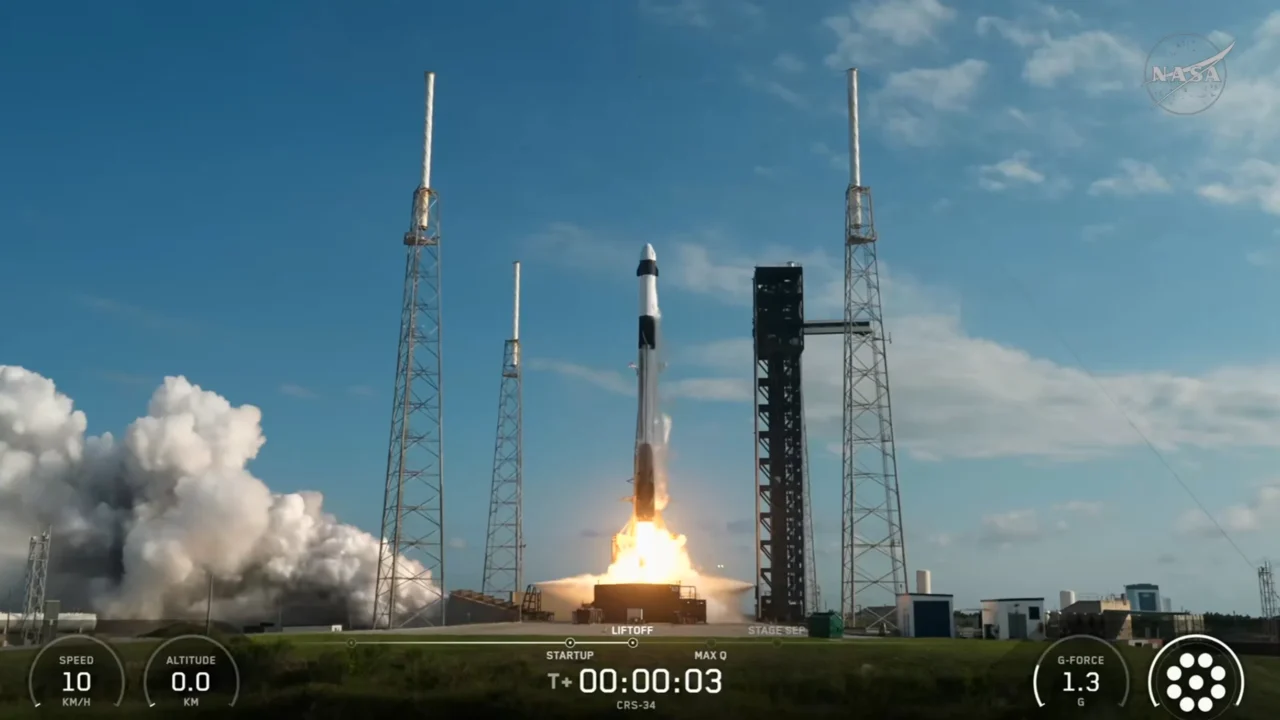
SpaceX launched its 34th commercial resupply mission for NASA on May 15, delivering nearly 6,500 pounds of cargo to the International Space Station (ISS). The Dragon spacecraft lifted off at 6:05 p.m. EDT from Cape Canaveral Space Force Station in Florida and is scheduled to dock autonomously with the station’s Harmony module on the morning of May 17.
The cargo includes a variety of scientific instruments and experiments intended to enhance research aboard the station. Among the payloads is a project to assess how accurately Earth-based simulators replicate microgravity conditions. Another experiment involves a bone scaffold made from wood designed to explore new treatments for fragile bone diseases such as osteoporosis.
Additional investigations will study the behavior of red blood cells and the spleen in space, providing insights into human physiology in microgravity. The cargo also contains an instrument to observe charged particles around Earth, which could affect satellite operations and power grids, contributing to a better understanding of planetary formation processes.
Further added is a device intended to make precise measurements of sunlight reflected by Earth and the Moon, supporting research in Earth and space sciences. These experiments represent just a portion of the extensive scientific work conducted aboard the ISS, spanning biology, physical sciences, and space science.
The Dragon spacecraft will remain docked to the ISS until mid-June. Upon departing, it will return cargo including time-sensitive research samples back to Earth with a planned splashdown off the coast of California.
Why it matters
The mission supports ongoing scientific research critical to understanding the effects of space on biological and physical systems, which has implications for human health and technology development. It also advances NASA’s efforts to prepare for longer missions, including Artemis lunar exploration and eventual human missions to Mars. Continuous resupply missions like this are essential to sustaining the ISS as a platform for research and international cooperation.
Background
The International Space Station has hosted a permanent human presence for over 25 years, serving as a unique laboratory for research that cannot be conducted on Earth. SpaceX’s Dragon cargo missions, contracted by NASA, have been vital to delivering supplies and experiments since 2012. These missions support the station’s crews and contribute to scientific advancements across multiple disciplines.
Sources
This article is based on reporting and publicly available information from the following source:
Read more Space & NASA stories on Goka World News.