
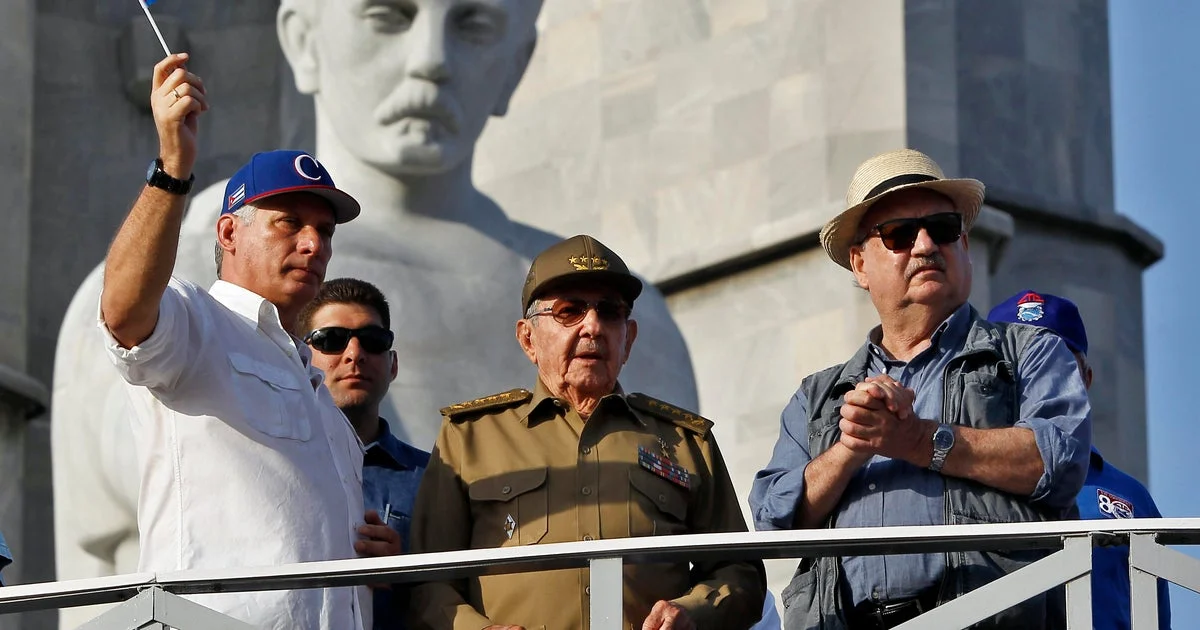
Amid increasing U.S. pressure and sanctions targeting Cuba, the island’s political leadership remains heavily influenced by the Castro family, with several figures playing critical roles as the Trump administration signals interest in significant political change.
Raúl Castro’s Continued Influence
Raúl Castro, the younger brother of revolutionary leader Fidel Castro, stepped down as Cuba’s president in 2018 and relinquished leadership of the Communist Party in 2021. However, he remains a powerful, central figure in Cuban politics. U.S. officials are reportedly preparing to indict Raúl Castro for his alleged involvement in the 1996 downing of two planes operated by the Cuban exile group Brothers to the Rescue.
Raúl, a former guerrilla commander who led Cuba’s armed forces and succeeded Fidel as president in 2008, is seen as a pragmatic leader. He was responsible for the 2014 U.S.-Cuba rapprochement under President Barack Obama, which expanded bilateral contacts before being rolled back under the Trump administration.
Miguel Díaz-Canel’s Role and Limitations
Miguel Díaz-Canel has served as Cuba’s president and Communist Party leader since 2018, marking the first time since the Cuban Revolution that a non-Castro leads the country. Handpicked by Raúl Castro, his current term extends until 2028. Despite holding the top official positions, experts describe Díaz-Canel as a loyal functionary lacking substantial independent authority.
The Trump administration remains skeptical that Díaz-Canel can implement the reforms the U.S. seeks. In response to U.S. threats of military intervention, Díaz-Canel stated that Cuba would resist any such attempts.
Emerging Castro Family Members and Economic Shifts
Oscar Pérez-Oliva Fraga, a great-nephew of Fidel and Raúl Castro, was appointed deputy prime minister and minister of foreign trade and investment in 2025. He has also joined the National Assembly, positioning him as a potential future leader capable of ascending to the presidency. Pérez-Oliva Fraga spearheaded a policy allowing Cubans abroad to invest and own businesses in Cuba, a significant departure from decades of state control and hostile rhetoric towards emigrants.
As trade minister, he oversees GAESA, a military-controlled conglomerate governing key sectors such as tourism and finance. The U.S. State Department estimates GAESA controls at least 40% of Cuba’s economy with revenues exceeding three times the state budget, and has imposed recent sanctions targeting the entity.
The Younger Generation: Raúl Castro’s Grandson
Raúl Guillermo Rodríguez Castro, known as “Raulito,” is Raúl Castro’s 41-year-old grandson serving as his bodyguard and adviser. Though not a formal government official, he has acted as a main intermediary between Cuba and the U.S., meeting with Trump administration officials, including Secretary of State Marco Rubio, in recent months.
Challenges to U.S. Strategy
The U.S. administration has drawn comparisons to its recent removal of Venezuelan leader Nicolás Maduro, signaling potential interest in a similar operation in Cuba. However, analysts identify a key obstacle: the lack of a clear Cuban equivalent to Venezuela’s interim leader, Delcy Rodríguez, complicating prospects for U.S.-backed political transition.
According to Cuba specialists, while economic discussions with the U.S. have opened in some respects, Cuban leaders maintain a firm red line against external interference in their political system or leadership, asserting national sovereignty as non-negotiable.
Why it matters
The ongoing U.S. efforts to encourage political change in Cuba come at a time when the country faces worsening economic conditions intensified by sanctions and a virtual oil blockade. The evolving roles of the Castro family members and shifting economic policies may influence Cuba’s internal stability and its relationship with the United States, potentially impacting regional geopolitics.
Background
Cuba has been governed by the Communist Party since the 1959 revolution led by Fidel Castro. After decades of U.S. embargoes aiming to pressure regime change, Cuba’s leadership has largely remained intact. Raúl Castro’s transition of power to Díaz-Canel marked a historic generational shift, although the Castros continue to wield significant influence behind the scenes.
Past U.S.-Cuba détente initiatives, such as the Obama-era normalization of relations, were reversed under the Trump administration, which reinstated sanctions and heightened military posturing. These developments frame the current diplomatic landscape and U.S. strategic calculations.
Sources
This article is based on reporting and publicly available information from the following source:
Read more Politics stories on Goka World News.