
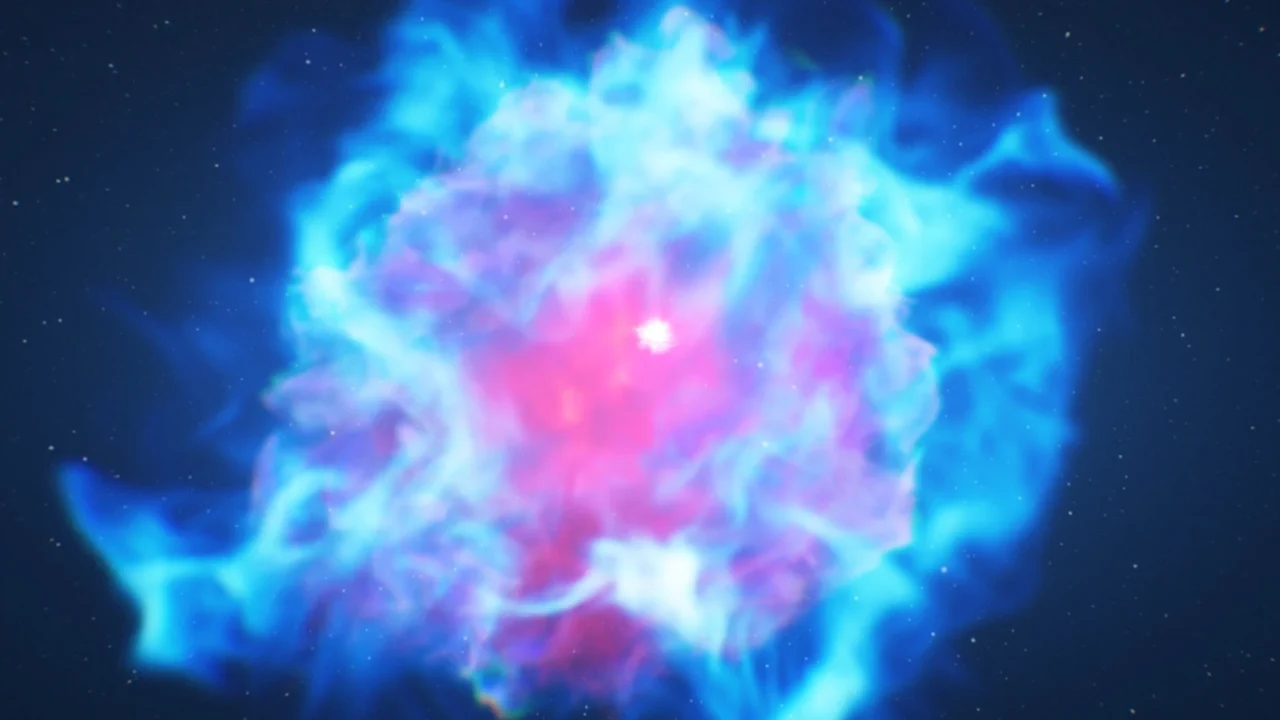
NASA’s Fermi Gamma-ray Space Telescope has detected gamma-ray emissions from an exceptionally bright supernova, offering new insights into the energy source powering such rare cosmic explosions. The international research team identified the gamma rays originating from SN 2017egm, a superluminous supernova located approximately 440 million light-years away in the galaxy NGC 3191.
Superluminous supernovae produce at least ten times the visible light of typical core-collapse supernovae. These explosions occur when massive stars exhaust their nuclear fuel, collapse under gravity, and explode, often leaving behind a neutron star or black hole. Since 2000, astronomers have cataloged nearly 400 superluminous supernovae, though gamma-ray detection from these events has been elusive until now.
Lead researcher Fabio Acero from the French National Centre for Scientific Research (CNRS) and the University of Paris-Saclay highlighted that “for nearly 20 years, astronomers have searched Fermi data for gamma-ray signals from thousands of supernovae,” but only SN 2017egm provided definitive evidence. The team’s findings were published in the journal Astronomy & Astrophysics.
Magnetar as the Power Source
The study suggests that the exceptional brightness of SN 2017egm arises from a newly formed magnetar—a neutron star with an extremely strong magnetic field, up to 1,000 times stronger than typical neutron stars. These magnetars spin several hundred times per second, emitting a powerful wind of electrons and positrons. Inside this “magnetar wind nebula,” interactions produce gamma rays that initially cannot escape, instead converting to lower-energy light that brightens the supernova.
Research co-authors Indrek Vurm and Brian Metzger modeled how these processes evolve as the supernova’s debris expands and cools. About three months post-explosion, gamma rays start leaking out, matching the observed timeline in SN 2017egm. However, the model shows discrepancies at later stages when the visible light fades irregularly, indicating that additional mechanisms—such as fallback debris accreting onto the magnetar and interactions with pre-existing stellar matter—may also contribute.
Implications for Future Observations
The team evaluated the detection capabilities of the upcoming ground-based Cerenkov Telescope Array Observatory, estimating that similar superluminous supernovae could be observed in gamma rays up to 500 million light-years away with sufficient observation time.
Judy Racusin, deputy project scientist for the Fermi mission at NASA’s Goddard Space Flight Center, emphasized that detecting gamma rays from supernovae opens a new avenue to study their internal mechanisms. Coupled with NASA’s space observatories, future observations will enhance understanding of these extraordinary cosmic phenomena.
Background
Core-collapse supernovae result from the death of stars much more massive than the Sun. The collapse triggers an explosion that expels stellar material, creating a rapidly expanding cloud of ionized gas. Occasionally, the resulting neutron star’s magnetic field becomes extraordinarily intense, forming a magnetar, whose energetic emissions can power the supernova’s extreme luminosity. Until this study, no definitive detection of gamma rays associated with these superluminous events had been confirmed by Fermi despite extensive searches.
Sources
This article is based on reporting and publicly available information from the following source:
Read more Space & NASA stories on Goka World News.