
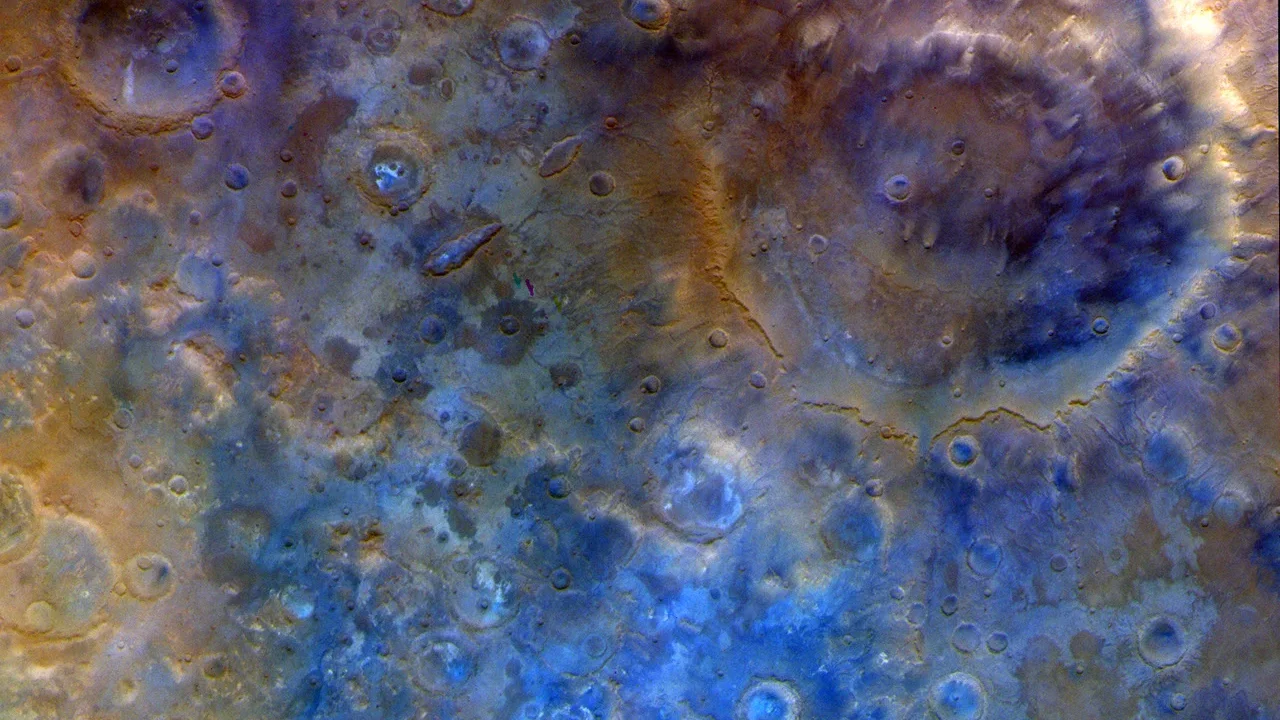
NASA’s Psyche mission has captured detailed, enhanced-color images of Huygens crater on Mars, shedding new light on the planet’s southern highlands. The images were taken with Psyche’s multispectral imager, which recorded data in red, green, and blue wavelengths to reveal surface composition differences not visible to the naked eye.
Huygens crater, visible in the upper right of the image, spans approximately 290 miles (470 kilometers) in diameter. It is characterized by a distinctive double-ring structure situated near 15 degrees south latitude within heavily cratered ancient terrain. The color variations seen in the image are attributed to differences in the dust, sand, and bedrock composition of the region.
The image was acquired on May 15, 2026, at about 1:18 p.m. PDT, shortly after Psyche’s closest approach to Mars. The resolution of the image is approximately 2,200 feet (670 meters) per pixel, allowing for detailed study of geological features across the surface.
This enhanced-color imagery is part of Psyche’s broader scientific objectives to understand the composition and history of planetary bodies. By analyzing the mineral and surface variations on Mars, researchers hope to gain insights into the processes that shaped the planet’s geological evolution.
Background
Launched to explore the metallic asteroid Psyche, the NASA mission also conducts flybys of Mars to gather data using its onboard instruments. Psyche’s multispectral imager is designed to capture a range of wavelengths that help scientists identify the mineral makeup and surface properties of celestial bodies.
This Mars flyby, including the imaging of Huygens crater, provides valuable comparative data for understanding both rocky and metallic worlds in our solar system. Mars’ southern highlands represent some of the oldest surfaces on the planet, making them critical to studying Mars’ ancient history.
For additional information about the Psyche mission and its objectives, visit NASA’s official science page at https://science.nasa.gov/mission/psyche/.
Sources
This article is based on reporting and publicly available information from the following source:
Read more Space & NASA stories on Goka World News.