
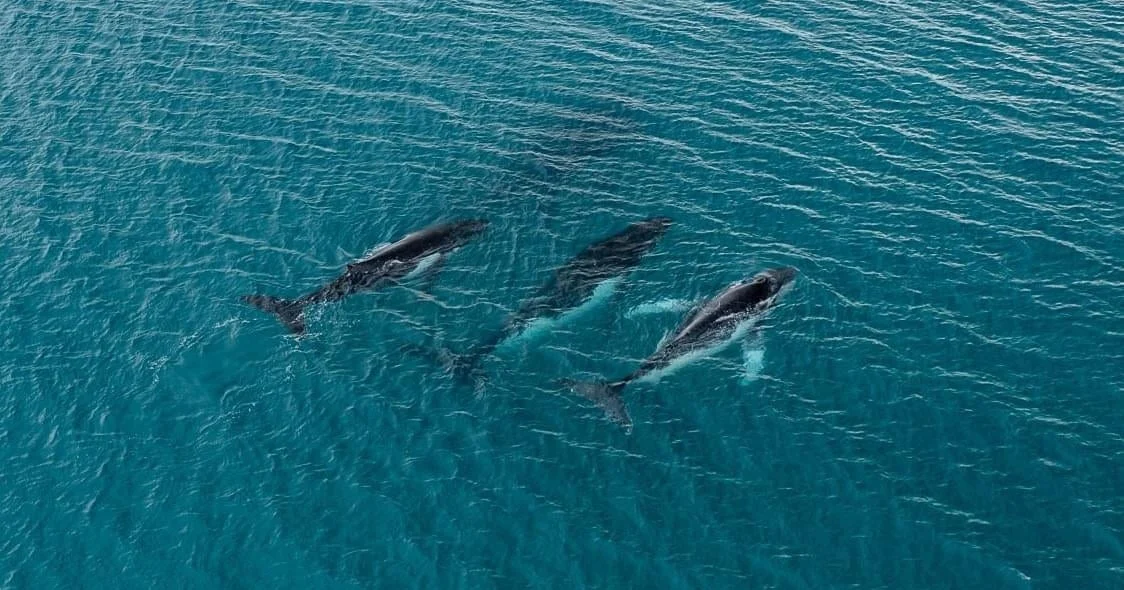
Two humpback whales have been documented making record-breaking migrations between the eastern coast of Australia and breeding grounds off Brazil, traveling distances of approximately 8,823 and 9,383 miles, according to a study published on May 20 in the journal Royal Society Open Science.
Scientists analyzed nearly 20,000 photographs taken from 1984 to 2025, contributed by both professional and citizen researchers. Using an automated image-recognition system to identify individual whales by the unique patterns on their tails, the team confirmed that these two whales had been sighted on both sides of the globe—an extraordinary and previously unrecorded behavior for their species.
One whale was first photographed in Queensland in 2007 and then identified near São Paulo, Brazil, in 2019. The other was spotted off the coast of Bahia, Brazil, before reappearing 22 years later in Hervey Bay, Australia.
Significance for Whale Populations
Stephanie Stack, a PhD researcher at Griffith University and co-author of the study, noted that such rare long-distance movements are important for the genetic health of humpback populations. They help maintain genetic diversity by connecting distant breeding groups. Additionally, these whales may facilitate the cultural transmission of song patterns across ocean basins, similar to how musical trends spread among human populations.
Dr. Cristina Castro of the Pacific Whale Foundation highlighted the role of citizen science in this discovery, emphasizing the value of public contributions to advancing knowledge about whale biology and migration.
Implications for Migration Patterns and Climate
The research supports the “Southern Ocean Exchange” hypothesis, which proposes that humpbacks sometimes travel to Antarctic feeding grounds and then return to entirely different breeding sites. Changes in the Southern Ocean, such as shifting sea ice patterns and the movement of krill populations due to climate change, may be encouraging these unusual migratory routes.
Background
Humpback whales, which can reach lengths of up to 55 feet, were severely impacted by commercial whaling in the 20th century. The U.S. listed them as endangered during the 1970s, and a global moratorium on commercial whaling was established in 1985. Although their populations have rebounded, four distinct segments remain endangered, and one is considered threatened, according to the National Oceanic and Atmospheric Administration (NOAA).
Sources
This article is based on reporting and publicly available information from the following source:
Read more Science Discoveries stories on Goka World News.