
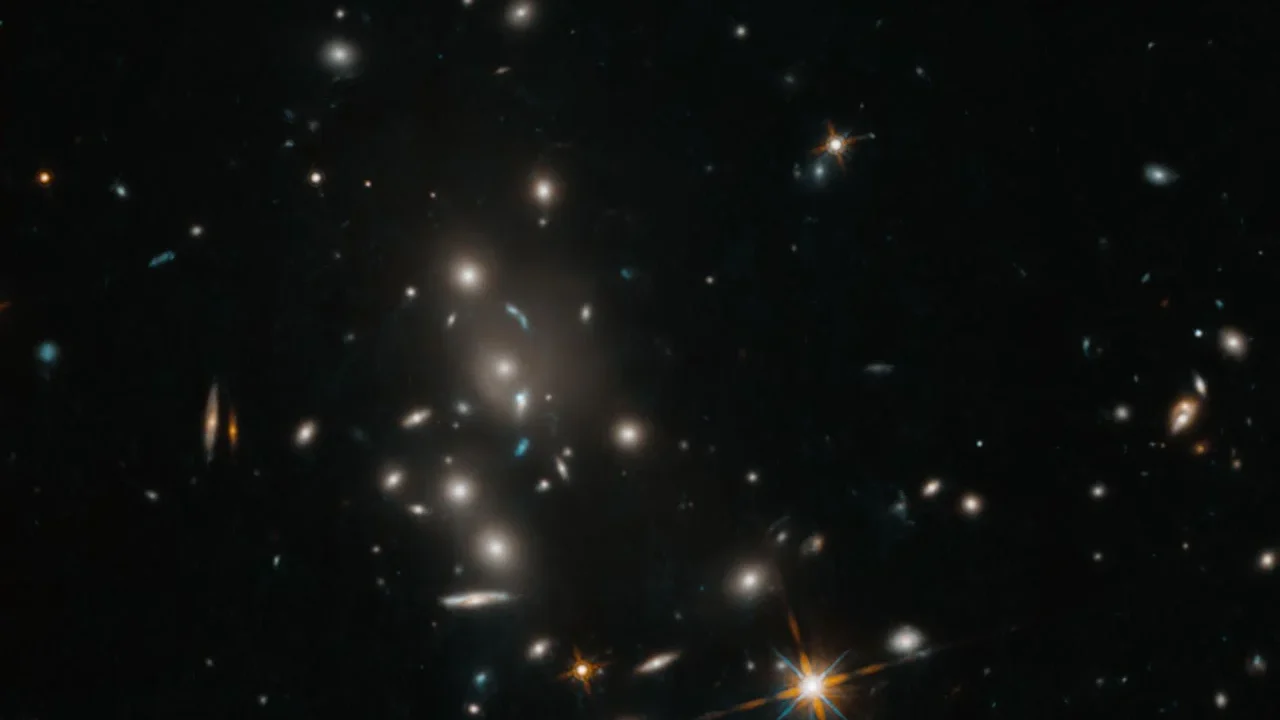
NASA’s Hubble Space Telescope has produced a detailed image of the galaxy cluster MACS J1141.6-1905, situated roughly four billion light-years from Earth in the constellation Crater. The image combines visible and infrared light observations, revealing galaxies of various shapes and sizes gathered near the cluster’s center-left.
The bright points of light identified in the image include several foreground stars, distinguishable by their diffraction spikes—patterns caused by light bending around supports for Hubble’s secondary mirror. These spikes help astronomers differentiate stars from the more diffuse light of distant galaxies.
This image was created using data from two separate Hubble observing programs targeting massive galaxy clusters known for their intense X-ray emissions. Both programs aimed to find distant galaxies amplified by gravitational lensing caused by the cluster’s immense gravity. They also sought to better understand the physical interactions occurring at the cores of these clusters.
Adding these observations to Hubble’s archive enriches a treasure trove of over 1.7 million observations collected since the telescope’s launch in 1990. This extensive archive allows astronomers to revisit historical data with new analysis techniques, often leading to fresh discoveries about the universe’s structure and evolution.
Why it matters
The study of galaxy clusters like MACS J1141.6-1905 provides critical insights into the large-scale structure of the universe and the distribution of dark matter. Gravitational lensing observed in these clusters acts as a natural telescope, enabling the study of galaxies that would otherwise be too faint or distant to observe. These observations contribute to understanding cosmic evolution and the forces shaping galaxy formation.
Background
Since its deployment in 1990, the Hubble Space Telescope has been pivotal in transforming astrophysics by capturing high-resolution images across multiple wavelengths. Its ability to observe in both visible and infrared light allows astronomers to peer through cosmic dust and explore distant objects that are redshifted due to the universe’s expansion. These capabilities have made Hubble an essential tool in mapping galaxy clusters and studying phenomena like gravitational lensing and X-ray emission from hot intracluster gas.
Sources
This article is based on reporting and publicly available information from the following source:
Read more Space & NASA stories on Goka World News.