
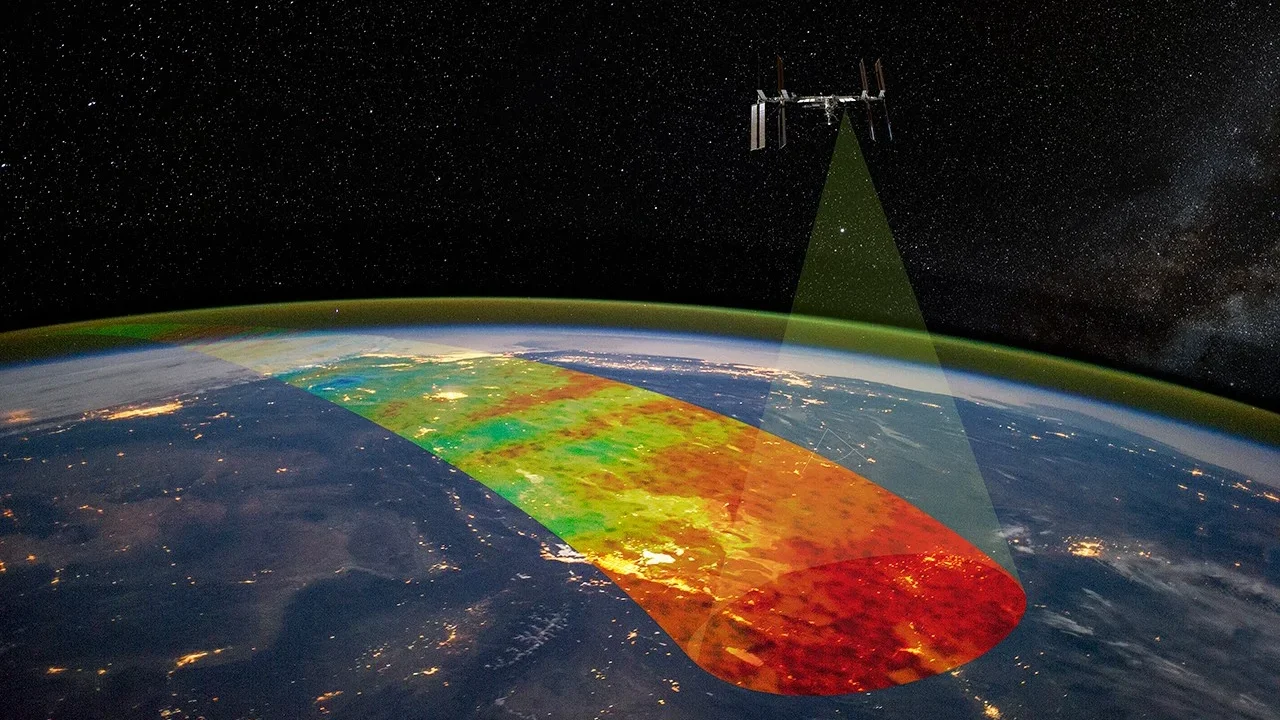
NASA has concluded its Atmospheric Waves Experiment (AWE) mission aboard the International Space Station (ISS), successfully surpassing its planned two-year operation by collecting detailed observations of atmospheric gravity waves and their influence on space weather.
Since its installation in November 2023, the AWE instrument monitored giant ripples in Earth’s atmosphere known as atmospheric gravity waves. These waves form when strong winds pass over mountain ranges or intense weather events such as tornadoes, thunderstorms, and hurricanes.
AWE captured these waves by measuring airglow—colorful bands of light in the upper atmosphere—primarily during nighttime, collecting more than 80 million infrared images over its 30-month mission. The instrument recorded four images per second from its vantage point on the ISS.
Mapping Weather’s Ripple Effect into Space
The mission provided unprecedented insight into how terrestrial weather phenomena propagate ripples upward, influencing space weather conditions that can disrupt satellite operations, navigation, and communication systems.
For instance, AWE documented atmospheric gravity waves from extreme events such as the May 2024 tornado outbreak in the central United States and Hurricane Helene’s impact on Florida’s Gulf Coast. The data revealed variations in wave characteristics depending on storm type, showing smaller, irregular waves with asymmetries during a specific Texas thunderstorm compared to other storms.
Understanding the behavior of atmospheric gravity waves is critical because they induce fluctuations in plasma density—the electrically charged gas in the upper atmosphere—which can interfere with radio signal transmissions between satellites and Earth.
A recent AWE study identified that waves with the greatest effect on the upper atmosphere have horizontal wavelengths between 30 to 300 kilometers, a range the instrument was designed to measure with precision.
Transition to New Research and Data Availability
With data collection complete, NASA powered down the AWE instrument on May 21, 2025, to make room for the CLARREO Pathfinder, a new instrument set to measure sunlight reflected from Earth and the Moon with significantly improved accuracy.
The ISS robotic arm Canadarm2 will remove AWE from its external mounting, and the instrument will be returned to Earth aboard a SpaceX Dragon cargo spacecraft, which will burn up upon re-entry.
All AWE data will remain publicly accessible for scientific research and citizen science projects. Utah State University’s Space Dynamics Laboratory, which built and managed AWE’s operations, already offers interactive visualizations online showing atmospheric gravity waves mapped in real time as the ISS orbits Earth.
Background
The AWE mission was funded by NASA’s Heliophysics Division and managed by the Explorers Program Office at NASA’s Goddard Space Flight Center. Its goal was to deepen understanding of how Earth’s lower atmosphere interacts with and influences space weather.
Joe Westlake, director of NASA’s Heliophysics Division, described the atmosphere as a “living, breathing ocean in the sky,” highlighting how weather events send ripples into space, shaping conditions that affect satellites and the orbital economy.
Sources
This article is based on reporting and publicly available information from the following source:
Read more Space & NASA stories on Goka World News.