
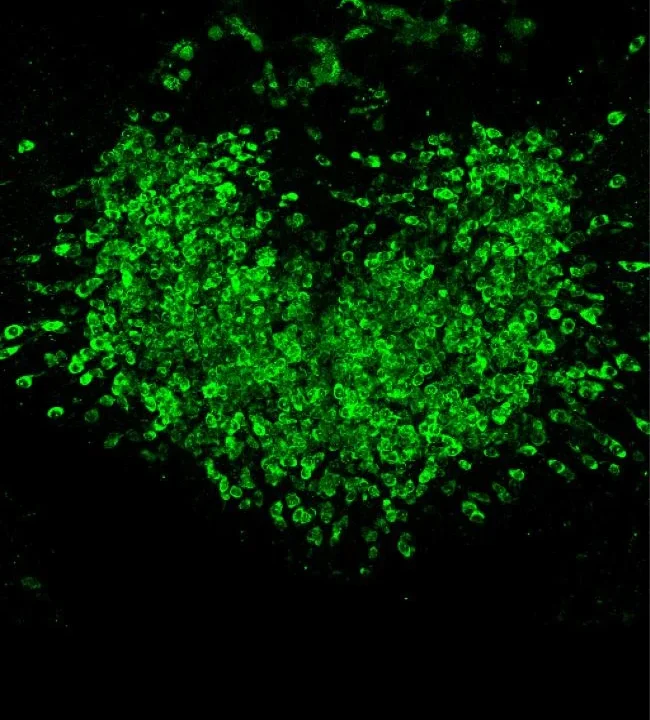
A team of scientists at the National Institutes of Health (NIH) has uncovered key intracellular processes in brain neurons that mediate the weight-loss effects of glucagon-like peptide-1 (GLP-1) receptor agonists, specifically the drug semaglutide. Their findings provide new insight into how GLP-1–based medications operate at the cellular level and suggest potential strategies to improve their long-term effectiveness.
The study, conducted in mice, focused on semaglutide’s impact on intracellular signaling molecules within the area postrema—a brain region implicated in appetite regulation. Using fluorescence imaging techniques on live brain tissue, researchers observed that semaglutide elevated levels of cyclic adenosine monophosphate (cAMP), a key signaling molecule, in neurons expressing GLP-1 receptors.
“We know much less about the nuts and bolts of what goes on within the neurons that these medications target. By digging into these mechanisms, we’re beginning to answer some of these questions,” said Andrew Lutas, Ph.D., co-corresponding author and investigator at NIH’s National Institute of Diabetes and Digestive and Kidney Diseases (NIDDK).
Though cAMP levels increased overall, the response varied considerably among individual neurons. Some maintained sustained cAMP elevations when exposed to semaglutide, while others showed only transient boosts, likely due to the internalization or degradation of GLP-1 receptors on those cells, researchers explained.
Importantly, the team demonstrated that inhibiting phosphodiesterase 4 (PDE4)—an enzyme responsible for breaking down cAMP—using the drug roflumilast enhanced the duration of cAMP signaling. This suggests that combining PDE4 inhibitors with GLP-1 receptor agonists might prolong or intensify the weight-loss effects, potentially reducing dosing frequency and addressing the common problem of treatment plateaus.
Michael Krashes, Ph.D., senior investigator at NIDDK, emphasized the variability in neuronal responses, saying, “It was not an all or nothing phenomenon. We observed that cAMP responses across cells varied on a continuum.”
The researchers caution that their methods allowed examination of intracellular signaling over only a few hours in ex vivo brain samples. Future studies are planned to explore long-term intracellular dynamics of GLP-1 drugs and to verify whether modulating cAMP can reliably extend therapeutic benefits.
Why it matters
GLP-1 receptor agonists such as semaglutide have become widely used for weight management and type 2 diabetes, but patient responses vary and weight-loss effects often plateau over time. Understanding the intracellular mechanisms in specific brain regions opens new avenues for enhancing drug efficacy and durability. The possibility of extending the drug’s effects through co-treatment with PDE4 inhibitors could improve clinical outcomes and reduce treatment burdens.
Background
GLP-1 receptor agonists work by activating brain pathways involved in appetite and metabolism, leading to reduced food intake and weight loss. While the brain regions affected by these drugs are well characterized, the intracellular signaling events within individual neurons have been largely unexplored until now. This study addresses that gap, focusing on the area postrema, a critical gateway for appetite-regulating signals.
The National Institute of Diabetes and Digestive and Kidney Diseases (NIDDK), part of NIH, supports research on metabolism, obesity, and related diseases, aiming to uncover the biological basis and potential treatments for these conditions.
Reference: Claire Gao et al., “Semaglutide drives weight loss through cAMP-dependent mechanisms in GLP1R-1 expressing hindbrain neurons,” Nature Metabolism, 2026. DOI: https://www.nature.com/articles/s42255-026-01534-8
Sources
This article is based on reporting and publicly available information from the following source:
Read more Science Discoveries stories on Goka World News.