
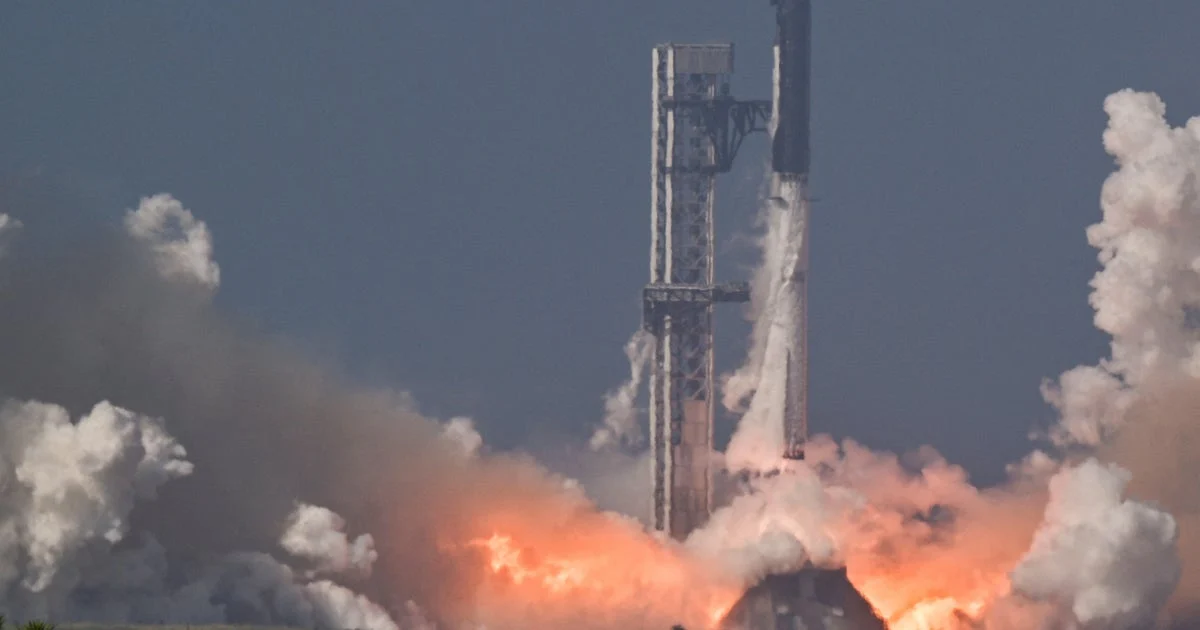
SpaceX conducted a test flight of its upgraded Super Heavy-Starship rocket on May 22, 2026, aiming to assess more powerful engines, improved control systems, and other enhancements designed to boost reliability and operational safety. The launch took place from a newly built, reinforced pad at the company’s Starbase facility on the Texas Gulf Coast.
The Super Heavy first stage features 33 methane-fueled Raptor 3 engines, which deliver up to 18 million pounds of thrust—about twice the liftoff power of NASA’s Space Launch System (SLS) moon rocket. During the flight, one of these Raptor engines shut down early while climbing out of the lower atmosphere. Additionally, multiple engines on the booster stage failed to ignite properly during the return-to-splashdown attempt, preventing it from reaching its planned recovery zone off the Texas coast.
The Starship upper stage, equipped with six third-generation Raptor engines—three optimized for vacuum operation—also encountered engine issues. One vacuum-optimized engine shut down prematurely during ascent. Despite this, the onboard flight computer extended the burn time of the remaining engines, enabling the upper stage to reach a satisfactory sub-orbital trajectory.
In space, the Starship deployed 22 Starlink internet satellite simulators from an improved dispenser, including two equipped with cameras that transmitted images of the vehicle during flight. The cameras are intended to help assess the condition of the spacecraft’s heat shield tiles in future missions.
Following separation, the Super Heavy booster flipped to return to the launch site but fell short of its splashdown target due to the engine malfunctions. The booster ultimately landed in the Gulf of Mexico but was not recovered.
The Starship upper stage completed a successful descent through the atmosphere, performing structural tests on its rear fins and executing a banking maneuver designed for future landing operations. It re-ignited two engines before flipping vertically for an on-target splashdown in the Indian Ocean. As expected, the vehicle then tipped over, broke apart, and exploded due to residual propellant ignition.
Despite engine issues, the Starship appeared to withstand the stresses of launch and re-entry well, showing less thermal damage than in previous test flights.
Why it matters
This test marks the first flight of SpaceX’s Version 3 Super Heavy-Starship, a critical step toward developing the world’s first fully reusable super heavy-lift rocket. The system is intended to support future missions launching large batches of next-generation Starlink satellites, government and commercial payloads, and ambitious crewed missions to the Moon and Mars.
NASA, which contracts SpaceX to develop a Starship variant as a lunar lander for the Artemis program, considers these tests vital. The agency plans to launch Artemis III astronauts to the lunar surface by 2028, partially relying on SpaceX’s lander to safely transport astronauts from lunar orbit to the surface.
Moreover, the new Texas launch pad is designed to endure the increased demands of rapid turnaround launches, signaling SpaceX’s intention to ramp up flight cadence. Achieving reliable engine performance and booster recovery remain key challenges before the rocket becomes operational for orbital and deep-space missions.
Background
Super Heavy serves as the first stage booster that propels the Starship upper stage into orbit. The combined launch vehicle stands 407 feet tall, making it the tallest and most powerful rocket attempted to date.
Previous test flights have demonstrated the vehicle’s basic flight capabilities but have experienced a range of technical issues, including engine failures and recovery difficulties.
SpaceX continues iterative testing to address these challenges, with orbital refueling tests planned before the end of 2026. Successful in-orbit refueling is necessary to extend Starship’s range for missions to the Moon, Mars, and beyond.
Sources
This article is based on reporting and publicly available information from the following source:
Read more Space & NASA stories on Goka World News.