
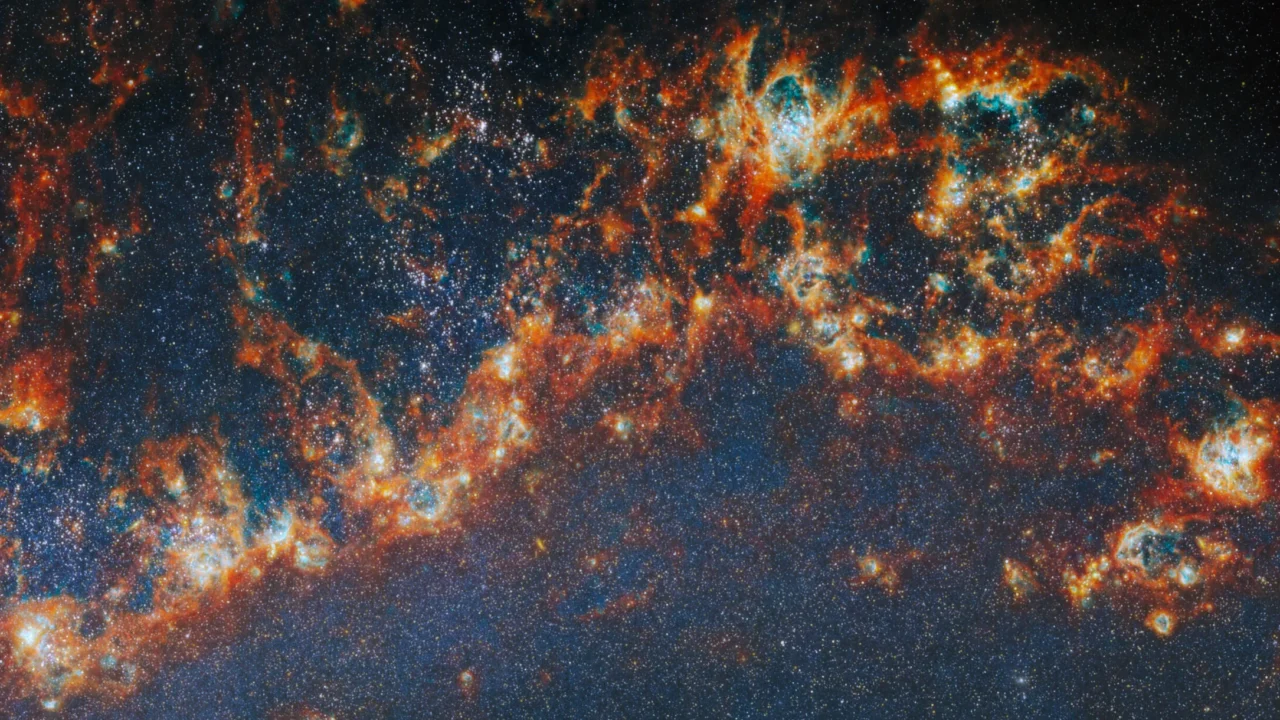
NASA’s James Webb Space Telescope has provided new insights into star cluster formation in the nearby spiral galaxy Messier 51 (M51). A recent study analyzing nearly 9,000 star clusters using Webb’s near-infrared imaging found that more massive clusters emerge from their natal gas clouds more rapidly than smaller clusters.
The observations focused on a section of one of M51’s spiral arms and were conducted in collaboration with the European Space Agency (ESA), the Canadian Space Agency (CSA), and research teams including Stockholm University’s astrophysicists A. Pedrini and A. Adamo, as part of the FEAST JWST program.
By studying star clusters on such a large scale, scientists aim to understand key processes involved in star formation, which in turn informs knowledge about galactic evolution and dynamics. Understanding how star clusters evolve and disperse their birth clouds sheds light on where and how planets might form within galaxies.
Why it matters
The rapid emergence of massive star clusters affects the surrounding interstellar medium and galaxy structure by influencing gas dynamics and triggering further star formation. These findings contribute to models that describe galaxy development over cosmic time and improve predictions about the environments where planetary systems arise.
Background
Messier 51, also known as the Whirlpool Galaxy, is one of the most studied nearby galaxies because of its prominent spiral structure and active star formation regions. Using Webb’s advanced near-infrared imaging, researchers can penetrate dust clouds that obscure star formation in visible wavelengths, allowing a clearer view of cluster evolution. The FEAST JWST team is focused on mapping star formation across multiple galaxies to deepen understanding of stellar and planetary origins.
Sources
This article is based on reporting and publicly available information from the following source:
Read more Space & NASA stories on Goka World News.