
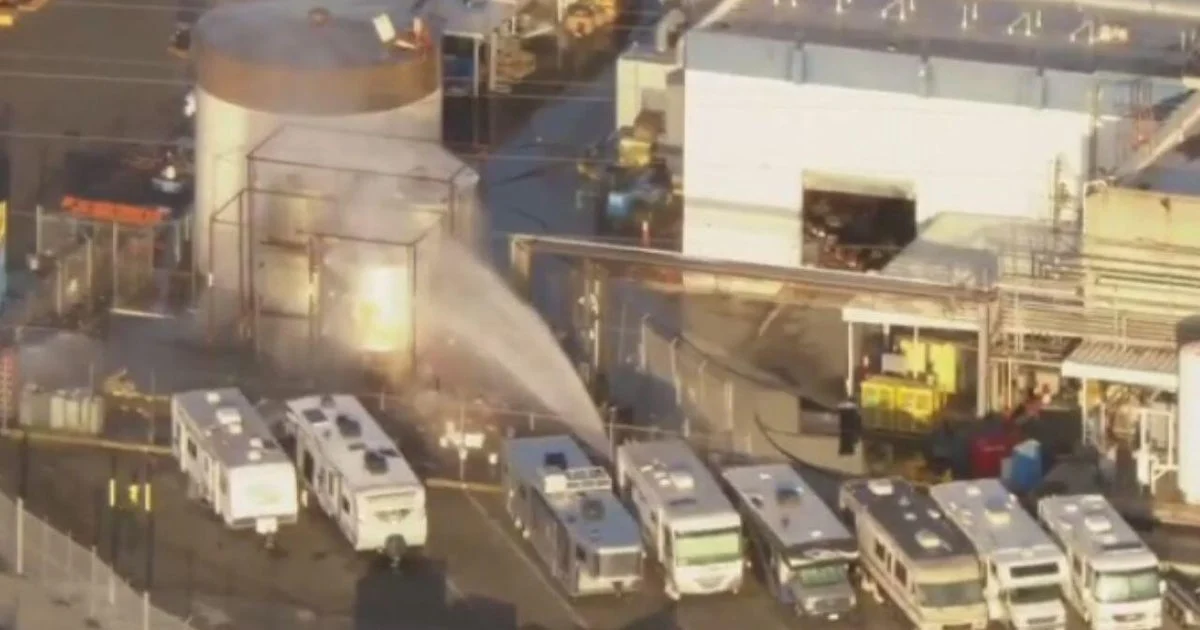
Firefighters in Orange County, California, conducted an overnight operation to test the pressure inside a cracked tank leaking hazardous chemicals, as more than 50,000 residents remained evacuated amid fears of a potential explosion.
What happened
The Orange County Fire Authority (OCFA) worked through Sunday night to assess a cracked tank at GKN Aerospace in Garden Grove leaking approximately 7,000 gallons of methyl methacrylate, a flammable chemical with toxic vapor. The fire authority’s interim chief, TJ McGovern, described the operation as essential to determining whether the “Boiling Liquid Expanding Vapor Explosion” (BLEVE) threat was mitigated.
During the operation, crews aimed to establish if pressure was being safely released by the crack or if vapor was building dangerously within the tank. Early findings showed the tank’s internal temperature exceeded 100 degrees Fahrenheit, more than twice the safe threshold for the chemical. Officials confirmed one known crack on the tank; previous reports of multiple cracks were clarified as peeling weather stripping due to cooling efforts with hose streams.
Orange County Fire Captain Brian Yau emphasized the high risk of the operation, noting that careful, methodical work by hazmat teams and experts was required. OCFA Incident Commander Craig Covey outlined two possible worst-case scenarios: a chemical spill if the tank ruptured or a thermal runaway explosion affecting adjacent tanks.
Meanwhile, California Governor Gavin Newsom requested a federal Emergency Declaration from President Trump to expedite federal assistance and funding. Over 785 state and first responders had been deployed to support local efforts by Sunday. U.S. senators and local representatives urged swift federal approval for additional aid.
In response to the incident, Orange County District Attorney Todd Spitzer launched an investigation into the tank failure, calling on whistleblowers from the company to come forward. A class-action lawsuit against GKN Aerospace was also filed by law firms representing evacuated residents concerned about health risks.
Why it matters
The chemical leak poses significant public safety and environmental hazards due to the flammable and toxic nature of methyl methacrylate vapor. The ongoing risk of a BLEVE explosion threatens the evacuated communities, making the safety of the tank and containment efforts critical. The large evacuation reflects the scale and severity of the threat. Federal assistance and legal scrutiny underscore the gravity of the incident and the demand for accountability.
Background
Methyl methacrylate is a chemical used in manufacturing plastics and epoxies, notable for its self-heating properties and low boiling point, which can lead to uncontrollable reactions and explosions if leaked and ignited. Previous safety inspections and emergency responses have focused on preventing such catastrophic events. The leak at GKN Aerospace has persisted for several days, prompting initial evacuation orders on Thursday night and escalating emergency response as conditions worsened. The state’s rapid deployment and request for federal support reflect heightened concern for managing complex hazardous material incidents.
Sources
This article is based on reporting and publicly available information from the following source:
Read more US News stories on Goka World News.