
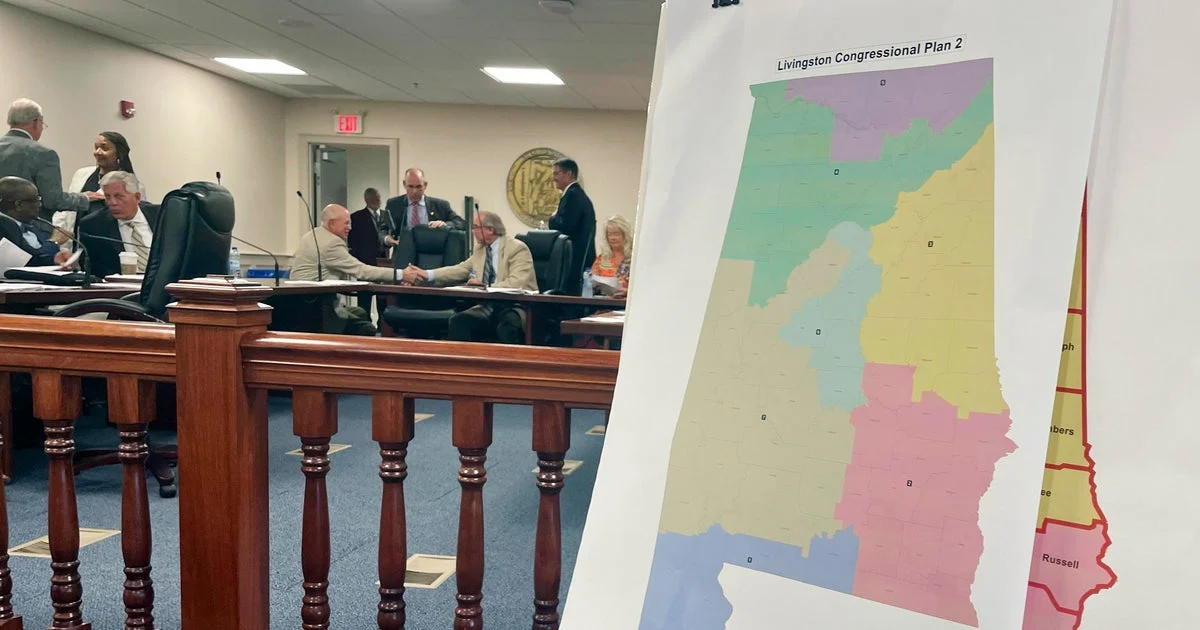
A federal district court on Tuesday temporarily blocked Alabama from using a congressional map adopted by the state legislature in 2023 for the upcoming 2026 midterm elections, ruling the plan is racially discriminatory. The court ordered Alabama to continue using a court-selected map featuring two majority-Black districts, the same lines used in the 2024 elections.
What happened
The three-judge federal panel found that Alabama’s Republican-led legislature intentionally discriminated on the basis of race by adopting a map with only one majority-Black district. The court determined this violated the Equal Protection Clause of the 14th Amendment. Circuit Judge Stanley Marcus and District Judges Anna Manasco and Terry Moorer wrote that the state’s redistricting plan diluted Black voters’ influence by distributing them across districts “at least in part because they were Black.”
The state had argued the map was drawn for political, not racial, reasons, but the court rejected this claim. It gave lawmakers a chance to propose a new map for the 2026 elections, but until then, elections must proceed under the court-drawn plan. Alabama Governor Kay Ivey had already scheduled a special primary under the new map for August 11 in four affected districts. Primaries in unaffected districts took place the week before.
The ruling follows the Supreme Court’s recent decision weakening protections under the Voting Rights Act, which prompted several Southern states, including Alabama, to attempt redrawing districts to benefit Republicans. Alabama’s delegation currently includes five Republicans and two Democrats. The GOP aimed to flip a Democratic seat held by Representative Shomari Figures using the 2023 map.
Why it matters
The decision is significant because it affirms that race-based gerrymandering remains unconstitutional despite recent Supreme Court rulings weakening the Voting Rights Act. It protects Black voters’ ability to elect candidates of their choice, a critical issue in Alabama and across the country. The ruling also prevents Alabama from implementing a map designed to diminish the political power of Black communities ahead of key elections.
This case highlights ongoing tensions between judicial oversight and state legislatures’ authority over redistricting, especially as courts navigate the implications of recent Supreme Court decisions on voting rights and racial discrimination.
Background
Alabama’s congressional districts were initially redrawn after the 2020 Census. The 2021 map was challenged under Section 2 of the Voting Rights Act for likely diluting Black voters. In response, the state legislature adopted a revised 2023 map creating a single majority-Black district, down from two. Federal courts blocked that plan from use in recent elections, imposing a court-drawn map that restored two majority-Black districts.
Last month, the Supreme Court’s ruling in a Louisiana voting rights case undermined a key Voting Rights Act provision, prompting Alabama and other states to attempt redistricting efforts favoring Republicans. The decision in Alabama’s case ordered a return to judicially approved district maps pending lawful redistricting efforts.
Sources
This article is based on reporting and publicly available information from the following source:
Read more Politics stories on Goka World News.