
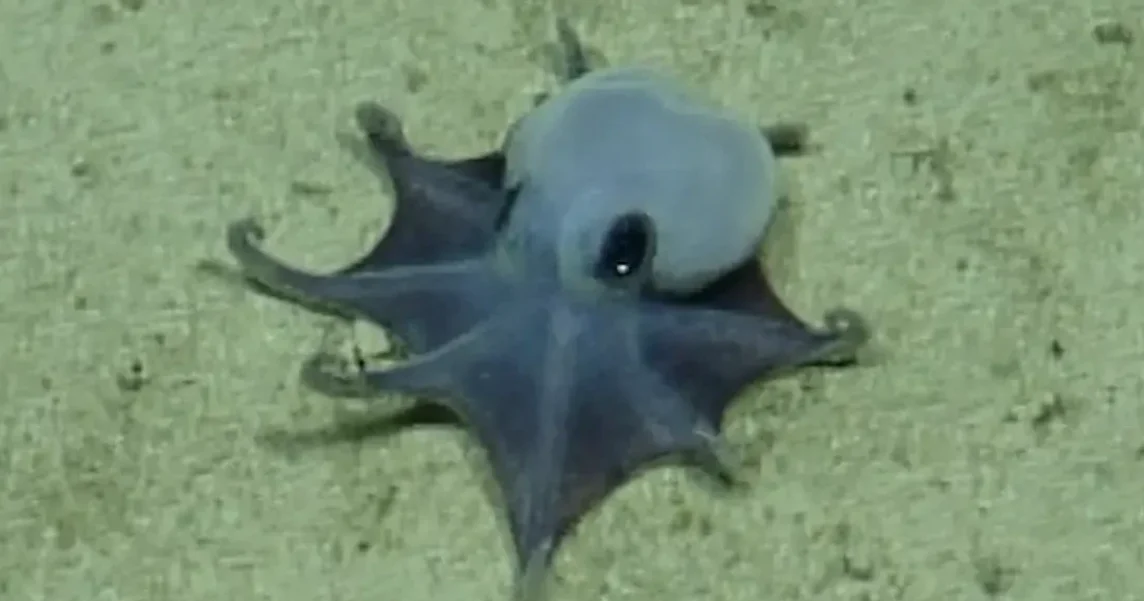
Scientists from the Charles Darwin Foundation have discovered a previously unknown octopus species, Microeledone galapagensis, nearly 6,000 feet below the ocean surface near the Galapagos Islands. This tiny, strikingly blue cephalopod was found during a deep-sea expedition and represents a rare addition to the ocean’s biodiversity.
What happened
The new octopus species was first sighted by a submersible near Darwin Island, part of the Galapagos archipelago. Initial excitement among researchers came from its vibrant blue color and small size, which allowed it to curl into the palm of a scientist’s hand. The discovery was confirmed with photographic evidence and a preserved specimen sent to the Field Museum of Natural History in Chicago.
Octopus expert Janet Voight led the species identification using non-invasive CT scans rather than traditional dissection to preserve the single valuable specimen. The scans produced detailed 3D images, revealing internal anatomy distinct from known relatives. Unlike most octopuses, Microeledone galapagensis features stubby arms with a single row of suckers and smooth skin, adaptations distinguishing it within its family, Megaleledonidae.
Along with its light blue dorsal coloration, the octopus has a deep purple underside. Researchers believe this coloration provides camouflage and protection from predators by concealing bioluminescent prey it captures beneath its webbed arms.
Why it matters
This discovery enhances understanding of deep-sea life, a vast and largely unexplored part of Earth’s ecosystem. Finding new species like Microeledone galapagensis contributes to biodiversity knowledge and informs conservation efforts in the region. The unique characteristics of this octopus illustrate specialized evolutionary adaptations to life in extreme deep-ocean environments.
Since much of the ocean floor remains uncharted, discoveries such as this emphasize the importance of continued marine exploration and study. These insights have potential implications for understanding species resilience to environmental changes.
Background
The Galapagos Islands have long been a hotspot for scientific discovery and evolutionary research, dating back to Charles Darwin’s 19th-century expeditions. Deep-sea species remain underrepresented due to the challenges of exploration at great depths.
Voight’s discovery represents her first new octopus species described after four decades studying cephalopod evolution. Recent years have seen several new octopus species identified in the Pacific, including four species off Costa Rica in 2024, highlighting the deep sea as a frontier for biological discoveries.
Sources
This article is based on reporting and publicly available information from the following source:
Read more Science Discoveries stories on Goka World News.