
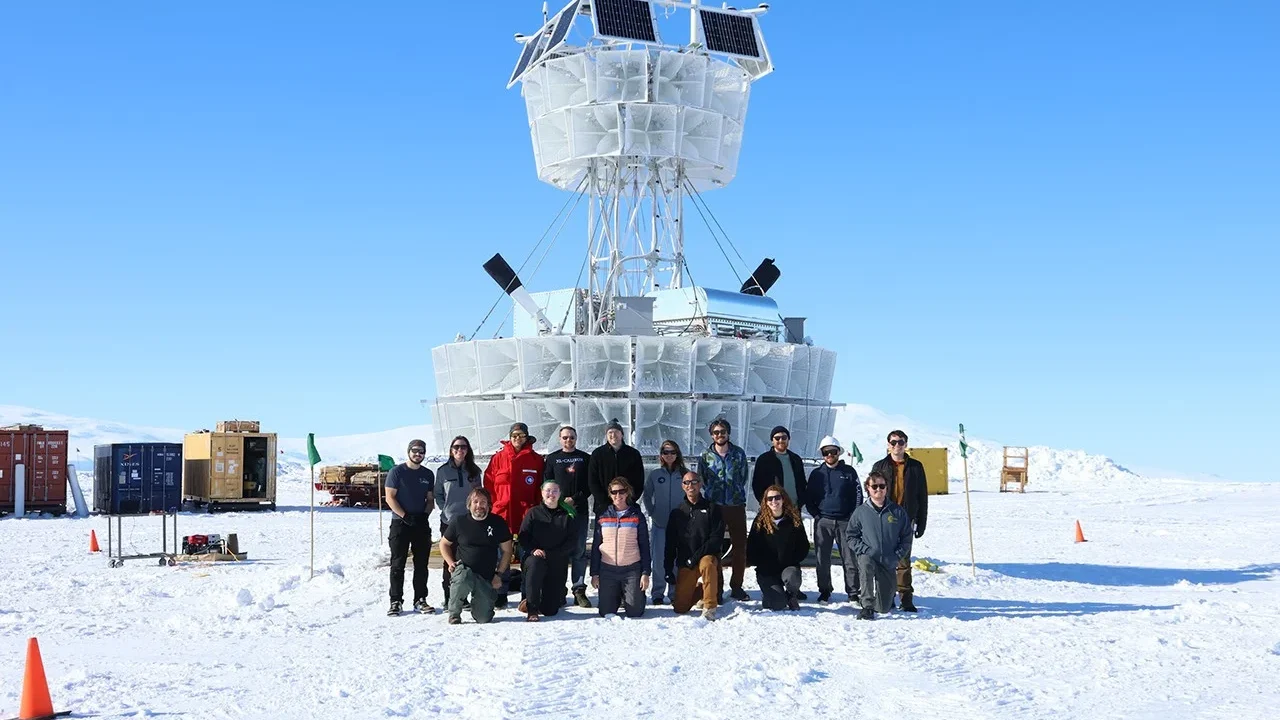
NASA’s Payload for Ultrahigh Energy Observations (PUEO) mission successfully flew a long-duration balloon over Antarctica to detect ultra-high energy neutrinos and cosmic rays. Using the Antarctic ice sheet as a vast detection medium, PUEO searched for faint radio signals generated by these energetic particles interacting with the ice.
What happened
PUEO launched on December 20, 2025, from NASA’s Long Duration Balloon Facility near McMurdo Station, Antarctica, flying at an altitude of about 120,000 feet for 23 days. The mission monitored a large volume of Antarctic ice for radio emissions resulting from ultra-high energy neutrino interactions and cosmic-ray-induced extensive air showers. After completing its flight, the payload was recovered along with all data storage devices. Analysis of the collected data is ongoing and may take up to a year.
The PUEO instrument features significant technological advancements over its predecessor, the Antarctic Impulsive Transient Antenna (ANITA), which conducted four Antarctic flights between 2006 and 2016. Key improvements include a novel interferometric phased array trigger system that coherently sums signals from multiple antennas in real-time, lowering detection thresholds and increasing sensitivity. The antenna collection area for frequencies above 300 MHz was doubled, while a separate low-frequency instrument sensitive down to 50 MHz was deployed at float altitude to better capture air shower signals.
These design optimizations allowed PUEO to fit within the limited volume constraints of the balloon platform while enhancing its ability to detect weaker and rarer signals than prior experiments.
Why it matters
The ultra-high energy neutrinos targeted by PUEO originate from the most extreme cosmic phenomena, such as supermassive black holes, neutron star mergers, and cosmic accelerators that propel particles to immense energies. Because neutrinos traverse vast cosmic distances with minimal absorption, their detection provides unique insights into distant, energetic astrophysical sources. Additionally, studying these particles tests fundamental physics at energies unattainable by Earth-based accelerators.
Better understanding the origin and composition of cosmic rays and neutrinos advances astrophysics and particle physics, potentially unveiling new aspects of the universe’s most powerful events and mechanisms.
Background
PUEO builds on the legacy of ANITA, which pioneered balloon-borne radio detection of cosmic neutrinos by using the Antarctic ice sheet as a natural detector. The mission is part of NASA’s Astrophysics Pioneers Program, which supports innovative, high-impact investigations in astrophysics. The success of PUEO’s technological innovations may inform future missions, including concepts that use the lunar regolith to detect ultra-high energy cosmic rays via radio signals.
Project leadership is provided by Dr. Abigail Vieregg of the University of Chicago, with sponsorship from NASA’s Astrophysics Division Pioneers Program.
Sources
This article is based on reporting and publicly available information from the following source:
Read more Space & NASA stories on Goka World News.