
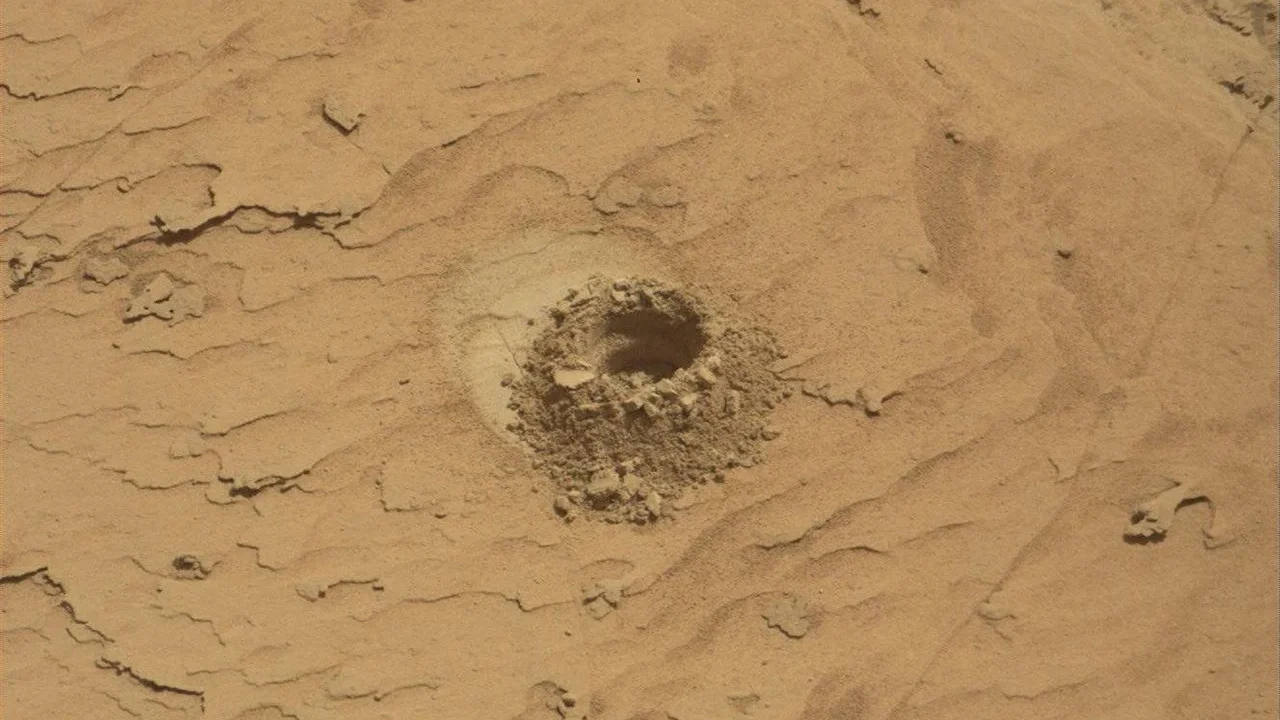
NASA’s Curiosity rover has successfully drilled and retrieved a rock sample from the Campo Marte site on Mars, marking an important milestone in its ongoing exploration of Martian geology and climate history.
What happened
After a previous drill attempt at the nearby Atacama block resulted in the unexpected entanglement of a rock fragment with the drill, the Curiosity team conducted thorough assessments and implemented mitigation strategies. The subsequent drilling at Campo Marte—selected for its favorable geological characteristics and larger size—was successful. Images transmitted to Earth showed Curiosity retracting its drill with collected rock powder, confirming the sample acquisition.
Following the drill, the team conducted standard tests by depositing small portions of the powdered sample onto the rover’s surface to ensure smooth delivery to the onboard analytical instruments—CheMin and SAM. These lab instruments can analyze tiny sample amounts (tens of milligrams) to yield detailed compositional data. Initial observations indicated that samples from Campo Marte resemble previously analyzed materials. One portion was delivered to CheMin for mineralogical study, guiding subsequent analysis with the Sample Analysis at Mars (SAM) instrument, which planned to use four additional sample portions.
The Curiosity drill penetrated 28 millimeters (1.1 inches) at Campo Marte, slightly shallower than its usual 35 millimeters. To evaluate remaining sample quantity, the missions team plans to repeat the powder drop test in upcoming plans.
Why it matters
Collecting and analyzing rock samples directly informs scientists about Mars’s geological composition, climatic conditions, and habitability potential. The successful drill at Campo Marte, following challenges at Atacama, demonstrates continued progress in operating complex hardware remotely under Martian conditions. The ability to analyze even small powder samples through onboard instruments like CheMin and SAM allows for precise characterization of Mars’s surface materials, advancing understanding of the planet’s past environments and potential for life.
Background
Curiosity has been exploring Mars since its landing in 2012 with the goal of assessing the planet’s habitability. It carries a suite of scientific instruments designed to analyze soil and rock samples to learn about Mars’s climate history and geological processes. Earlier drilling attempts, including the Atacama sample, have faced technical challenges, but the mission team adapts plans to optimize sample collection and scientific return.
Curiosity’s twin drill undergoes extensive testing on Earth, but actual performance on Mars is critical for adapting techniques to the unique environment of the Red Planet. The ongoing sample collection and analysis campaign contributes to NASA’s long-term objective of understanding Mars as a possible home for past life.
Sources
This article is based on reporting and publicly available information from the following source:
Read more Space & NASA stories on Goka World News.