
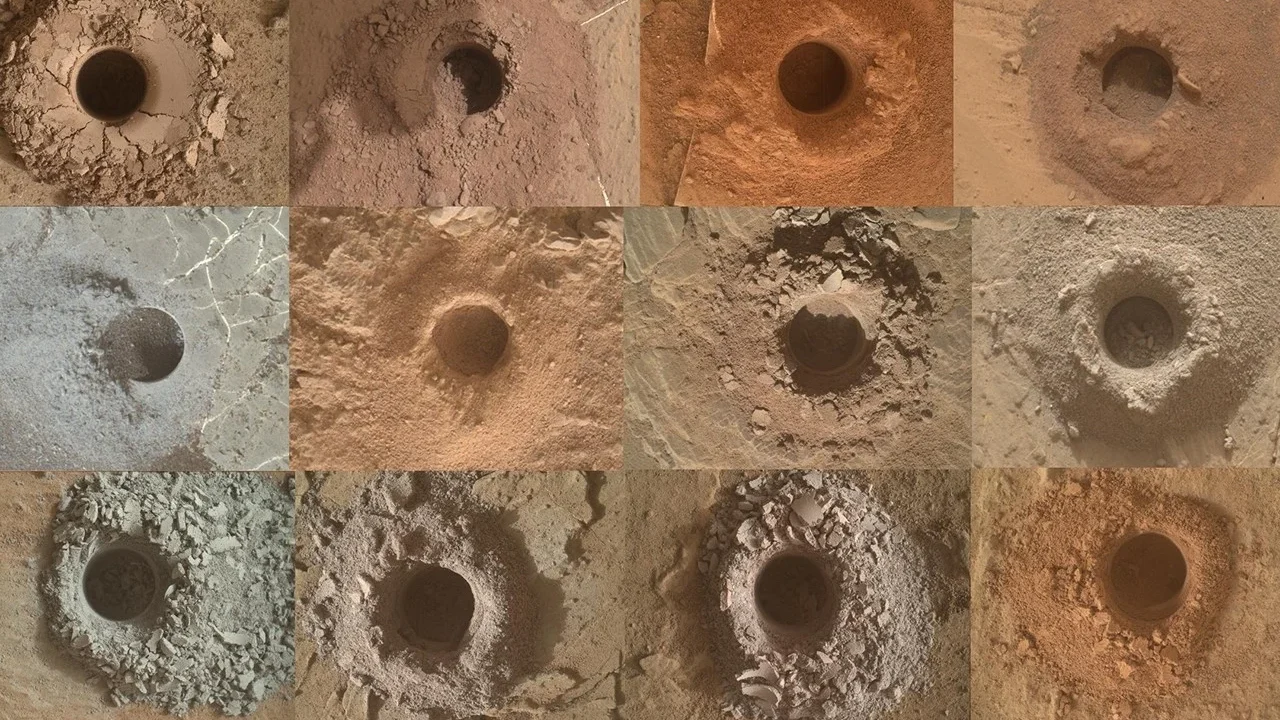
NASA’s Curiosity rover has identified hematite crystal structures as reliable markers for understanding environmental changes in ancient Mars. The findings reveal that warm, wet conditions persisted for millions of years in Gale Crater’s deep layers, suggesting a potentially habitable environment long after the planet’s climate began cooling.
What happened
Researchers analyzed 20 rock samples collected by Curiosity across various elevations within Gale Crater, using data from the rover’s Chemistry and Mineralogy (CheMin) instrument. The study, published in Science, shows that hematite crystallite sizes vary with elevation—larger crystallites were found in lower layers, while smaller ones dominated upper layers.
Additionally, the mineral goethite, which forms alongside hematite under certain conditions, was absent in lower elevations but present higher up. This pattern suggests that deep Gale Crater hosted warm, long-lasting groundwater aquifers for up to 4.7 million years, even as surface conditions became colder.
Scientists explained that under warmer, neutral to slightly alkaline water conditions, goethite converts to hematite, with larger hematite crystals forming over time through Ostwald ripening, where smaller crystals dissolve and promote growth of larger ones. The upper layers, by contrast, reflect colder and drier environments where water was more transient.
This analysis was made possible by the direct examination of Martian rock powders delivered by Curiosity’s robotic arm to CheMin, which performs X-ray diffraction to measure crystal size and structure with high precision.
Why it matters
Hematite crystallite size provides a novel, precise mineralogical marker for reconstructing Mars’ climatic history and the duration of habitable conditions. The discovery of prolonged warm groundwater in Gale Crater’s lower strata highlights that habitable environments existed under the surface even while Mars’ overall climate was deteriorating. This extends the timeline for potential microbial life in Martian history, guiding future exploration and astrobiology efforts.
Background
Curiosity, managed by NASA’s Jet Propulsion Laboratory and part of NASA’s Mars Exploration Program, has been exploring Gale Crater since 2012. The crater’s sedimentary layers offer a chronological record of Mars’ environmental evolution, from wetter conditions billions of years ago to drier, colder periods. The CheMin instrument, developed by NASA Ames Research Center, enables detailed mineralogical studies crucial for interpreting Mars’ geologic and climatic past directly from surface samples.
Sources
This article is based on reporting and publicly available information from the following source:
Read more Space & NASA stories on Goka World News.