
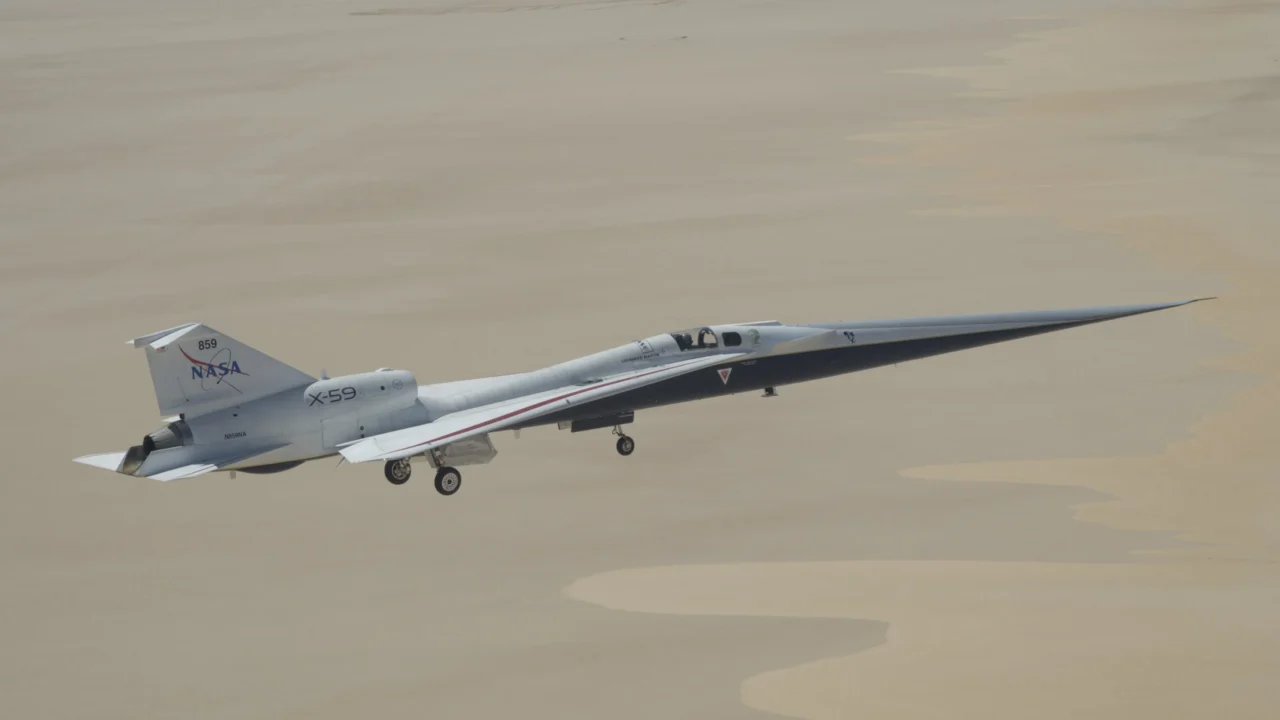
NASA’s X-59 quiet supersonic research aircraft is scheduled to conduct its first supersonic flight this June, advancing key test milestones toward demonstrating quiet supersonic technology for commercial aviation.
What happened
After completing an initial series of test flights since its first flight in October 2025, NASA’s X-59 is preparing to fly faster than the speed of sound for the first time at approximately 43,000 feet altitude. The aircraft is expected to exceed 630 mph (Mach 1) during a series of test flights in early June, followed by a “mission conditions” flight reaching Mach 1.4 (925 mph) at around 55,000 feet.
These speed and altitude targets align with NASA’s goals for the X-59 to fly over U.S. communities to demonstrate quiet supersonic flight, with the ultimate aim of collecting public feedback on the aircraft’s low-noise sonic “thump.” The early supersonic flights, however, will not focus on quiet sonic boom demonstrations as the X-59 will be accompanied by a conventional supersonic chase plane producing traditional sonic booms that will mask the quieter noise.
The ongoing test program has already seen the X-59 reach near-supersonic speeds (Mach 0.95) and altitudes up to 43,000 feet. Key milestones include gear retraction, multiple flights per day, and testing of critical systems such as fuel, hydraulics, environmental controls, and the aircraft’s unique eXternal Vision System, which replaces a traditional windshield with cameras and displays for the pilot.
Flight engineers will monitor the X-59’s performance closely during these upcoming tests, gradually expanding the aircraft’s operational envelope to eventually reach its top design speed of Mach 1.6 (1,218 mph) and a maximum altitude of 60,000 feet. The series of flights will mix supersonic, subsonic, and various altitude conditions to gather comprehensive data on performance and handling.
Why it matters
The X-59’s supersonic flights mark a critical step toward proving the feasibility of quiet supersonic travel, which could enable commercial passenger flights that fly faster than sound without disruptive sonic booms. This technology aims to revive and transform supersonic aviation by reducing noise pollution concerns, potentially opening new routes and markets for faster air travel worldwide.
As NASA collects data on the X-59’s performance and noise signature, the project approaches Phase 2 of the Quiet Supersonic Technology (QueSST) mission, where real verification of the aircraft’s quiet sonic “thump” will be conducted. Success in these tests could influence future regulations and community acceptance of supersonic overland flights, which are currently limited by noise restrictions.
Background
The X-59 QueSST (Quiet Supersonic Technology) aircraft is NASA’s flagship effort to develop supersonic flight technology that minimizes sonic booms, a major barrier to commercial supersonic transport over land. Traditional supersonic jets, like the Concorde, produced loud booms that restricted their flight paths primarily to over oceans.
Following its first flight in late 2025, the X-59 has undergone a series of subsonic and near-supersonic test flights to validate design features and system reliability. Data from these flights supports engineering refinements and prepares for more advanced supersonic operations.
Envelope expansion flights this summer aim to validate the aircraft’s airworthiness at supersonic speeds and altitudes representative of anticipated real-world operations. Ultimately, the mission will provide critical data to regulators and the aerospace industry to pave the way for quieter, faster commercial supersonic aircraft.
Sources
This article is based on reporting and publicly available information from the following source:
Read more Space & NASA stories on Goka World News.