
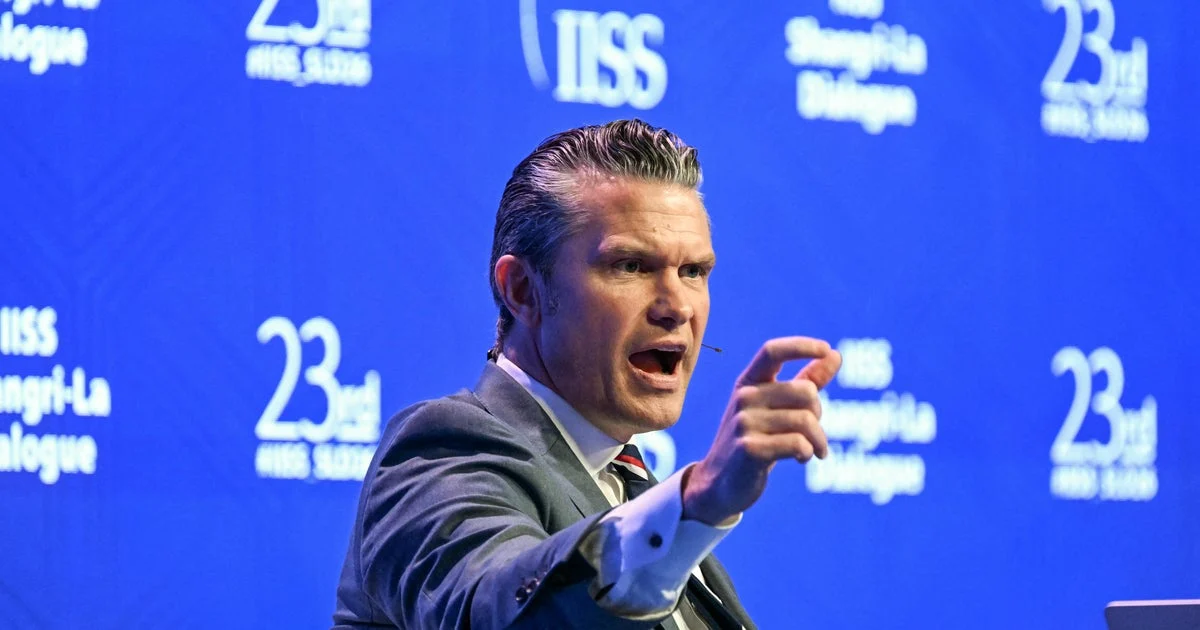
U.S. Defense Secretary Pete Hegseth moderated his previous warnings about China’s threat during a speech at the Shangri-La defense conference in Singapore on May 30, 2026, while reaffirming America’s commitment to Taiwan and regional security in the Indo-Pacific.
What happened
Speaking to world leaders and security officials, Hegseth emphasized respect for China’s ambitions and acknowledged its significant military buildup. He stated that the United States remains prepared for any contingency, with no changes in its stance on Taiwan’s security. His remarks marked a departure from last year’s more confrontational tone that explicitly labeled China a “threat” to Taiwan, which drew a stern rebuke from Beijing at the time.
Hegseth highlighted President Donald Trump’s recent meeting with Chinese leader Xi Jinping in Beijing, where the two agreed on building a “constructive relationship of strategic stability” based on fairness and reciprocity. Despite this, Hegseth insisted the U.S. would not allow China to dominate the Indo-Pacific, warning that any hegemonic control would destabilize the regional balance of power that the U.S. and its partners aim to preserve.
He further urged allies in the region to increase defense spending and build stronger partnerships, contrasting this with his criticisms of some European countries for neglecting defense commitments. At a related AUKUS event, he joined Australian and British defense ministers to announce new investments in underwater drone technologies to enhance maritime security.
Why it matters
Hegseth’s toned-down rhetoric signals an attempt by the U.S. administration to balance deterrence with diplomacy in managing relations with China, a critical global power whose military expansion and ambitions influence regional stability. The reaffirmation of support for Taiwan underscores the continued U.S. commitment amid rising tensions, maintaining strategic ambiguity while signaling preparedness.
The call for increased allied defense spending and cooperation reflects the U.S. strategy to strengthen regional security frameworks as a counterbalance to Chinese influence. The new undersea drone initiative under the AUKUS partnership also represents a focus on advanced technological capabilities to address maritime security challenges.
Background
Last year, Hegseth’s direct warnings about China’s threat to Taiwan escalated tensions, provoking criticism from Chinese officials. This year’s change in tone came shortly after President Trump’s visit to Beijing, where he praised Xi Jinping and expressed optimism about U.S.-China relations. However, Washington maintains its legal obligation to support Taiwan’s defense while following a policy of strategic ambiguity regarding military intervention.
The Indo-Pacific region remains a central focus for U.S. security policy, with concerns about how China’s growing military presence might affect the balance of power. The Shangri-La Dialogue is an annual forum widely regarded as a key platform for addressing security issues and building cooperation among Asia-Pacific countries and their partners.
Sources
This article is based on reporting and publicly available information from the following source:
Read more Politics stories on Goka World News.