
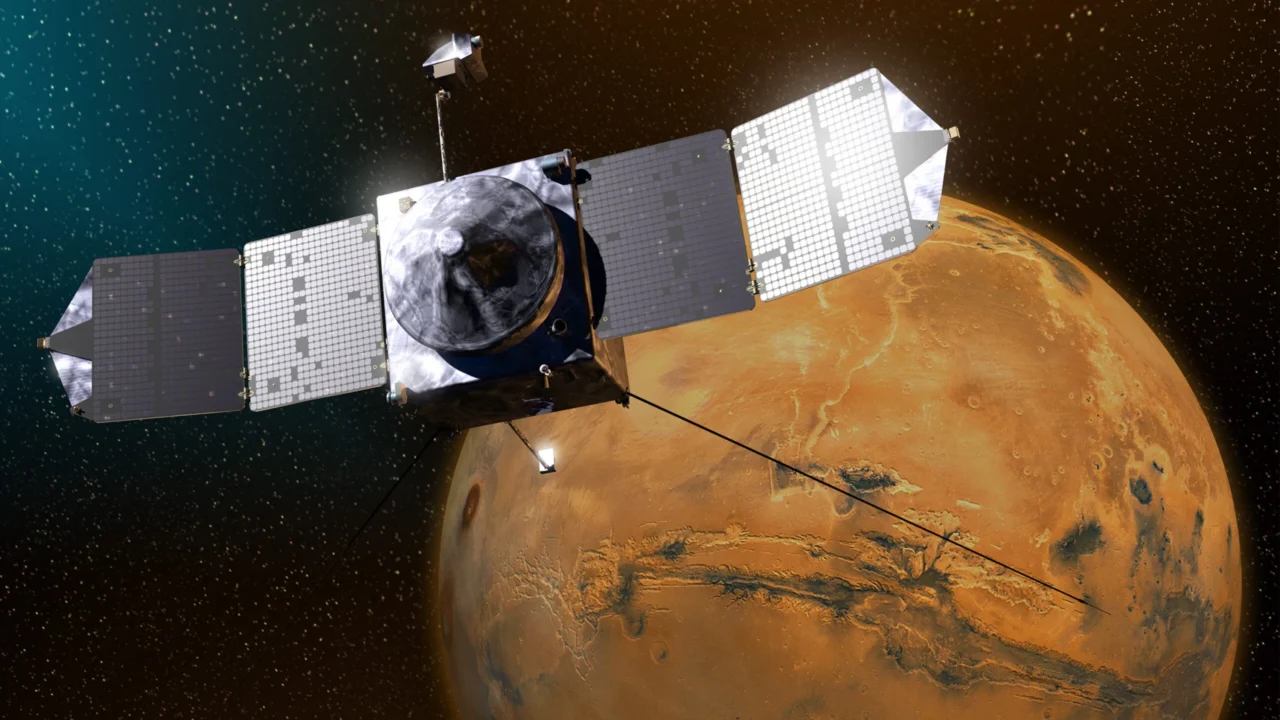
NASA has officially ended its Mars Atmosphere and Volatile Evolution (MAVEN) mission following a loss of spacecraft signal in December 2023, concluding over 11 years of scientific observation and data relay service around Mars.
What happened
The MAVEN spacecraft last transmitted telemetry on December 6, 2023, before passing behind Mars, after which NASA lost contact. Subsequent attempts to recover communication failed. An anomaly review board convened in February 2024 analyzed the situation and found MAVEN entered safe mode but was rotating at an unusually high rate upon reemerging. This rotation caused the spacecraft’s batteries to drain, resulting in a loss of power to its communication system. The board concluded MAVEN is no longer recoverable and cannot continue its scientific or data relay mission. NASA has commenced formal decommissioning procedures, including archiving the full mission dataset.
Why it matters
MAVEN provided critical insights into the Martian upper atmosphere, climate evolution, and the planet’s interaction with solar wind and space weather. Its data have been essential in understanding how Mars lost much of its original atmosphere over billions of years, transforming from a potentially habitable environment to the arid world observed today. The mission’s findings inform future Mars exploration, including human missions, by highlighting radiation risks and atmospheric conditions. MAVEN also played a vital role in relaying data from Mars rovers to Earth, holding the solar system record for most data relayed from another planet in a single day.
Background
Launched in November 2013, MAVEN was NASA’s first orbiter dedicated to studying the Martian atmosphere and its evolution. It investigated atmospheric loss mechanisms driven by solar wind and solar storms, discovered various types of auroras on Mars, and measured atmospheric sputtering processes for the first time on any planet. The spacecraft also observed how global dust storms increase water loss from Mars’ atmosphere. In 2022, MAVEN contributed to NASA’s study of comet 3I/ATLAS near Mars with detailed imaging campaigns. Over its mission, MAVEN’s science team produced more than 800 publications, significantly advancing planetary science.
MAVEN was managed by NASA’s Goddard Space Flight Center, with science operations from the Laboratory for Atmospheric and Space Physics at the University of Colorado Boulder. Lockheed Martin Space built the spacecraft, and NASA’s Jet Propulsion Laboratory provided navigation and Deep Space Network support.
Sources
This article is based on reporting and publicly available information from the following source:
Read more Space & NASA stories on Goka World News.