
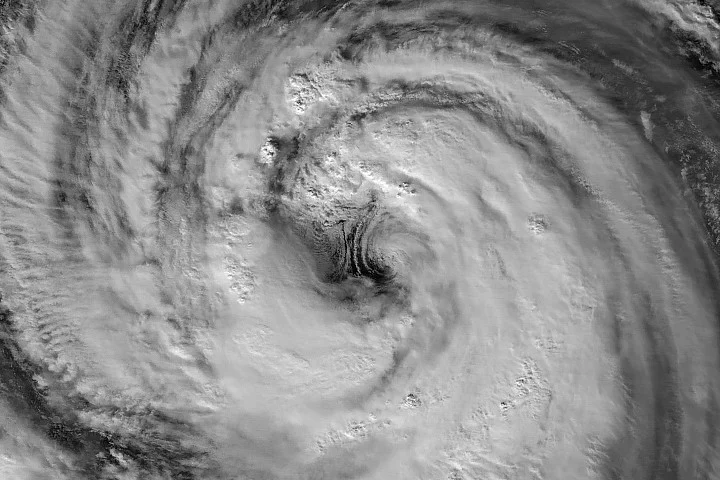
In late May 2026, Typhoon Jangmi advanced toward southern Japan, generating sustained winds of up to 130 kilometers per hour and heavy rainfall that raised flooding concerns across several areas.
What happened
The storm moved north-northwest over the Philippine Sea, its slow-spinning circulation tracked by NASA satellites. On May 30, the Visible Infrared Imaging Radiometer Suite (VIIRS) aboard the Suomi NPP satellite captured a detailed nighttime image showing Jangmi with sustained winds of approximately 120 kilometers per hour (75 miles per hour), classifying it as a Category 1 storm on the Saffir-Simpson scale.
NASA meteorologists noted the typhoon’s large eye and eyewall, including a low-level rotational feature known as a mesocyclone on the southeastern side of the eye. By May 31, a NOAA-20 satellite image recorded Jangmi slightly strengthening with winds reaching 130 kilometers per hour (80 miles per hour), with the storm’s eye located south of Okinawa but its outer rainbands extending over land.
Forecasts predicted the typhoon would pass near Okinawa before turning northeast toward the Amami region around June 1 and 2, continuing to deliver intense rainfall, especially along Japan’s Pacific coast.
Why it matters
Typhoon Jangmi’s heavy rains posed a significant risk of flooding and landslides in southern Japan, potentially disrupting communities and infrastructure. Monitoring by NASA’s Earth-observing satellites enabled detailed tracking of the storm’s structure and movement, supporting timely warnings and preparedness efforts.
Background
Typhoons are common in the western Pacific during the late spring and summer months. Jangmi is part of the 2026 Pacific typhoon season. The use of satellite instruments such as VIIRS allows scientists to observe storm properties like eye size, wind speeds, and cloud cover in near real-time, improving forecasts and hazard assessments for affected regions.
Sources
This article is based on reporting and publicly available information from the following source:
Read more Climate & Environment stories on Goka World News.