
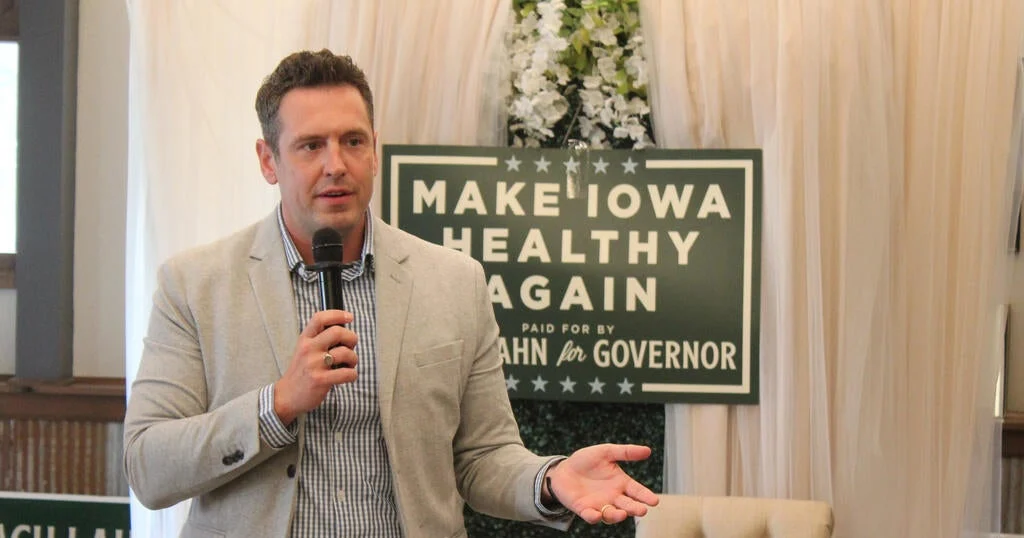
Zach Lahn, a farmer and businessman, won the Iowa Republican primary for governor, defeating Trump-endorsed Congressman Randy Feenstra. Lahn will face Democrat Rob Sand in the November general election for a race widely viewed as competitive.
What happened
Lahn, who emphasizes his ties to the “Make America Healthy Again” movement and runs an agricultural and investment firm, secured the GOP nomination against a crowded field. His victory came despite Feenstra’s early designation as the favorite, bolstered by President Donald Trump’s endorsement last week. Feenstra, who did not participate in any primary debates, conceded on Tuesday night, acknowledging the upset.
Lahn ran on a populist platform called “Iowa First,” focusing on increasing local ownership of farmland, reversing youth outmigration, and addressing the state’s high cancer rates. He criticized out-of-state investors for treating Iowa farmland like a commodity rather than a heritage. His endorsements included those from the MAHA Action group, aligned with allies of Health and Human Services Secretary Robert F. Kennedy Jr., Turning Point Action, and former Rep. Steve King.
Democrat Rob Sand, the two-term state auditor, was unopposed for his party’s nomination. Sand campaigns on government accountability, expanding universal pre-K, and opposes GOP-led school voucher programs. He presents a moderate stance on social issues amid efforts by Republicans to portray him as a liberal.
Why it matters
The race will decide Iowa’s next governor in an open-seat contest, as incumbent Republican Kim Reynolds opted not to run for reelection. Iowa, once a swing state, has trended Republican in recent federal and state elections, with Trump winning by substantial margins and GOP victories in gubernatorial races.
The Iowa governor’s race is rated a tossup by the Cook Political Report, reflecting national and local dynamics that could reshape the state’s political landscape. Economic pressures on Iowa farmers, partisan shifts, and low approval ratings for Governor Reynolds add uncertainty. Lahn’s campaign faces a financial disadvantage compared to Sand’s well-funded effort, including substantial contributions from Sand’s in-laws.
Background
Iowa has not elected a Democratic governor in 20 years. Sand is the state’s only statewide elected Democrat, having secured reelection narrowly in 2022. Reynolds has governed since 2017, but her low approval ratings and recent economic challenges—such as the impact of China’s trade restrictions on soybeans and rising input costs for farmers—have complicated the GOP’s position.
With Reynolds stepping down, the 2026 governor’s race opens up a rare opportunity for political change. Additionally, Iowa’s Senate and House races also present battlegrounds amid shifting voter sentiments in the Midwest.
Sources
This article is based on reporting and publicly available information from the following source:
Read more Politics stories on Goka World News.