
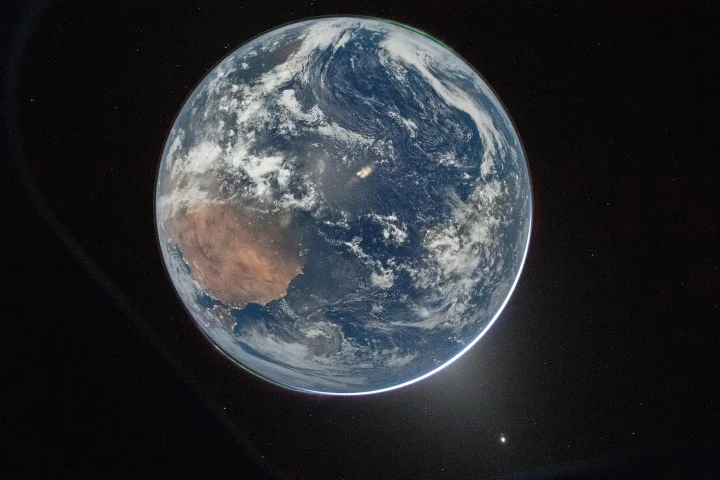
NASA’s Artemis II mission crew captured a striking image of Earth’s full disk illuminated by moonlight while en route to the Moon, providing a rare perspective of our planet’s place in the solar system.
What happened
After completing the translunar injection burn that sent the Orion spacecraft on its trajectory to the Moon, an Artemis II astronaut took a photo showing Earth eclipsing the Sun from Orion’s viewpoint. The image displays Earth’s nighttime hemisphere lit not by the Sun, but by reflected moonlight, enabling visibility of city lights from human settlements in regions such as Spain, Portugal, northern Africa, sub-Saharan Africa, and Brazil.
Also visible are natural phenomena including green auroras above Earth’s polar regions, caused by charged solar particles interacting with the atmosphere. A faint glow known as zodiacal light appears near Earth, resulting from sunlight reflecting off interplanetary dust, with research suggesting Mars as a possible major dust source. Venus appears as a bright object near the bottom right of the image.
The photograph required a high ISO camera setting of 51,200 to capture the faintly illuminated surface details during Earth’s night phase. This single human-captured, full-disk image differs from previous spacecraft views taken from low Earth orbit or by satellites with specialized nighttime light products, offering a unique comprehensive view of Earth at night.
Why it matters
The photograph showcases Earth’s complexity as a dynamic planet interacting with the solar environment, highlighting the interplay between natural and human-made light at night. Experts cite the image’s scientific value in advancing understanding of Earth from a solar system perspective, emphasizing that nighttime views remain an underexplored frontier in Earth science.
Cindy Evans, a NASA exploration scientist, praised the image for revealing Earth as both a solar system body and a life-supporting planet, while Miguel Román of NASA’s Goddard Space Flight Center noted its potential to inspire future Earth science studies focused on nighttime light phenomena.
Background
NASA missions have long captured Earth imagery in innovative ways, such as the Apollo 12 crew’s 1969 photo of Earth eclipsing the Sun and the International Space Station’s nighttime Earth photography from low orbit. NASA’s Black Marble project has developed detailed records of artificial lighting visible from space over various timescales. Artemis II’s deep-space vantage point, however, provides a new context by depicting Earth’s night features illuminated by moonlight against solar system phenomena in a single frame.
Sources
This article is based on reporting and publicly available information from the following source:
Read more Space & NASA stories on Goka World News.