
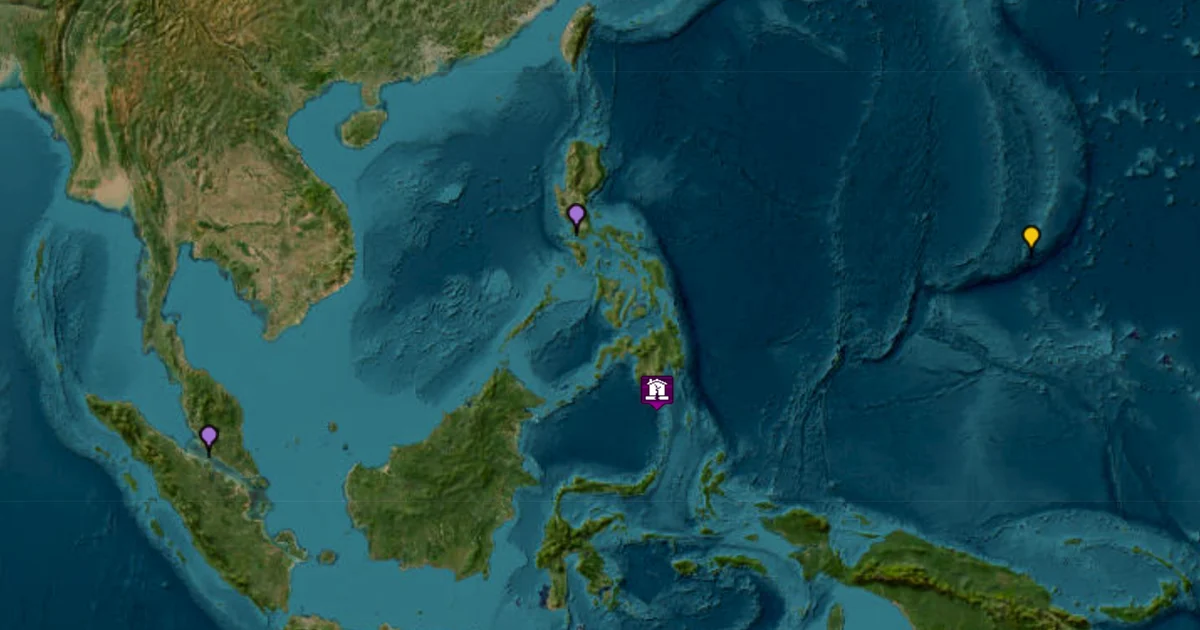
A strong 7.8 magnitude earthquake rattled the southern Philippines early Monday, causing structural damage and prompting tsunami warnings for parts of Southeast Asia and the western Pacific. Authorities urged residents in vulnerable coastal areas to move to higher ground amid fears of incoming tsunami waves.
What Happened
The earthquake struck at 7:37 a.m. local time, with its epicenter located 8 miles southwest of the coastal city of General Santos on Mindanao island. The Philippine Institute of Volcanology and Seismology reported the quake’s depth at 6.2 miles. The tremor resulted in damage to buildings, including the partial collapse of a small commercial structure in General Santos, although there were no immediate reports of casualties.
Key Facts
- Magnitude registered at 7.8 by Philippine authorities; the U.S. Geological Survey noted variations, estimating the earthquake at 6.5 magnitude for aftershocks and 34 miles depth for the primary event.
- General Santos, a city of over 700,000 people known for its tuna processing industry, experienced power outages and structural damage.
- Tsunami warnings were issued for the Philippines, Indonesia, Malaysia, Taiwan, Japan, Guam, Papua New Guinea, and other western Pacific islands.
- The Pacific Tsunami Warning Center advised possible tsunami waves up to 10 feet along some Philippine coastlines and up to 3 feet on Indonesian and Malaysian coasts.
- Tsunami waves of smaller magnitudes were recorded in North Sulawesi and North Maluku provinces of Indonesia.
- No threat was reported for Hawaii.
- Residents as far as north-central Indonesia felt tremors from the earthquake.
Why It Matters
This earthquake underscores the persistent seismic risk faced by the Philippines, a country situated along the Pacific “Ring of Fire,” making it prone to significant earthquakes and volcanic activity. The triggered tsunami warnings highlight the potential for widespread regional impact, affecting multiple countries in Southeast Asia and the Pacific.
Background
The Philippines is one of the world’s most disaster-prone nations, experiencing frequent natural hazards including earthquakes, volcanic eruptions, and an average of 20 typhoons annually. Its geologic setting on active seismic fault lines explains the country’s vulnerability to major earthquakes.
Analysis
The shallow depth of the earthquake contributed to its strong surface shaking near populated areas, amplifying damage risks. Variations in reported magnitude and depth among agencies are common shortly after significant quakes as data is refined. The subsequent aftershocks, some reaching magnitude 6.5, indicate ongoing seismic instability.
Who Is Affected
The immediate impact is on the residents of General Santos and nearby coastal communities of Mindanao. The wider tsunami alerts affect populations in the Philippines and neighboring countries including Indonesia and Malaysia, with possible ripple effects as far as Taiwan, Japan, Guam, and Papua New Guinea.
Reactions / Official Statements
Teresito Bacolcol, head of the Philippine Institute of Volcanology and Seismology, urged people living in coastal areas to evacuate to higher ground or move inland to avoid potential tsunami hazards. Local media reported the partial collapse of a provincial office building with no injuries confirmed.
What Remains Unclear
Information about potential casualties, the full extent of structural damage, and whether anyone is trapped under debris remains unconfirmed. Official assessments are still ongoing, and the full scope of aftershocks and tsunami impact is not yet known.
What Comes Next
Authorities will continue monitoring aftershocks and tsunami activity while conducting damage and relief assessments in affected areas. Evacuation orders and warnings will remain in place until officials confirm the region is safe. Regional governments are expected to coordinate response efforts to mitigate further risks.
Sources
This article is based on reporting and publicly available information from the following article-relevant source(s):
Read more World News stories on Goka World News.