
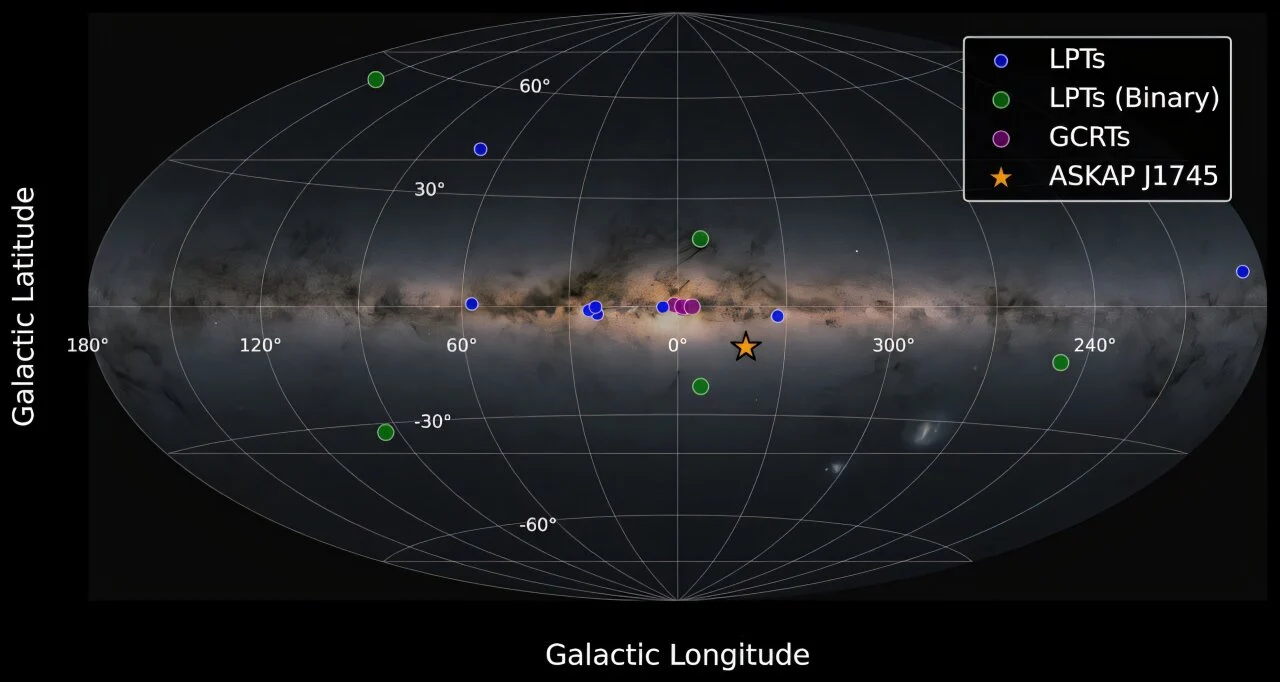
Astronomers have made a breakthrough in understanding mysterious repeating bursts of radio signals from space by identifying a binary star system responsible for such emissions. The discovery offers crucial insights into the nature of long-period radio transients—rare cosmic phenomena that have puzzled scientists for years.
What Happened
The newly identified source, known as ASKAP J1745, was detected using the Australian Square Kilometre Array Pathfinder (ASKAP) radio telescope, alongside X-ray and optical telescopes. ASKAP J1745 is a binary system comprising two stars orbiting each other closely, one a white dwarf accreting material from its companion. Both radio and X-ray bursts have been observed repeating on the same orbital timeframe, linking the emissions to the orbital dynamics of the system.
Key Facts
- ASKAP J1745 is classified as a “cataclysmic variable,” a binary system where a white dwarf pulls material from a companion star.
- The system’s radio bursts repeat regularly over the orbital period, an uncommon feature among known long-period radio transients.
- Simultaneous detection of radio, X-ray, and optical signals provides a multi-wavelength perspective previously unavailable for these transients.
- The radio bursts arise from interactions between energetic particles and strong magnetic fields in the system, likely linked to accretion processes.
Why It Matters
This discovery helps resolve the mystery surrounding long-period radio transients, a small class of cosmic sources known for their slow, repeating bursts of radio waves. For astronomers, ASKAP J1745 serves as a “Rosetta stone,” enabling better interpretation of other transients lacking detailed multi-wavelength data. Understanding these emissions sheds light on extreme astrophysical environments involving plasma flows and intense magnetic fields that cannot be recreated in laboratories on Earth.
Background
Long-period transients were initially thought to be slowly spinning neutron stars (pulsars), but their unusually long intervals and emissions challenged that view. Some hypotheses suggested accreting white dwarfs might be responsible. Many long-period transients have been found near the galactic center, a region obscured by dust that complicates observations. Prior to ASKAP J1745, little was known about their precise origins or mechanisms causing the radio bursts.
Analysis
The combination of accretion onto a highly magnetic white dwarf and the interaction with its companion provides a plausible mechanism for producing bright, repeating bursts at radio and X-ray wavelengths. The detection across multiple wavelengths confirms that the bursts are linked to orbital interactions and accretion processes. This multi-spectral approach marks a significant advance over previous detections based solely on radio data.
Who Is Affected
This discovery primarily impacts the astronomical research community by providing a new framework for studying long-period radio transients and accreting binary systems. It offers a new tool to interpret signals from similar sources and informs theoretical models of stellar evolution and magnetic interactions in binary star systems.
Reactions / Official Statements
This information was not confirmed in the reviewed sources.
What Remains Unclear
While ASKAP J1745’s emissions have been explained through its binary nature and accretion processes, the detailed physics of how the radio bursts arise from charged particles and magnetic fields remain under study. The diversity among other long-period transients also suggests multiple formation scenarios that have yet to be fully understood.
What Comes Next
Astronomers plan to apply similar multi-wavelength observation methods to other long-period transients to test whether they share physical mechanisms with ASKAP J1745. Further studies will focus on refining models of accretion and magnetic interactions to explain the bursts’ properties and periodicity.
Sources
This article is based on reporting and publicly available information from the following source:
Read more Science Discoveries stories on Goka World News.