
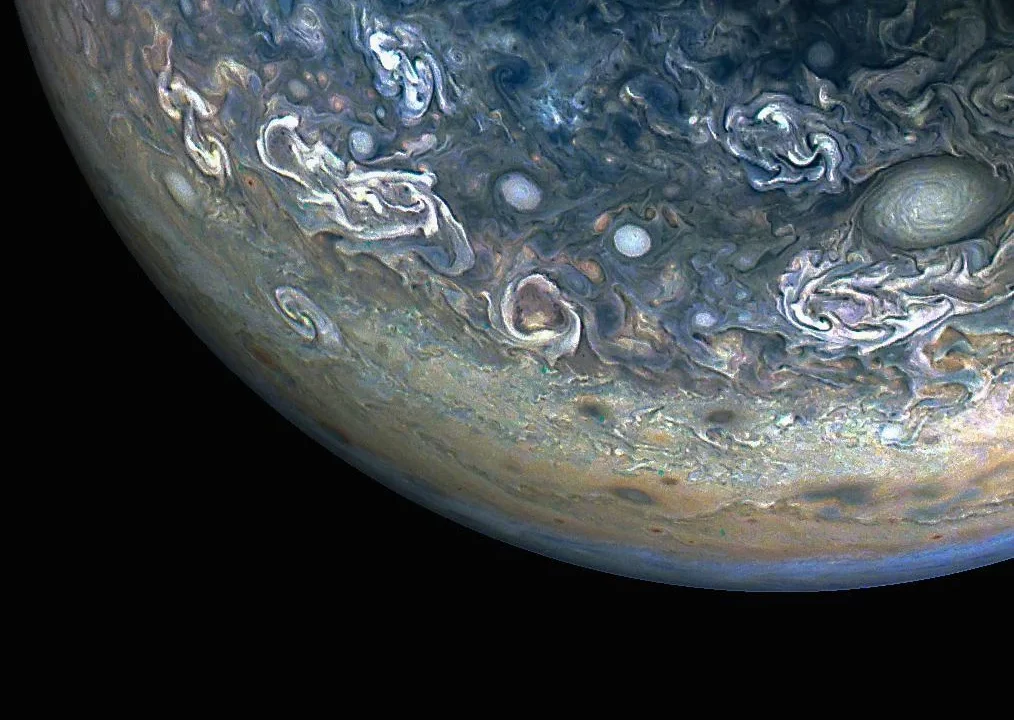
NASA’s Juno spacecraft has delivered a vivid and detailed view of Jupiter’s northern hemisphere, showcasing dynamic cloud formations and cyclonic storms characterized by chaotic atmospheric behavior. The image was captured during Juno’s 61st close flyby of the gas giant on May 12, 2024, and subsequently enhanced by a citizen scientist.
What Happened
During its latest close pass over Jupiter, Juno’s onboard JunoCam instrument collected raw imaging data of the planet’s northern hemisphere. Citizen scientist Gary Eason processed this data using digital techniques to enhance the color and clarity, creating a striking image showing turbulent cloud structures in an area known as a folded filamentary region.
Key Facts
- The image highlights chaotic clouds and cyclonic storms located in Jupiter’s folded filamentary region.
- Folded filamentary regions are areas where Jupiter’s zonal jets—winds responsible for the planet’s striped cloud bands—break down.
- In these regions, cloud patterns evolve rapidly over a few days due to atmospheric turbulence.
- The image was taken on May 12, 2024, during Juno’s 61st close flyby.
- The image processing was performed by a citizen scientist, illustrating public involvement in NASA’s science efforts.
Why It Matters
Understanding the complex atmospheric dynamics of Jupiter’s folded filamentary regions offers valuable insights into the behavior of gas giant atmospheres. These studies expand knowledge of planetary weather systems, turbulence, and jet interactions beyond Earth, improving models of giant planet meteorology and contributing to broader planetary science.
Background
Jupiter’s atmosphere is dominated by alternating east-west jet streams, creating its iconic bands. However, at certain latitudes, these jets destabilize, producing folded filamentary regions marked by chaotic clouds and unstable storms. The Juno mission, launched in 2011 and orbiting Jupiter since 2016, aims to investigate the planet’s composition, gravity field, magnetic environment, and atmospheric phenomena.
Analysis
The enhanced JunoCam image processed by a citizen scientist demonstrates the value of combining NASA spacecraft data with public participation. The vivid portrayal of turbulent cyclones and cloud filaments in the folded filamentary region exposes the highly dynamic processes that challenge current models of Jupiter’s atmospheric jets. Continued data collection during Juno flybys will help decode these rapid atmospheric changes.
Who Is Affected
Scientists studying planetary atmospheres and gas giants benefit from this detailed imaging, refining theoretical models applicable to other planets, including exoplanets. The public also gains engagement opportunities through citizen science projects, fostering broader interest in space exploration and research.
Reactions / Official Statements
This information was not confirmed in the reviewed sources.
What Remains Unclear
Specific physical mechanisms driving the rapid evolution of cloud features within folded filamentary regions remain under investigation. Further insights into how these jets break down and feed storm activity are yet to be fully understood.
What Comes Next
Juno will continue its repeated close flybys of Jupiter, gathering more atmospheric data and imagery. Future analyses will aim to clarify the origin and evolution of turbulent storms seen in folded filamentary regions and enhance understanding of Jupiter’s meteorology.
Sources
This article is based on reporting and publicly available information from the following source:
Read more Space & NASA stories on Goka World News.