
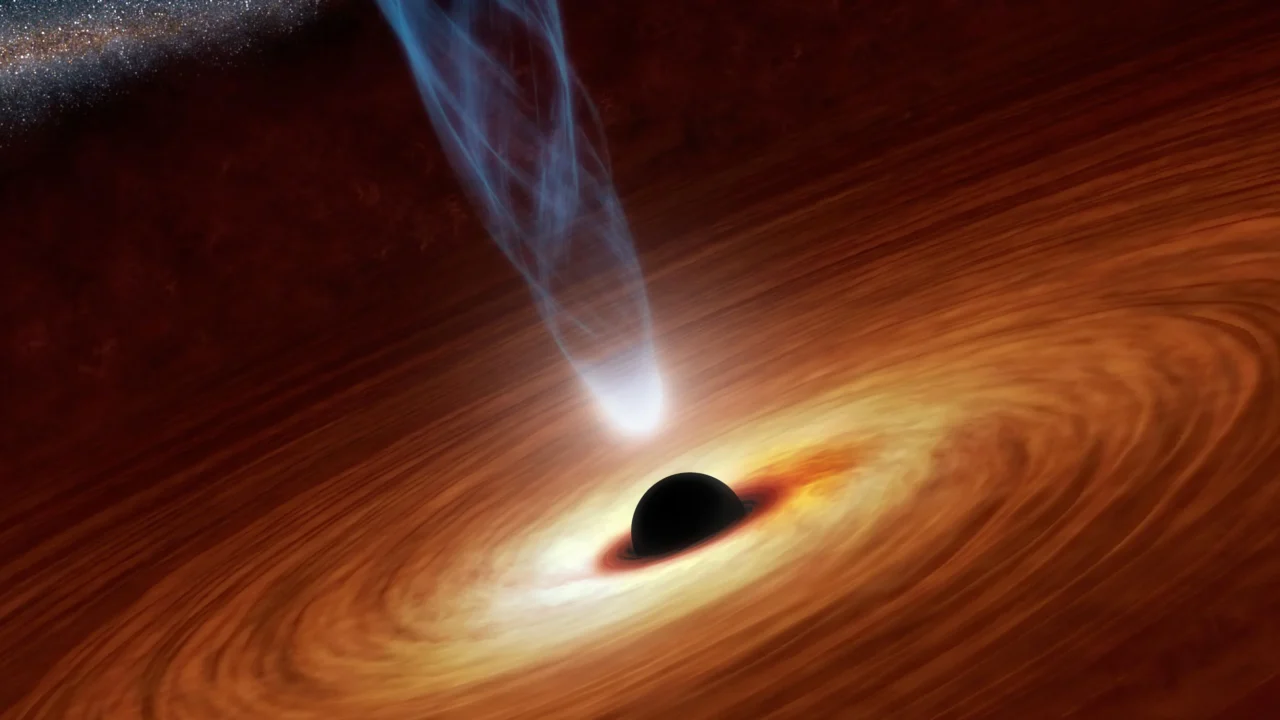
Astronomers at MIT have identified the earliest known flickering quasar, tracing its light back to approximately 850 million years after the Big Bang. This discovery reveals that supermassive black holes in the early universe could develop mature accretion disk structures much earlier than previously expected.
What Happened
The MIT-led team detected variability, or “flickering,” in the light emitted from a distant quasar located in the cosmic dawn, the universe’s infancy period. Using infrared data from NASA’s NEOWISE mission, which surveyed the sky over 14 years, the researchers observed brightness fluctuations of about 20 percent in a quasar shining with the intensity of 12 trillion suns. This flicker allowed the team to analyze the quasar’s accretion disk — the swirling disk of gas and dust feeding the supermassive black hole at its center.
Key Facts
- The flickering quasar dates back to 850 million years after the Big Bang, representing the earliest detected quasar flicker to date.
- The quasar’s accretion disk was found to be surprisingly flat and thin, resembling structures seen in mature, nearby quasars.
- Observations were made possible by infrared data from NASA’s NEOWISE space telescope, which captured light redshifted into longer wavelengths and smoothed out variability over billions of light years.
- The quasar flickers randomly, akin to the unsteady flame of a candle, revealing insights into the gas feeding process around the black hole.
Why It Matters
The observation challenges existing assumptions that supermassive black holes in the early universe would have chaotic, puffy accretion disks due to their youth and rapid growth. Instead, the thin, pancake-like accretion disk suggests an early maturation of these cosmic giants, indicating that rapid initial growth phases occur even earlier than previously detectable. Understanding these mechanisms is crucial to solving the mystery of how supermassive black holes formed and evolved so quickly in the universe’s infancy.
Background
Supermassive black holes, often billions of times the mass of the sun, reside at the centers of most galaxies and play a critical role in galaxy formation and evolution. Quasars represent active phases where these black holes accrete large amounts of material, emitting immense energy that outshines entire galaxies. Previous studies have found numerous quasars in the early universe, but their structure and growth patterns remained elusive due to observational challenges.
Analysis
The flickering of quasars occurs due to fluctuations in how gas is fed into the black hole, and this variability encodes information about the structure of the accretion disk. By studying the flicker across multiple wavelengths, the researchers could map the disk’s geometry and temperature profile. The data indicate that despite the distant quasar’s young cosmic age, its accretion disk exhibits a stable, flat geometry typically associated with much older, settled black holes.
Who Is Affected
This discovery is significant for astronomers and cosmologists studying the formation and evolution of supermassive black holes and their host galaxies. It informs models of early galaxy formation and the role of black holes in shaping cosmic structures.
Reactions / Official Statements
Anna-Christina Eilers, an assistant professor of physics at MIT, highlighted that the mature disk structure “provides direct evidence that the same feeding processes and structures observed in the nearby universe were already in place at very early times.” Gene Leung, a postdoctoral researcher at MIT, emphasized that the discovery points to intense, rapid growth phases occurring before black holes become observable as bright quasars.
What Remains Unclear
This information was not confirmed in the reviewed sources.
What Comes Next
The research team aims to identify quasars from even earlier cosmic times, hoping to observe their premature development stages directly. Such observations could further clarify the formation processes of the earliest supermassive black holes and refine understanding of the universe’s first billion years.
Sources
This article is based on reporting and publicly available information from the following source:
Read more Science Discoveries stories on Goka World News.