
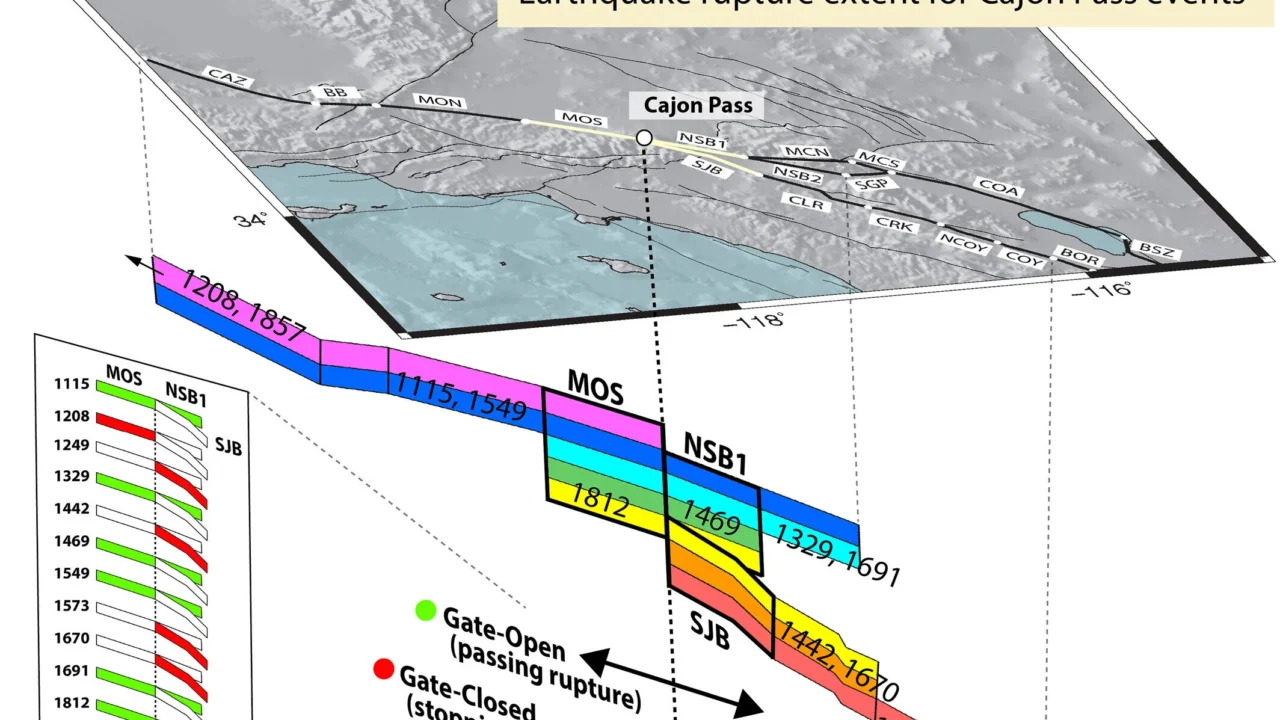
A recent study led by researchers at the University of Bern reveals that tectonic stress along California’s Cajon Pass—where the San Andreas and San Jacinto faults converge—has reached its highest level in the past 1,000 years. By simulating centuries of earthquake history with a physics-based model, the team highlights the potential for a significant seismic event that could rupture both fault systems simultaneously.
What Happened
An international team of geoscientists developed a four-dimensional earthquake cycle model to examine stress accumulation on the southern San Andreas and San Jacinto faults, focusing on the tectonically complex junction known as Cajon Pass. The model incorporates 1,000 years of earthquake history reconstructed from geological and historical data to evaluate current stress conditions. Their findings show that the stress at Cajon Pass is at or beyond the highest levels observed in the last millennium.
Key Facts
- The San Andreas and San Jacinto faults accommodate most tectonic plate motion in Southern California.
- The Cajon Pass acts as an “earthquake gate,” influencing whether ruptures cross one or both fault systems.
- The model shows present-day stress on the San Jacinto-Bernardino section at 3.6 MPa, exceeding historical maxima.
- The neighboring Mojave South section of the San Andreas Fault shows stress levels of 2.8 MPa.
- Historical examples include the 1857 Fort Tejon earthquake, which stopped at Cajon Pass, and the 1812 Wrightwood earthquake that crossed both fault systems.
Why It Matters
High and similarly aligned stress levels on both fault systems increase the likelihood of a joint rupture crossing Cajon Pass, which could trigger a significantly larger earthquake than one confined to a single fault. This scenario poses substantial risk to heavily populated and infrastructure-critical areas, including the greater Los Angeles region and key transport corridors.
Background
Earthquakes in Southern California generally occur where tectonic plates lock and then release built-up stress along faults. The 1857 Fort Tejon quake was the last major event affecting the broader Los Angeles area. Since then, a prolonged “quiet period” has allowed stress to accumulate along the San Andreas and San Jacinto faults. Cajon Pass is a unique junction connecting these faults, where rupture behavior can vary and affect earthquake size and impact.
Analysis
The model integrates spatial and temporal data over a millennium, simulating how individual earthquakes affect stress on surrounding fault segments. It highlights the dynamic behavior of Cajon Pass as an “earthquake gate,” which does not simply block or transmit ruptures but responds to stress conditions that evolve over centuries. High stress convergence on both faults signals increased potential for multi-fault ruptures, which historically correlates with more severe seismic events.
Who Is Affected
Communities in and around the greater Los Angeles area, San Bernardino, Riverside, and the Coachella Valley face amplified risk due to the possibility of a large-scale earthquake simultaneously impacting the San Andreas and San Jacinto faults via Cajon Pass. This corridor contains dense populations and critical infrastructure, including highways, railroads, and energy networks.
Reactions / Official Statements
Dr. Liliane Burkhard, lead author from the University of Bern, emphasized that while the study does not predict when an earthquake will occur, it provides a physics-based framework to better understand and prepare for future scenarios. The research team includes collaborators from the University of Hawaiʻi, the US Geological Survey, and the Scripps Institution of Oceanography, reflecting wide scientific consensus on the study’s foundational methodology.
What Remains Unclear
The exact timing and magnitude of any forthcoming earthquakes in this region remain uncertain. While the study assesses stress conditions and potential scenarios, it cannot specify when a rupture will occur or its precise impact.
What Comes Next
The study’s modeling approach and the concept of an “earthquake gate” offer tools for ongoing seismic hazard assessment in California and other complex fault systems globally. Continued data collection and refinement of models like these are vital for infrastructure planning and emergency preparedness efforts.
Sources
This article is based on reporting and publicly available information from the following source:
Read more US News stories on Goka World News.