
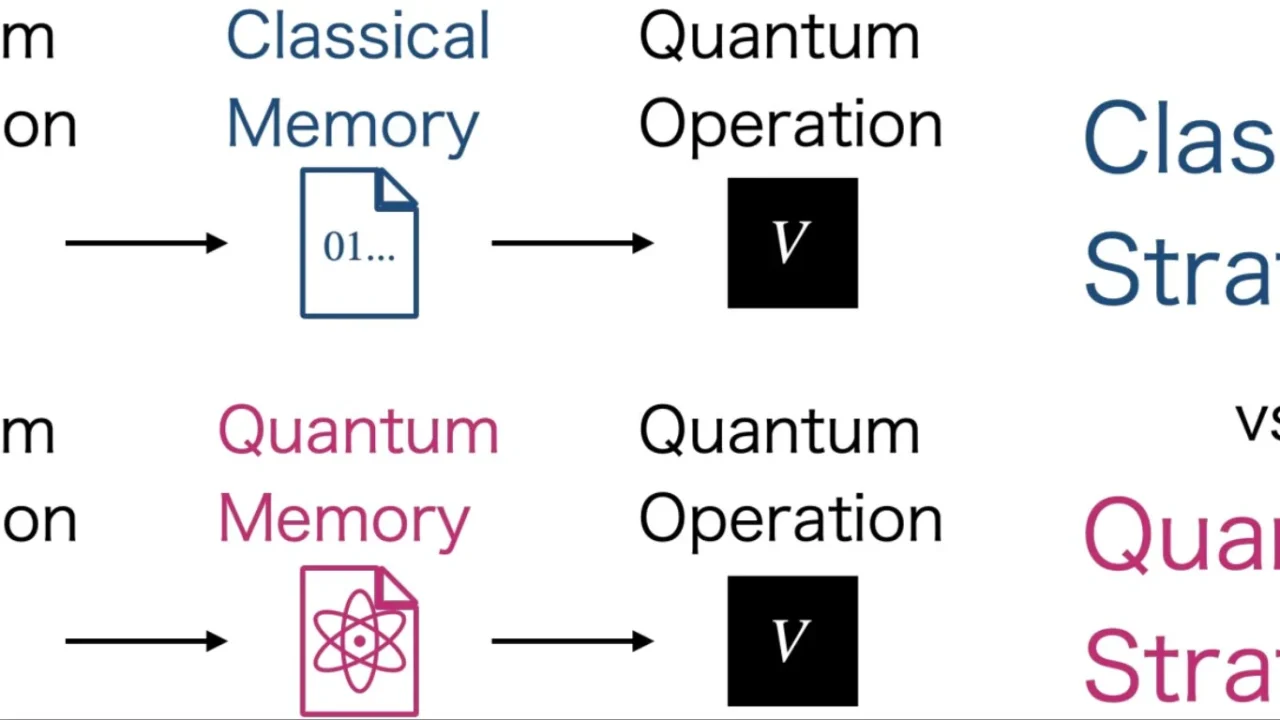
Quantum memories, systems that store information using quantum mechanics, have been shown to outperform classical storage techniques specifically in the handling of unknown quantum operations, according to a new study by researchers at the University of Tokyo. Their findings establish a definitive quantum advantage in a complex information processing task previously unresolved.
What Happened
The University of Tokyo team investigated the capability of quantum memories to store and retrieve unknown isometry channels—quantum operations that expand smaller quantum systems into larger ones while preserving information. They rigorously compared classical methods, which estimate and store classical data about the operations, to quantum methods that store the operations directly as quantum states. Their results revealed that the quantum storage strategy significantly outperforms any classical estimation approach.
Key Facts
- The study focused on isometry channels, a type of unknown quantum operation.
- A classical strategy estimates the unknown operation by probing it multiple times, storing the estimate as classical data.
- The quantum strategy directly encodes the operation into a quantum program state without fully identifying it.
- The researchers established the optimal classical benchmark limited by the standard quantum limit.
- The quantum approach, based on port-based teleportation, demonstrated a quadratic improvement in efficiency compared to the classical method.
Why It Matters
The research provides robust proof that quantum memories can perform certain quantum information storage tasks inefficient or impossible for classical devices, enabling more effective quantum computing and communication processes. This advantage may also support privacy preserving quantum operations and enhance the practical use of quantum technologies.
Background
Quantum memory uses quantum states to retain information, promising enhanced performance over classical memories on some tasks. Prior research showed classical strategies were already optimal for unitary operations, leaving open whether quantum memory could surpass classical limits for other channel types such as isometry channels, which are more general quantum transformations.
Analysis
The team derived the fundamental limits of classical strategies through precise estimation performance metrics, demonstrating the quantum memory approach’s superiority is not due to weak classical comparisons but to intrinsic quantum properties. The quantum method achieves an operational efficiency unavailable to classical strategies, stemming partly from quantum phenomena like no-cloning constraints.
Who Is Affected
This advancement impacts quantum information science researchers and developers focused on quantum computing, secure quantum communication, and quantum software. It could influence future quantum devices requiring efficient storage and manipulation of unknown quantum operations.
Reactions / Official Statements
Satoshi Yoshida, lead author, emphasized that their findings clarify the boundary where quantum memory offers a true advantage, identifying the classical limit for isometry channel storage. He also highlighted open research directions about minimizing quantum resources for such storage and multi-copy retrieval scenarios.
What Remains Unclear
The minimum quantum memory resources (program cost) required for storing isometry channels remain undetermined. It is also unknown how the quantum advantage scales when retrieving multiple copies of stored operations, which may alter the comparative performance landscape between quantum and classical strategies.
What Comes Next
The researchers plan to explore the quantum program cost for isometry channels more fully and investigate the extension of their quantum memory strategy to multiple-copy retrieval tasks potentially using multi-port teleportation techniques.
Sources
This article is based on reporting and publicly available information from the following source:
Read more Science Discoveries stories on Goka World News.